

Vadodara sits at a strategic crossroads in Gujarat's industrial landscape. With chemicals, pharmaceuticals, food processing, engineering goods, and petrochemicals all running significant operations here, the demand for precise, high-speed, and reliable packaging solutions is substantial and growing steadily. The city's industrial zones, including Gorwa, Makarpura, and GIDC Vadodara, are home to businesses that export nationally and internationally. For those businesses, packaging quality is not a background detail. It is a front-line commercial requirement.
Why Finding the Right Packaging Company in Vadodara Matters More Than You Think
Here is a situation that plays out more often than it should. A mid-sized pharmaceutical company in Vadodara was running a semi-automatic sachet line with three operators per shift. Fill weights were inconsistent. Seal rejections were running at about 4%. Downstream, their quality team was spending hours on rework. When they finally upgraded to a proper automatic VFFS line with an integrated auger filler, their rejection rate dropped to under 0.5% and output nearly tripled.
The machine cost was recovered in under eight months. The operator headcount on that line went from three to one.
In my experience evaluating packaging operations across Gujarat, this is not an exceptional outcome. It is what happens when a business stops tolerating a packaging line that was never really built for its actual production demands.
According to a 2023 industry analysis published by the Indian Packaging Machinery Manufacturers Association, over 62% of mid-sized food and pharma businesses in Gujarat identified packaging line inefficiency as a top-three operational constraint. The gap between what these businesses need and what their current equipment delivers is real, measurable, and fixable.
What Vadodara's Industrial Mix Means for Packaging Requirements
Vadodara is not a single-industry city. Its manufacturing base is genuinely diverse, and that diversity shapes what packaging solutions are actually in demand here.
The chemical and petrochemical sector needs robust sachet and pouch formats for specialty products. The pharmaceutical corridor needs precise powder and granule filling with regulatory compliance built into the machine specifications. The food processing sector needs high-speed, film-efficient VFFS lines that can handle everything from farsan and snacks to spice blends and ready-to-cook mixes.
That variety means a strong packaging company serving Vadodara needs a broad product portfolio, not just one or two machine models. And it needs the technical depth to configure machines properly for each application rather than selling the same standard setup to every customer.
Types of Packaging Solutions Available for Vadodara Businesses
Understanding what actually exists in the market helps you ask better questions when you start talking to vendors.
Vertical Form Fill Seal Machines
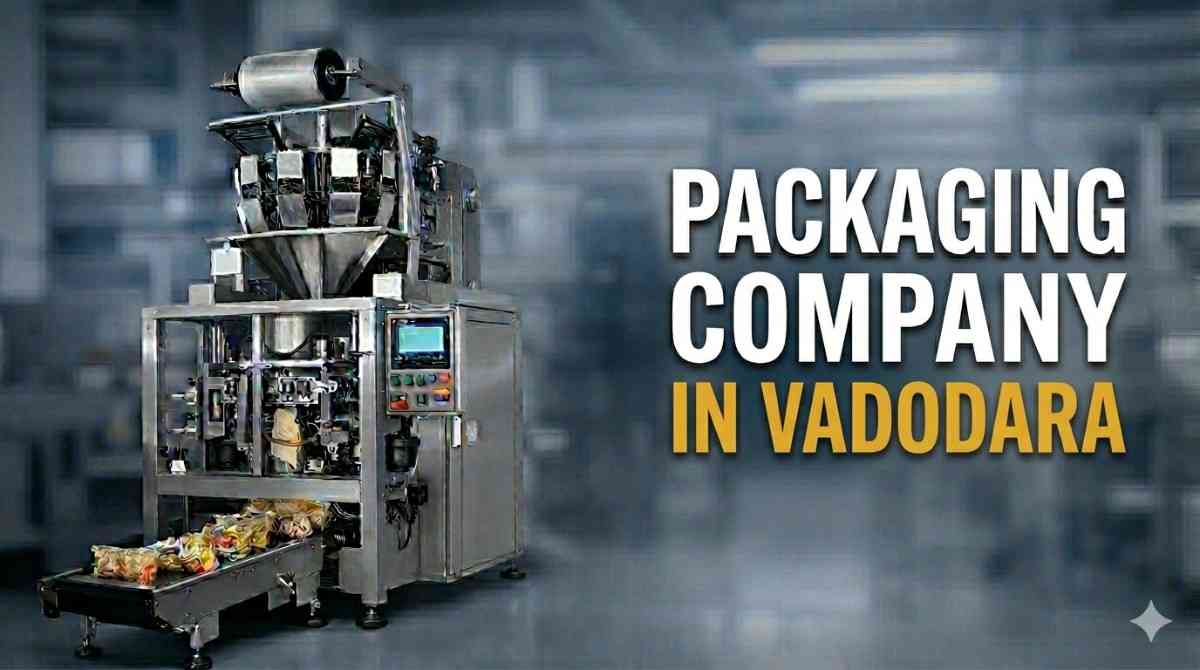
The workhorse of most automated packaging operations. A VFFS machine takes a roll of flexible packaging film, forms it into a tube, creates the bottom seal, fills the pouch with product, seals the top, and cuts it for discharge. All in one continuous or intermittent cycle. For Vadodara businesses in food, pharma, and agri-processing, this is typically the core machine around which the rest of the line is built.
Modern VFFS machines from serious manufacturers come with servo-driven sealing systems that deliver consistent seal quality at high speeds, PLC automation for reliable cycle control, and touchscreen HMI interfaces that make recipe management and format changeovers straightforward for operators who are not engineers.
Auger Filler Systems
For powders, this is the standard filling technology. Auger fillers use a rotating screw to dispense controlled volumes of powder into each pouch. They are the right choice for spices, pharmaceutical powders, protein supplements, detergents, and any other free-flowing or slightly cohesive powder product. Fill accuracy with a well-calibrated auger filler is typically within plus or minus one percent of target weight.
Multihead Weigher Systems
When gram-level fill accuracy matters for snacks, dry fruits, frozen foods, or other granular products, a multihead weigher mounted above the VFFS machine is the standard professional setup. It distributes product across multiple radial buckets and combines bucket combinations that hit the target weight with speed and precision that no manual or single-head system can match.
Stick Pack Machines
Narrow single-serve pouches for sugar sticks, spice sachets, ORS packets, protein shots, or pharmaceutical powders. Stick pack machines run at high cycle speeds and are well suited to both food service and retail supply chains. Several Vadodara-based businesses in the pharmaceutical and nutraceutical space use this format extensively.
Duplex Packaging Systems
Two parallel packaging lines in a single integrated machine footprint. For businesses that need to run two different SKUs simultaneously, or that want to scale output without proportionally scaling floor space, a duplex system is a well-engineered solution.
What to Actually Evaluate When Shortlisting a Packaging Company
This is where most buyers lose the plot. They collect three or four quotes, compare the headline numbers, and go with whoever is cheapest or has the nicest sales pitch. The packaging line they end up with then underdelivers for years, and they wonder what went wrong.
Here is what a more rigorous evaluation actually looks like:
1. Depth of Industry-Specific Experience Has this company built machines for your specific product category? A machine configured for dry fruit packaging behaves very differently from one configured for pharmaceutical powder sachets. Ask for reference installations in your exact product category, not just your general industry.
2. Machine Technology Specifications Get the full technical spec sheet. Look at the servo motor brand, the PLC make, the sealing jaw material and heating system, the film tracking mechanism, and the HMI software quality. These details tell you more about the machine's real-world reliability than any brochure claim.
3. Design Patents and R and D Investment Companies that hold design patents have demonstrated a commitment to engineering innovation that goes beyond assembling standard components. I've noticed that businesses which take IP seriously tend to produce machines with fewer chronic reliability issues because they have actually worked through the engineering problems that matter.
4. Client Reference Quality Not just a list of brand logos on a website. Ask for specific contacts at reference clients who are running the same machine model you are evaluating. Then call them. Ask about real-world reliability, service response quality, and whether they would buy from the same manufacturer again.
5. After-Sales Service Infrastructure For Vadodara-based buyers, this question is especially important when evaluating manufacturers based in other cities. How quickly can a technician reach your facility? Are critical spare parts stocked in Gujarat or do they ship from the manufacturer's home city? What is the average response time for a service call? Get all of this confirmed in writing before you sign anything.
6. Live Product Trial Policy Any manufacturer worth considering will run your actual product on their machine before you commit. Bring your packaging film. Bring your product. Evaluate seal quality, fill accuracy, changeover time, and machine stability during the trial yourself. When I tried comparing two seemingly similar machines on trial with the same product, the performance difference was striking and completely invisible in the spec sheets.
Industries in Vadodara That Need Strong Packaging Solutions
Vadodara's industrial diversity means the packaging machine market here serves a wide range of sectors:
- Food and Snacks: Farsan, chakli, sev, namkeens, biscuits, extruded snacks, and dry fruits
- Spices and Masalas: Ground spices, whole spice blends, seasoning mixes, and cooking pastes in sachet format
- Pharmaceuticals and Nutraceuticals: Powder sachets, ORS packets, supplement blends, and herbal formulations
- Chemicals and Agri-Inputs: Specialty chemical sachets, fertilizer blends, and pesticide powder pouches
- FMCG and Home Care: Detergent powders, dishwash powders, henna, and hair color sachets
- Dairy and Beverage: Milk powder, flavored drink sachets, instant tea and coffee premixes
If your product fits any of these categories, there is a VFFS-based packaging format designed for it. The key is finding a manufacturer who actually understands your specific product's behaviour inside a packaging machine.
Why Vadodara Manufacturers Look Beyond Local Suppliers
This is a question worth addressing directly because it comes up regularly. Gujarat has local packaging equipment suppliers, but many of Vadodara's most serious manufacturing businesses source their primary VFFS machinery from manufacturers based in Faridabad, Pune, or Coimbatore. The reason is straightforward. The most technically advanced packaging machine manufacturers in India tend to be clustered in specific industrial hubs that have developed genuine depth over decades.
Faridabad is one of those hubs. VS PacKit, which operates under V.S. International from its DLF Industrial Area facility in Faridabad, is a manufacturer that regularly supplies to businesses across Gujarat including Vadodara. Their installed base includes nationally recognized names like Haldiram's, Parle, Patanjali, Cadbury, Bikanervala, and Adani. For a Vadodara buyer, that reference base means you can actually verify the machine's performance at scale before you commit.
What makes a Faridabad-based manufacturer viable for Vadodara clients specifically is the service model. VS PacKit's service coverage explicitly includes Vadodara, which means technician availability, spare parts logistics, and commissioning support are structured for Gujarat-based clients rather than being an afterthought.
A Practical Step-by-Step Buying Process for Vadodara Businesses
If you want to get this right without spending six months going in circles, here is the process that actually works:
Step 1: Write down your exact product and packaging requirements before you contact any vendor. Product type, fill weight range, pouch format, required output per shift, packaging film material, and any regulatory or retail specification requirements. Being specific here saves enormous time later.
Step 2: Shortlist three to five manufacturers based on verified industry experience. Not based on Google search ranking or brochure quality. Based on actual reference installations in your product category.
Step 3: Visit at least two manufacturing facilities in person. Walk the production floor. Talk to the engineering team. Ask about their R and D process. Look at the build quality of machines currently in production. Facility visits reveal things that no catalogue or video call ever will.
Step 4: Run a live product trial at your top two choices. Bring your own film and product. Watch the machine run for at least 30 to 45 minutes. Evaluate seal consistency, fill accuracy across multiple samples, and how the operator manages the machine during the trial.
Step 5: Contact reference clients directly. Ask specifically about downtime frequency, service response quality, and long-term satisfaction. These conversations are the most valuable part of the entire evaluation process.
Step 6: Compare total cost of ownership across a five-year horizon. Factor in installation, commissioning, operator training, spare parts consumption, annual maintenance, and expected service costs. The machine with the lowest upfront cost frequently ends up being the most expensive option over five years.
Closing Thoughts
Vadodara's manufacturing sector is genuinely world-class in several of its core industries. The packaging infrastructure supporting those industries deserves to match that standard.
The businesses here that are growing fastest have figured out that the right packaging company is not necessarily the nearest one or the cheapest one. It is the one with the technology, the reference base, the service infrastructure, and the industry knowledge to actually solve your specific packaging problem and keep solving it as your business scales.
Do the evaluation properly. Visit facilities. Run real trials. Talk to real customers. And choose a partner whose machines will still be delivering consistent results five years from today.