
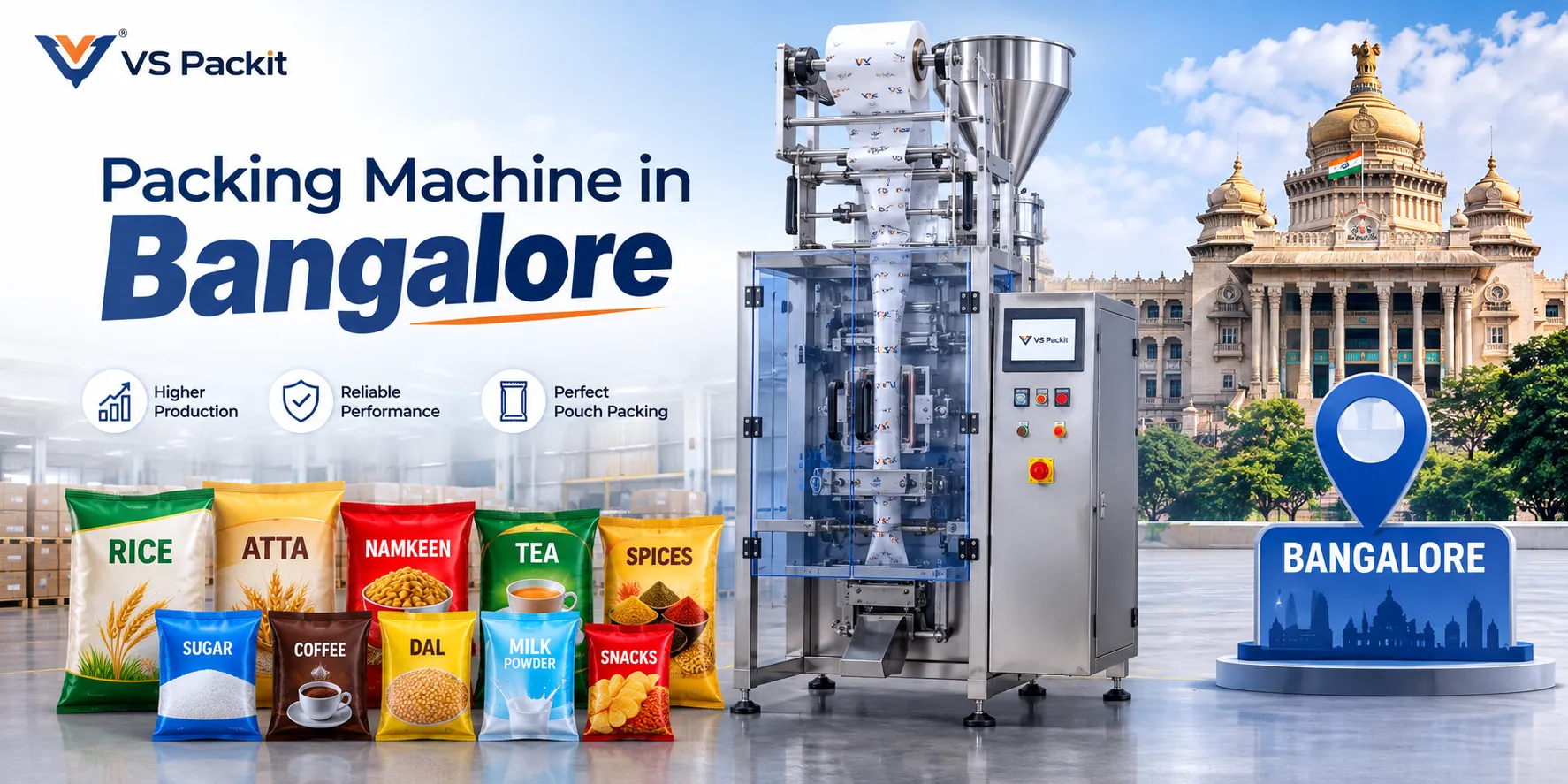
If you have typed "packing machine in Bangalore" into Google recently, you already know the problem. Most of what shows up is either a directory page with fifty companies crammed into one list, or a manufacturer's site that talks a lot about being "leading" and "trusted" without telling you a single useful number. No prices. No real specs. No honest comparison of what a semi-automatic machine can do versus a fully automatic one. Just a wall of buzzwords.
We wanted to fix that. This guide actually gets into the numbers, the machine types, and the questions you should be asking before you sign a purchase order. Honestly, if you are running a food business, a spice unit, or a small FMCG brand out of Bangalore, this is the kind of research that saves you a very expensive mistake.
Before you read further, if you would rather just talk it through with a real person, say hello to our team and we will walk you through what fits your product.
Why the Bangalore market is a bit different
Bangalore is not just a tech city anymore. It has a genuinely large cluster of food processing units, spice packers, dry fruit traders, and small dairy operations spread across Peenya, Nelamangala, and the outskirts near Hosur road. That mix means the demand for packing machines here is unusually varied. A unit packing masala in 50 gram pouches has completely different needs than one packing 1 kg atta bags or 200 ml milk sachets.
This is exactly where a lot of local listings fall short. They show you a machine photo and a "get best price" button, but they don't tell you which machine actually suits your product's flow properties, pouch size, or output speed. A powder does not behave like a granule, and a granule does not behave like a chip. Trust us on this one, we have seen buyers order the wrong auger filler and then spend months fighting with product spillage.
What "packing machine manufacturer in Bangalore" should actually mean
Here's the thing nobody tells you upfront: a lot of listings that show up for packing machine manufacturer in Bangalore are actually resellers or trading companies, not the people who build the machine. That is not automatically a bad thing, but it changes who you call when something breaks two years down the line.
A genuine manufacturer will usually be able to show you:
- Their own factory or assembly floor, not just a showroom
- Spare parts availability without a three week wait
- Engineers who can walk you through the PLC and servo setup, not just sales staff reading a brochure
- Reference installations you can actually visit or call
If you are comparing options across India and not just Bangalore, it helps to look at the broader field of packaging machine manufacturers in India rather than narrowing yourself to one city too early. Sometimes the right machine builder is a few hours away and will still ship, install, and train your operators on site.
Automatic packing machine in Bangalore: what "automatic" really covers
This is where most buyers get confused, and honestly it's an easy trap to fall into. "Automatic" gets used loosely. It can mean:
- Semi-automatic: an operator loads the pouch or product manually, machine does the sealing
- Fully automatic VFFS (Vertical Form Fill Seal): film comes in as a roll, machine forms the pouch, fills it, seals it, and cuts it, all without a person touching the product
- Fully automatic with multihead weigher: same as above but with a weighing head on top for accurate, high speed filling of irregular shaped products like chips or namkeen
A basic semi-automatic pouch sealer can run anywhere from a couple of lakh rupees. A fully automatic VFFS line with a multihead weigher, on the other hand, sits at the higher end because you are paying for the weighing accuracy and the speed. Based on current market pricing across India, automatic packing machines typically range from around ₹1.45 lakh on the simpler end to ₹25 lakh for a high speed, multi-head, fully loaded line. Where your business lands on that range depends on your daily output target, your pouch size, and whether you need auto coding and batch printing built in.
If your production volume is growing and you are still packing by hand or with a semi-auto unit, it is worth reading why more businesses are switching to automatic packing machines. The short version: labor cost and consistency, but there is more nuance to it than that, and the article covers it properly.
Pouch packing machine in Bangalore: matching machine to product
A pouch packing machine is really just the piece of equipment that turns a roll of laminated film into a filled, sealed pouch. But the "right" one depends entirely on what you're putting inside it.
- Free flowing powders like atta, besan, or masala need an auger filler
- Granules and small chips like namkeen or fryums usually need a multihead weigher for speed and accuracy
- Liquids like milk or ghee need a completely different filling head with a volumetric or flow meter system
- Sticky or oily products need corrosion resistant contact parts, otherwise you'll be cleaning gummed up filler heads every other day, which nobody enjoys
If you skip this matching step and just buy whatever machine is cheapest or most available in Bangalore right now, you'll likely end up retrofitting it within a year. We've seen it happen more than once, and it's always a more expensive fix than getting it right the first time.
Packing machine price in Bangalore: a realistic breakdown
Prices genuinely swing a lot depending on automation level, build quality, and after sales support. Here's a rough picture based on what's actually selling in the market right now, not inflated brochure numbers:
| Machine type | Approximate price range |
|---|---|
| Small manual or mini pouch machine | ₹7,000 to ₹25,000 |
| Semi-automatic pouch sealer | ₹1 lakh to ₹3 lakh |
| Basic fully automatic VFFS | ₹1.45 lakh to ₹5 lakh |
| Automatic VFFS with multihead weigher | ₹6 lakh to ₹15 lakh |
| High speed industrial line with coding, weigher, conveyor | ₹15 lakh to ₹25 lakh+ |
A word of caution here: a quote that looks unusually low compared to this range is worth a second look. Sometimes it means thinner gauge stainless steel, a weaker PLC brand, or missing after sales support. None of that shows up on a spec sheet, only after a few months of daily use.
A few things worth checking before you finalize
- Ask for a live demo with your actual product, not a sample they always use for demos
- Confirm warranty period and what it covers, some cover the PLC and motor but not the sealing jaw
- Check pouch size flexibility, some machines need a full changeover kit if you shift pouch sizes often
- Ask how quickly spares reach Bangalore if the manufacturer is based elsewhere
And honestly, don't rush this decision just because a sales call created urgency. Take the time to actually understand what you're comparing. Our earlier piece on how to choose the right packaging machinery supplier for your business goes deeper into the supplier vetting process if you want a proper checklist.
Working with suppliers versus manufacturers directly
There's nothing wrong with buying through a supplier, especially if you want faster delivery or bundled accessories. But it's worth knowing who you're actually dealing with. Browsing a list of packaging machine suppliers can help you compare a few options side by side before you commit, rather than going with the first company that answers the phone.
Still not sure which machine fits your product and your budget?
Reach out to us here and we'll help you figure it out without the sales pressure.