

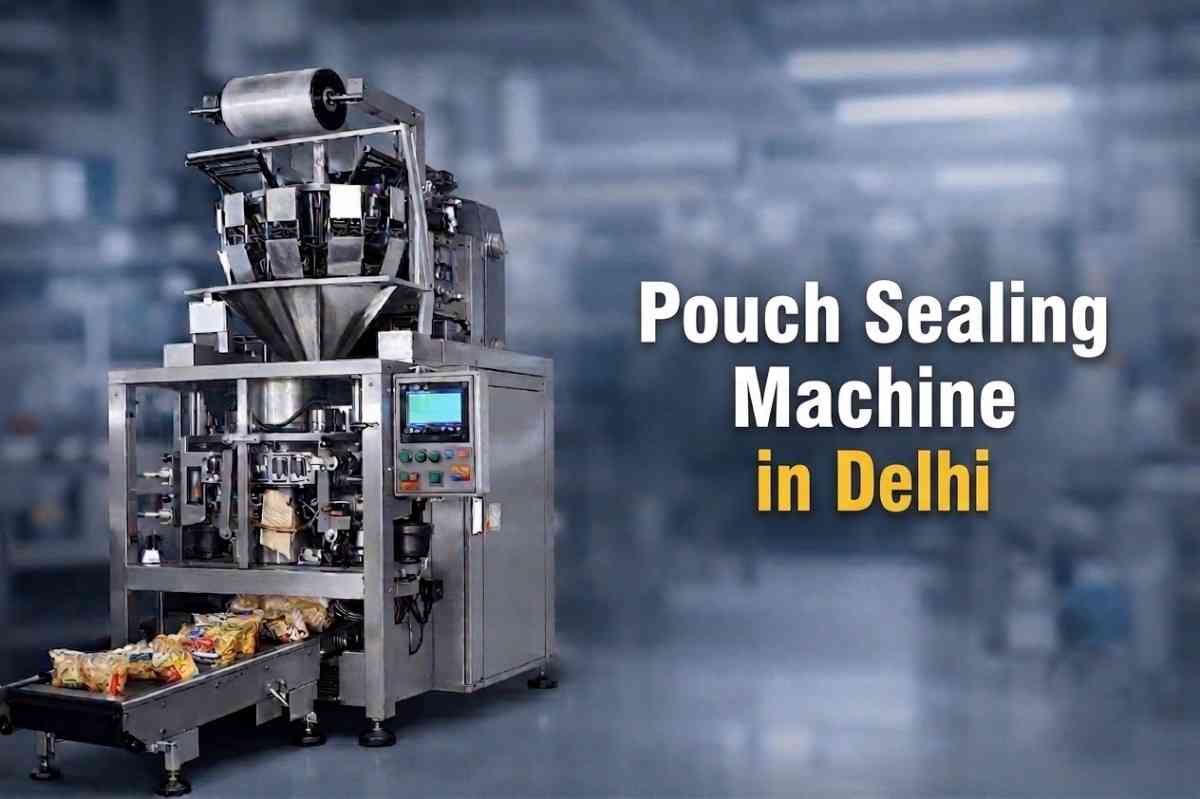
Delhi NCR is one of the most active manufacturing zones in the country. Thousands of food units, FMCG brands, pharma companies, and industrial manufacturers operate here. They all package something. And for most of them, the pouch seal is the last line of defence between a good product and a rejected one.
This guide cuts through the confusion and helps you make a well-informed decision.
The Real Role of a Pouch Sealing Machine in Delhi's Manufacturing Ecosystem
Delhi and its surrounding industrial belt, including Faridabad, Noida, Gurgaon, Bawana, Narela, and Okhla, collectively form one of India's highest-density packaging machinery markets. The sheer variety of products manufactured here means the demand for different types of pouch sealing solutions is always high and always evolving.
According to the Flexible Packaging Association of India, flexible pouches now account for over 55% of primary packaging formats used across food and FMCG categories in North India. Every one of those pouches needs a seal. And that seal needs to be airtight, consistent, and retail-ready, not just for one batch but for millions of cycles across the machine's working life.
That scale of requirement is exactly why choosing the right pouch sealing machine in Delhi deserves more thought than most buyers give it at first.
Understanding How Pouch Sealing Actually Works
Most people think sealing is simple. You close the pouch, apply heat, done. But that picture leaves out the engineering that separates a reliable seal from one that fails on the transit truck or the retail shelf.
A proper pouch seal is controlled by three variables working together: seal bar temperature, jaw dwell time, and applied pressure. If even one of these shifts outside the correct range, you end up with seals that look acceptable visually but have microscopic weak points. Those weak points cause leaks, moisture ingress, and contamination days or weeks after the product has left your facility.
Think of it like a weld joint on metal. A weld that looks clean on the surface but was made at the wrong temperature or with insufficient time will fail under load. The same physics applies to film sealing. The machine needs to hit the right conditions every single time, across thousands or even millions of cycles, without drift.
That is the engineering challenge. And that is why the quality of the sealing system inside a machine matters far more than its listed speed or output capacity.
Types of Pouch Sealing Machines Available in Delhi
When you start exploring the market, you will encounter several categories of sealing machines. Each has a specific use case, and choosing the wrong type for your product is one of the most expensive mistakes you can make early in the buying process.
Integrated VFFS Pouch Sealing Machines
Vertical Form Fill Seal machines are the gold standard for high-volume pouch packaging. They form the pouch from flat roll film, fill it with your product, and seal it in a single automated cycle. There is no pre-formed pouch to handle manually. The sealing system is built into the machine and optimised for its specific operating rhythm.
These machines are ideal for snacks, pulses, spices, dry fruits, flour, sugar, protein powders, detergents, and a wide range of other products. The seal quality is consistent because the sealing jaws are engineered to work in precise coordination with the fill and form cycles.
Continuous Band Sealers
These seal pre-formed pouches by running them through a heated conveyor belt. They are simpler machines, lower in cost, and suited for smaller operations or supplementary sealing needs. They do not fill the pouch themselves. They only close it after manual or separate machine filling.
Impulse Sealers
Impulse sealers deliver a controlled burst of heat only at the moment of sealing, then cool immediately. They work well for thicker films and heat-sensitive materials. Not designed for industrial-scale output, but useful for low-volume specialty applications or sample production.
Vacuum Pouch Sealers
For products where oxygen exposure accelerates spoilage, vacuum sealers remove air from the pouch before closing it. Standard in fresh food, meat, dairy, pharmaceutical, and certain nutraceutical applications.
Stick Pack and Sachet Sealers
Designed specifically for narrow, elongated pouches used in single-serve applications. Coffee, sugar, salt, protein powder singles, and pharmaceutical sachets are the common use cases. These machines seal on all sides of the sachet and are built for continuous high-speed operation.
What Separates a Good Pouch Sealing Machine from an Average One
When I tried comparing the performance of several machines across different Delhi-based manufacturers during a sourcing project for a food processing client, the gap between the better-built machines and the rest showed up in two places: seal consistency over long production runs and film wastage per thousand pouches.
The machines that performed better consistently shared the same engineering characteristics. Here is what genuinely matters:
- Servo-driven jaw actuation: Servo motors control jaw movement with programmable precision. This means consistent pressure and timing on every single seal cycle regardless of production speed or operator variation
- PLC automation with product-specific parameter storage: Operators store temperature, dwell time, and pressure settings for each product. Switching between products involves recalling a saved profile rather than manual readjustment, which eliminates seal inconsistency during changeovers
- High-grade sealing jaw materials: Precision-machined jaws with proper Teflon coating or serrated profiles distribute heat evenly across the full seal width without creating hot spots or cold zones
- Film tension management: A controlled film unwind system maintains consistent tension throughout the roll. Poor tension control is the primary cause of film wrinkles in the seal area, which directly causes weak seals
- Cooling jaw integration: After the heat seal is made, a cooling jaw firms up the seal before the pouch is cut and released. Machines without proper cooling produce seals that deform or peel under light stress
- Digital temperature controllers with real-time feedback: The machine monitors actual jaw temperature continuously and compensates automatically for any drift, ensuring every seal is made at exactly the right condition
I have noticed that machines built without servo actuation are significantly more prone to seal failures during the last quarter of each production shift when mechanical components have been operating at temperature for extended periods. That drift is invisible to operators but shows up in rejection rates.
How to Evaluate Suppliers Before Buying a Pouch Sealing Machine in Delhi
Delhi has a large and active machinery market. Not all of it is what it appears to be. Many businesses operating as "manufacturers" are actually traders sourcing machines from factories elsewhere and adding their own branding. The engineering knowledge to support you after purchase often does not come with the transaction.
Here is a practical checklist for evaluating any supplier you are seriously considering:
- Visit their production facility before signing anything. A real manufacturer has a workshop with machining equipment, assembly bays, and a testing area. A trader has a showroom and brochures.
- Ask specifically about the sealing system. What brand of servo motor? What PLC controller? What is the jaw material and how are temperatures maintained? If they cannot answer these precisely, they did not build the machine.
- Request a live trial with your product and film. Run your actual product at your actual fill weight on their machine. Inspect the seals visually and physically. Pull test samples from the batch.
- Check for design patents or proprietary engineering. Companies that invest in original engineering protect it. Patents are verifiable indicators of genuine R&D rather than copied designs.
- Ask for reference customers in your industry. Not generic testimonials. Actual contacts at businesses running your type of product on their machines. Call them.
- Clarify spare parts supply and response times. Sealing jaws, heating elements, sensors, and belts are consumable items. Know exactly how long replacement parts take to reach your facility in Delhi when you need them urgently.
- Get all after-sales commitments in writing. Warranty terms, response times, service call procedures, and parts availability guarantees should all be documented. Verbal assurances are worth nothing when a machine goes down during peak production.
VS PacKit: A Trusted Name for Pouch Sealing Machines in Delhi
For Delhi-based businesses looking for a pouch sealing machine backed by genuine engineering expertise and a verifiable track record, VS PacKit is consistently among the names that serious buyers arrive at.
VS PacKit is the packaging machinery brand of V.S. International, headquartered in Faridabad, Haryana, placing them squarely within the Delhi NCR industrial belt. With over two decades of hands-on experience in designing and manufacturing VFFS machines and complete pouch packaging lines, they bring technical depth that resellers simply cannot replicate.
Their machines are engineered around servo-driven sealing systems and full PLC automation, delivering the kind of seal consistency that high-volume multi-shift production environments demand. Two granted design patents, with additional patents in progress, reflect a company that invests seriously in original engineering rather than reverse-engineering existing products.
In my experience looking at their machine builds alongside others in the same category, the component quality visible in VS PacKit machines, particularly the sealing jaw engineering and servo integration, reflects a manufacturing philosophy focused on long-term reliability over cost-cutting at the assembly stage.
Their client list reinforces this. Adani, Haldiram's, Parle, Patanjali, Cadbury, Bikanervala, Weikfield, Bikano, Badshah, and a long list of other demanding brands run VS PacKit machines on their production lines. These are companies that cannot afford packaging failures. VS PacKit serves businesses across Delhi, Faridabad, Noida, Ahmedabad, Mumbai, Chennai, Hyderabad, Pune, and Vadodara.
The VS PacKit Product Range for Pouch Sealing and Packaging
Here is a clear overview of what VS PacKit builds that is directly relevant to pouch sealing requirements:
- Komet 81: Precision intermittent motion VFFS machine with integrated sealing, built for consistent high-volume output across diverse product categories
- Indus 5000: Advanced intermittent motion packaging system engineered for demanding multi-shift environments with exacting seal quality requirements
- GT-5S: High-speed VFFS machine for production lines where output volume and sealing throughput are the primary operational priorities
- Komet Sprint: Compact VFFS machine for smaller production setups that still demand professional-grade seal quality and operational reliability
- SP-914 Stick Pack Machine: High-speed continuous motion sachet and stick pack sealing system for single-serve packaging formats
- Servo Auger Fillers: Precision powder dispensing integrated with accurate sealing for complete packaging of powders and fine granules
- Volumetric Cup Fillers: Reliable filling and sealing for free-flowing granular products including sugar, seeds, rice, and grains
- Duplex Packaging Systems: Parallel dual-line output for high-capacity operations requiring maximum sealing throughput without proportional floor space increase
- Multihead Weighers: Integrated weighing accuracy for snack and food lines where consistent fill weight ahead of sealing is operationally critical
Industries in Delhi That Rely on Pouch Sealing Machines
The demand for pouch sealing machines across Delhi NCR spans an enormous range of industries. Current buyers and users include:
- Snack food and namkeen producers in Bawana, Narela, and Okhla
- Spice and masala grinding units supplying North Indian retail markets
- Flour mills and grain processors packaging for retail and wholesale
- Pharmaceutical and nutraceutical companies requiring precision sachet sealing
- Detergent and homecare product manufacturers
- Tea, coffee, and instant beverage packaging businesses
- Dry fruit and nut packagers for domestic retail and export
- Protein supplement and health food brands targeting urban consumers
- Ayurvedic and herbal product manufacturers requiring food-grade sealing compliance
- Animal and pet feed businesses packaging for retail distribution
If your operation falls into any of these categories and your current sealing setup is producing inconsistent results, rejected batches, or unexplained downtime, the conversation worth having is with a genuine manufacturer, not another service call to the same inadequate machine.