

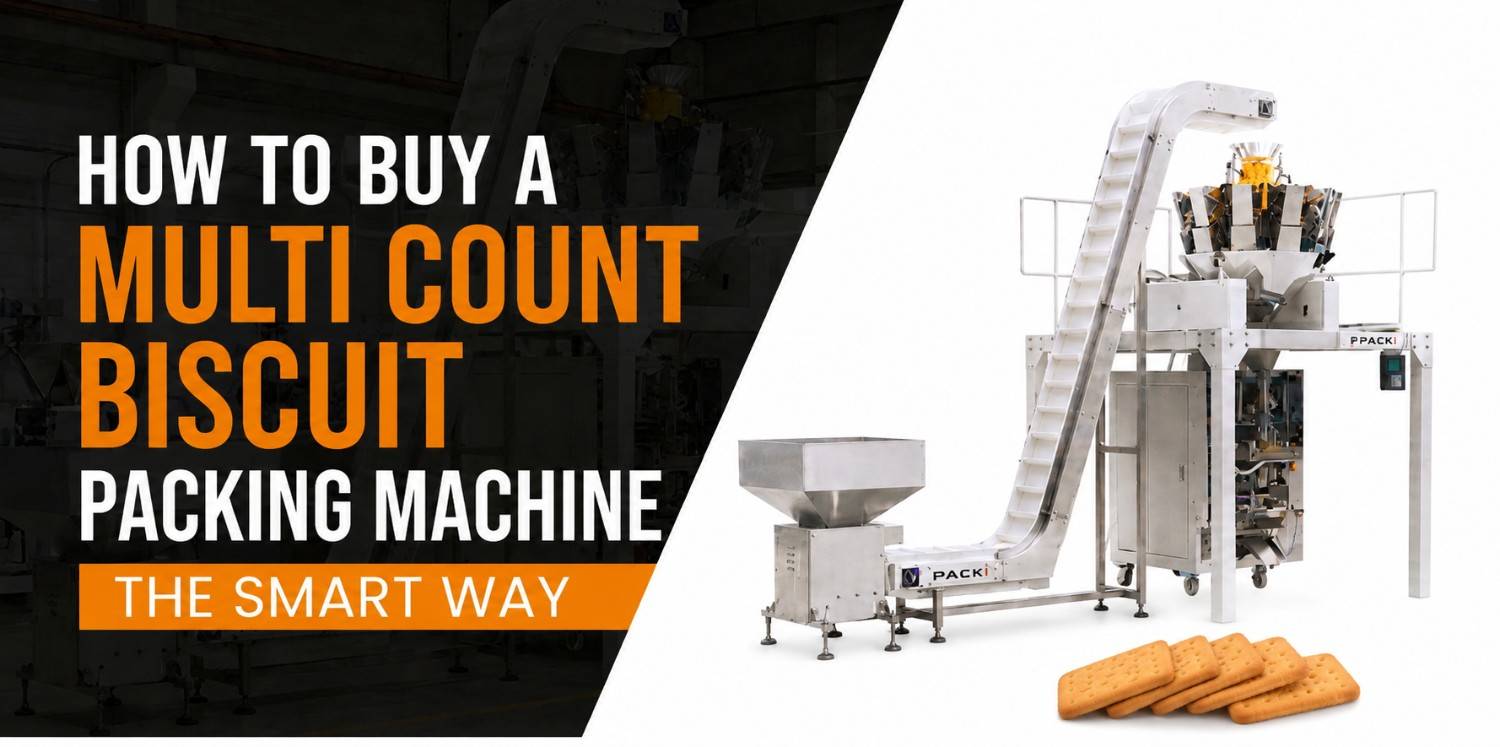
If you run a biscuit manufacturing unit, a namkeen factory, or any food processing business that needs to pack products in counted quantities, you have probably already realized something: buying a Multi Count Biscuit Packing Machine is not as simple as picking the cheapest option from an online listing.
The wrong machine slows your entire production line. It misses count targets, jams during peak hours, and costs more in downtime and rework than it ever saved on paper. The right machine, on the other hand, becomes the backbone of your packaging floor, running accurately and consistently shift after shift.
This guide is written to help you make that decision the smart way, whether you are setting up a new packaging line, upgrading an existing one, or scaling a growing food business.
The Real Problem Most Buyers Run Into
Here is a situation that plays out frequently in Indian food factories.
A mid-sized biscuit manufacturer in Indore decides to automate packaging. They buy a machine based on a supplier's demonstration video and a competitive quote. The machine arrives, gets installed, and within three weeks the problems begin. The count is inconsistent. The film sealing leaves air pockets. The machine cannot handle the slightly irregular shape of their cream biscuits without jamming every forty minutes.
The root problem was not the machine itself. It was the mismatch between the machine's actual capability and the specific production requirement.
Multi count biscuit packing involves counting discrete biscuit units, stacking or collating them correctly, and sealing them in a film pouch with accurate count, weight, and presentation. Each of these steps has variables that need to match your product, your film type, and your line speed. Understanding those variables before you buy is the entire point of this guide.
What a Multi Count Biscuit Packing Machine Actually Does
At its core, this machine combines three functions into one automated system.
First, it counts the biscuits. Modern machines use sensors, vibratory feeders, and counting mechanisms to separate and count individual biscuits with high accuracy. Depending on the configuration, this can be a linear counting system or a multi-lane rotary counter for higher throughput.
Second, it collates and orients them. Biscuits need to be stacked or arranged in a specific orientation (flat stack, on-edge, or mixed layer) before they enter the packing stage. This determines how they sit in the finished pouch and how the pouch looks to the end consumer.
Third, it forms, fills, and seals the pouch. This is where the VFFS machine (Vertical Form Fill Seal) technology comes in. The film is pulled from a roll, formed into a tube around the product, sealed at the bottom, filled with the counted biscuit stack, and then top-sealed and cut. The result is a finished, sealed pouch ready for secondary packaging.
Some configurations also integrate a checkweigher or metal detector downstream for quality assurance.
Types of Multi Count Biscuit Packing Configurations
Not every biscuit packing requirement is the same. Here are the main configurations you will encounter.
Single Lane VFFS with Counting Module
The most common entry-level configuration. A counting module feeds counted biscuits into a single VFFS machine. Suitable for production speeds of 40 to 80 pouches per minute depending on biscuit size and count per pack. Good for small to mid-sized operations.
Multi-Lane Parallel VFFS
Two or more VFFS machines run in parallel from a common counting and distribution system. Significantly higher output. Used in large biscuit factories where a single lane cannot meet the required production rate.
Flow Wrap with Count Stacking
Some biscuit products are packed in flow wrap (horizontal packaging) rather than VFFS pouches. The counting and stacking system feeds a horizontal flow wrapper. This format is common for premium biscuit brands and cream sandwich biscuits where presentation matters.
Combination Packing Lines
A combination of an automatic packaging machine handling primary pouch packing followed by a secondary carton packing system. Common in export-oriented units and modern FMCG factories.
Five Questions to Answer Before You Shortlist Any Machine
These questions will do more for your buying decision than any supplier brochure.
Question 1: What is your target output in pouches per minute?
Do not guess. Calculate it from your daily production target, your available shift hours, and your planned downtime allowance. A machine rated for 60 pouches per minute running at 80 percent efficiency gives you around 48 usable pouches per minute. Work backwards from your requirement and make sure the machine's rated speed comfortably exceeds your actual need.
Question 2: What is the exact biscuit geometry you are packing?
Biscuit diameter, thickness, and surface texture determine what counting mechanism will work reliably. Thin, crispy biscuits behave very differently from thick, creamy sandwiches. Irregular or brittle products require gentler handling throughout the counting, stacking, and filling stages. Share actual biscuit samples with your machine supplier before finalizing.
Question 3: What film type and pouch format do you need?
BOPP, metallized BOPP, PE, laminated structures, pillow pouches, gusseted pouches, standup pouches. Each combination requires different sealing jaw configurations and temperature profiles. Confirm your film specification with your packaging material supplier before specifying the machine.
Question 4: What is your accuracy requirement on count?
Consumer packaged goods regulations in India require accurate count declaration. If your pack says 10 biscuits, 9 biscuits reaching the consumer is a compliance problem. What count accuracy does the machine guarantee, and what testing methodology does the supplier use to prove it?
Question 5: What after-sales support does the supplier offer?
A machine sitting idle because a sensor failed and a replacement part takes two weeks to arrive is a production crisis. Ask specifically about spare parts availability, service engineer response time, remote diagnostics capability, and operator training provided at commissioning.
What the Spec Sheet Does Not Tell You
Machine specifications are a starting point, not a complete picture. Here are things you need to verify beyond the datasheet.
Changeover Time Between SKUs
If you produce multiple biscuit sizes or count variants, how long does it take to changeover the machine from a 5-count pack to a 10-count pack? Some machines require extensive mechanical adjustments and film path re-threading. Others are designed for quick-change tooling. For operations with frequent SKU changes, this matters enormously.
Film Wastage Rate
Every VFFS pouch packing machine generates some film waste from reel changes, startup, and shutdown. Higher quality machines minimize this. Over a year of production, even a small percentage reduction in film waste adds up to meaningful cost savings.
Sealing Quality Consistency
Seal quality is about food safety, not just aesthetics. A properly sealed biscuit pouch maintains product freshness and shelf life. Ask to see sealing test results under the actual ambient temperature and humidity conditions of your factory, not just lab conditions.
Noise and Vibration Levels
This sounds minor until your factory floor runs twelve hours a day. Machines with excessive vibration also tend to have higher rates of biscuit breakage in the counting and filling stages.
A Real Production Floor Scenario
Consider a small biscuit brand in Rajkot producing glucose biscuits for the institutional market. Their requirement was 50-count packs running at 55 pouches per minute, with BOPP film pouches and a compact footprint because their factory floor space was limited.
The wrong approach would have been to buy the first machine matching the 55 pouches per minute specification. The smart approach was to share the exact biscuit sample, the film specification, and the floor space constraint with the supplier, request a live trial on those specific biscuits before order confirmation, and verify the changeover procedure firsthand.
That is the due diligence that separates a successful installation from a costly mistake.
Common Mistakes Buyers Make When Purchasing Biscuit Packing Machines
Choosing on speed rating alone
A machine rated at 100 pouches per minute running at 60 percent efficiency because of frequent jams is slower than a machine rated at 70 pouches per minute running at 95 percent efficiency. Real-world efficiency matters more than peak rated speed.
Ignoring film compatibility
Not all VFFS machines seal all film structures equally well. Metallized films and laminated structures require precise temperature control and dwell time settings. A machine optimized for plain BOPP may produce poor seals on laminated film.
Underestimating the importance of operator training
Even the best automatic packaging machine produces poor results if operators do not know how to set it up correctly. Budget for proper training during commissioning and make sure the supplier provides documentation in a language your operators can actually use.
Buying a machine that cannot scale
If your business grows from 55 pouches per minute to 90 pouches per minute in two years, can the machine be upgraded, or does it need to be replaced entirely? Scalability should be part of the initial specification discussion.
Why VS PacKit Understands What Biscuit Manufacturers Actually Need
VS PacKit has built its reputation among Indian food manufacturers by focusing on exactly what matters in real production environments: machines that run consistently, count accurately, seal reliably, and keep maintenance demands low.
Their Multi Count Biscuit Packing Machine range is built around VFFS technology with integrated counting modules designed for the specific handling requirements of biscuit products, including fragile, thin, and cream-filled varieties. The machines are engineered for Indian production conditions, which means they are designed to handle the ambient temperature and humidity variations that affect sealing quality in Indian factories across seasons.
What sets VS PacKit apart for buyers who have been through a bad machine experience before is the application-first approach. Before recommending a configuration, the VS PacKit team reviews the actual product, the production target, the film specification, and the floor layout. The result is a machine recommendation that fits the real requirement, not just the headline speed spec.
For small businesses and startups entering packaged food production, VS PacKit offers configurations that match realistic initial production volumes without forcing an over-investment in capacity that sits idle. For established manufacturers scaling up, the modular design approach allows production capacity to grow without a complete line replacement.
After-sales support is backed by trained service engineers, a readily available spare parts network, and operator training at commissioning that actually prepares your production team to run the machine confidently from day one.
Conclusion
A Multi Count Biscuit Packing Machine is not just a piece of equipment. It is a daily production commitment. The right machine, correctly specified and properly supported, becomes one of the most reliable investments your factory makes. The wrong one becomes a source of daily frustration, production losses, and maintenance costs that compound over time.
The smart buying approach comes down to understanding your specific requirement, asking the right questions before shortlisting, verifying performance with your actual product rather than generic demonstrations, and choosing a supplier who treats after-sales support as seriously as the initial sale.
VS PacKit brings the technical depth and application experience to help you get this decision right the first time. Connect with the VS PacKit team today with your production requirements and get a recommendation built around what your factory actually needs.