

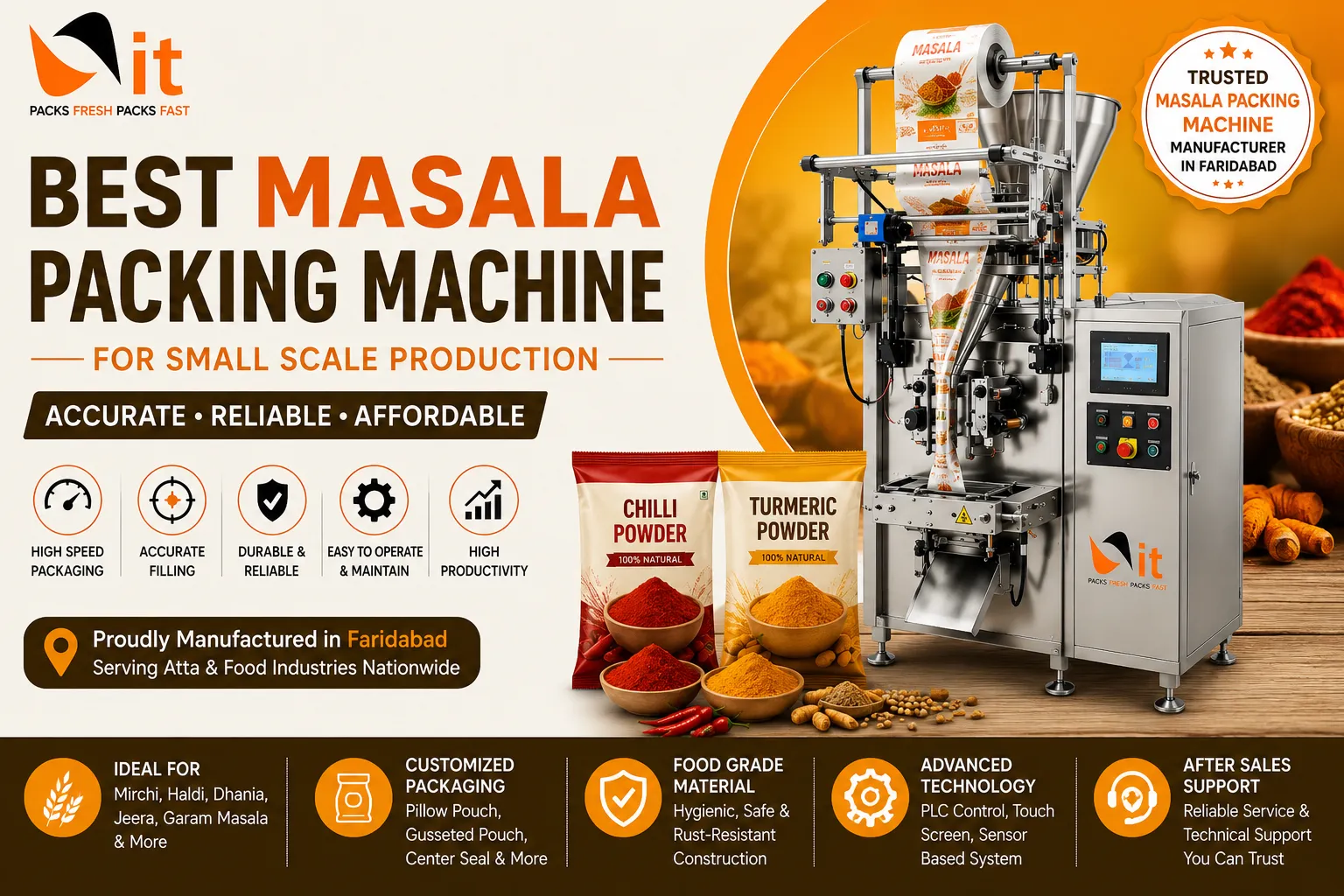
What Is the Best Masala Packing Machine and Price for a Small Business?
For a small masala business, the best choice is a semi-automatic auger-fill masala packing machine. It handles turmeric, chilli, coriander and garam masala. Its price generally runs from about ₹1.5 lakh to ₹3.5 lakh, depending on pouch size range, build quality and brand. Fully automatic VFFS lines cost more, typically ₹3.5 to 8.5 lakh, and suit larger volumes.
Not sure which one fits your masala?
Tell us your product and daily volume and our team will suggest the right machine.
Why Do Small Masala Units Need a Different Approach?
Small spice manufacturers need pouches that look as professional as a big FMCG brand's, without spending lakhs on a high-speed multihead system. They fall into a gap: too big for hand-filling and stapling, and too small for enterprise automation.
A large brand cares about pouches per minute and integrated date coding. A unit packing a few hundred kilos a day cares about low upfront cost, small floor space, quick switching between masala varieties, and not needing a maintenance engineer on payroll. So "best" here means the best balance of cost, simplicity and room to grow. An oversized machine ties up capital you need elsewhere, and a manual setup means your packaging never matches your product quality.
What Is a Masala Packing Machine and How Does It Work?
A masala packing machine fills a measured amount of spice into a pouch and seals it. In auger machines, a rotating screw meters powder by volume, then the machine forms or takes the pouch, fills it and heat-seals it. Machines range from compact semi-automatic units, sometimes searched as a "mini masala packing machine", to fully automatic form-fill-seal lines.
Which Masala Packing Machine Type Fits Small-Scale Production Best?
For most early-stage masala businesses, a semi-automatic auger-based pouch packing machine hits the sweet spot.
- Lower upfront investment: It skips continuous-motion film handling, integrated printers and high-speed servo systems, which a small unit rarely needs on day one.
- Simple operation: One operator loads pouches and triggers the fill-seal cycle, so labor and training costs stay low.
- Good enough accuracy: Auger fillers meter turmeric, chilli powder, coriander, garam masala and pan masala well for retail pouches of 20g to 500g, without the ±0.1% precision of large multihead systems.
- Compact footprint: It fits a small production room.
A note on khada masala: Whole spices like sabut jeera, dalchini, elaichi and whole red chillies don't flow through an auger the way powders do. For khada masala SKUs, use a vibratory feeder or a volumetric cup filler. Ground masala works best with a servo auger filler.
This is also the machine type that upgrades most naturally. Many manufacturers build their semi-automatic and automatic ranges around the same filling mechanism, so moving up later doesn't mean relearning your process. VS PacKit's lineup, for example, runs from compact semi-automatic models to higher-speed automatic systems as volumes grow. See the full filler range.
What Is the Masala Packing Machine Price in India?
Indicative prices for 2026 are below. Exact quotes depend on specification.
| Machine type | Indicative price | Best for |
|---|---|---|
| Semi-automatic auger-fill | ₹1.5 lakh to ₹3.5 lakh | Small units, a few hundred kg per day |
| Fully automatic VFFS | ₹3.5 lakh to ₹8.5 lakh | Growing brands, higher daily volumes |
| Multihead weigher lines | Higher, quoted on request | Large volumes, many SKUs |
What changes the price:
- Fill type: auger, cup filler or multihead weigher
- Pouch size range and pouch style
- Automation level (manual timing vs PLC)
- Build quality and contact-part material
- Add-ons such as date coding or nitrogen flushing
To compare quotes fairly, give every supplier the same product, pouch size and output target.
How Much Does a Small Masala Packing Machine Cost?
A small masala packing machine at the compact, entry-level end generally sits at the lower part of the ₹1.5 lakh to ₹3.5 lakh range. That is meaningfully below the ₹3.5 to 8.5 lakh typical of fully automatic VFFS lines, which is why it is the right entry point when you don't yet need the extra capacity.
Budget for more than the machine itself:
- Printed film rolls: A recurring cost that grows faster than most people expect.
- Change parts: Needed if you pack multiple pouch sizes.
- Warranty and after-sales support: Aim for at least one year. A two-day breakdown can halt a small unit's whole production week.
How Do You Find a Masala Packing Machine at a Low Price?
A masala packing machine at a low price is possible, but cheapest is not always cheapest to own. To keep costs down without hurting quality:
- Choose semi-automatic if your volume is a few hundred kilos a day.
- Skip features you don't need yet, such as integrated printers and multihead weighers.
- Insist on the essentials: SS304 contact parts, adjustable fill weight and a reliable sealing jaw.
- Compare total cost: Include film waste, spare parts and service, not just the sticker price.
- Ask for a trial with your own masala before you pay.
A very cheap machine with weak sealing can cost more in returns, wasted film and lost shelf life than the money it saved.
Which Pan Masala Packing Machine Should You Choose?
Pan masala is usually packed in small sachets, often 1g to 5g, so it needs a machine built for very small pouches. Confirm these before buying a pan masala packing machine:
- Minimum pouch size: Check that the machine reliably fills and seals your sachet size.
- Filler type: An auger suits fine, powdery blends. A cup filler may suit granular or mixed pan masala.
- Seal quality: Small sachets need consistent sealing, since a weak seal lets moisture in and aroma out.
- Speed and output: Sachet volumes are high, so ask about pouches per minute for the size you need.
Test your actual blend on the machine, because pan masala mixes vary widely in texture.
Which Masala Needs Which Filler?
| Product | Suggested filler |
|---|---|
| Turmeric, chilli powder, coriander | Servo auger filler |
| Garam masala, pan masala (fine) | Auger filler |
| Pan masala (granular) | Cup filler |
| Khada masala (whole spices) | Vibratory feeder or cup filler |
What Features Should a Small Masala Packing Machine Have?
Even on a small budget, insist on these:
- SS304 contact parts. Spice powders are mildly corrosive, and food-grade stainless steel prevents contamination and rust.
- Adjustable fill weight. You will likely pack several SKUs at different weights, so quick, tool-free adjustment saves time.
- Digital temperature control on the sealing jaw. Inconsistent sealing is the biggest cause of shelf-life complaints in small masala brands.
- Multiple pouch formats. Center-seal, gusseted or stand-up pouches, depending on how you want to look on the shelf.
- Basic PLC or digital counter. It improves consistency from batch to batch.
Common Mistakes Small Businesses Make When Buying
- Buying on speed alone. A 40-pouches-per-minute machine is wasted if your daily volume is a few hundred pouches.
- Skipping the trial run. Fine chilli powder flows differently from coarse garam masala. Ask for a trial with your own product, not the manufacturer's test powder.
- Ignoring service reach. Ask how service requests are handled in your city before you buy.
- Underestimating film costs. Include film in your per-unit cost from day one.
- Overbuying automation too early. Money tied up in unused capacity is money not spent on marketing, raw material or distribution.
When Should You Upgrade Your Masala Packing Machine?
A semi-automatic machine serves you well until you run it near its daily capacity or add a second shift just for packaging. Then move to a fully automatic auger or cup-fill VFFS system, such as a duplex auger machine, and later a multihead weigher if your SKU count and volume justify it.
For a wider view of choosing a supplier, read our guide to packaging machinery manufacturers in India.
Conclusion
For a small masala business, the best machine isn't the most advanced one. It matches your batch sizes, protects your margins and leaves room to scale. A well-built semi-automatic auger filler from a manufacturer with real spice-packing experience and responsive service is the most practical starting point in India today.