
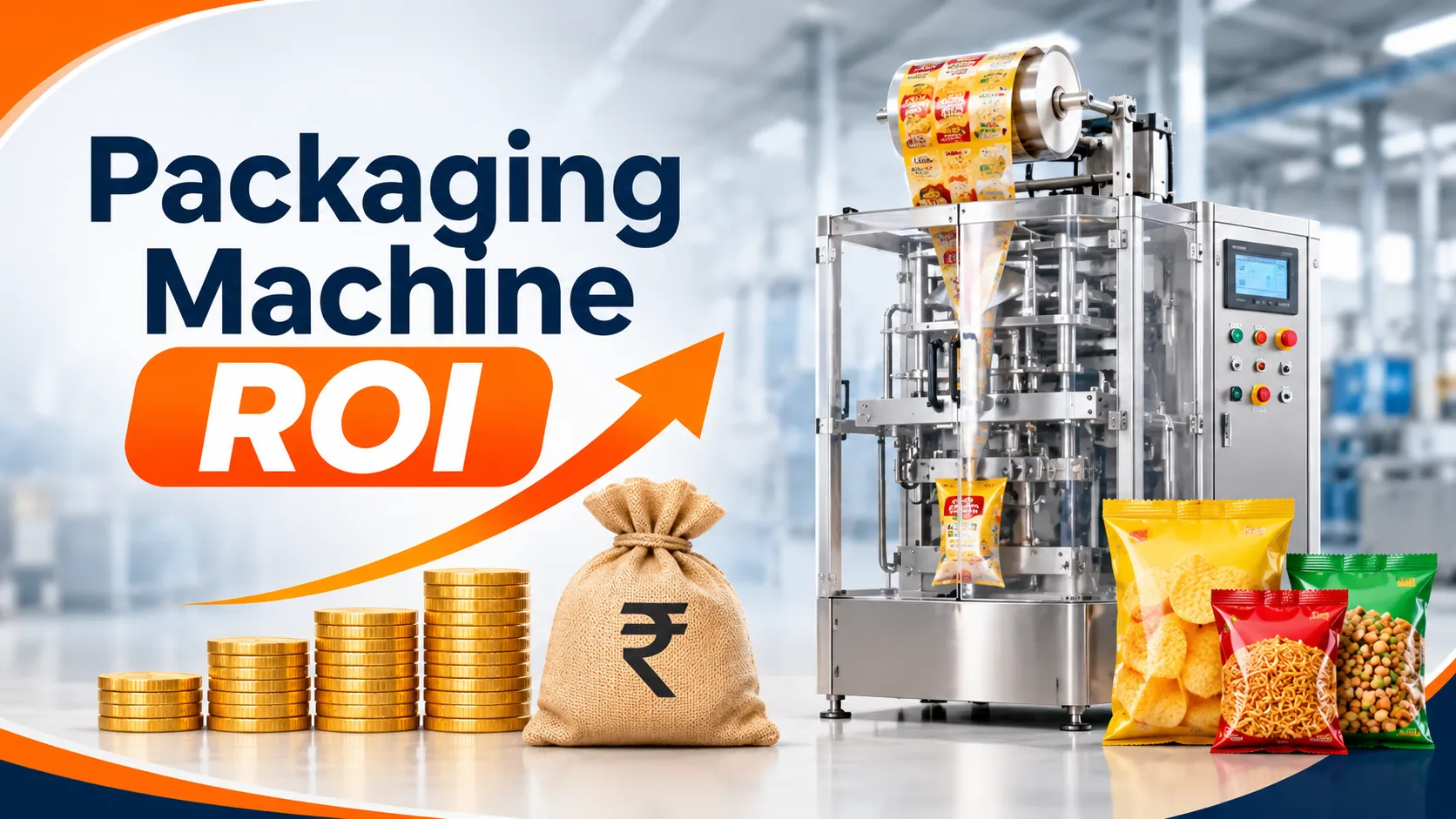
Most buyers ask the price of a packing machine first. A better first question is how long the machine takes to pay for itself. A machine that costs more but saves labour, film and rejected packs every day can return its price faster than a cheap machine that wastes material. This guide shows how to work out packaging machine ROI and the payback period for a vertical form fill seal (VFFS) line, step by step, using plain arithmetic you can do in a spreadsheet.
It is written for owners of spice, flour, snack, grain and powder units who now pack by hand or on a semi-automatic sealer and are deciding whether to move to an automatic line. The example numbers below are illustrative, so replace them with your own figures before you decide anything.
What ROI and Payback Period Mean
Two measures are enough for most buying decisions.
- Payback period: the number of months the monthly savings take to cover the total cost of the machine. A shorter payback means lower risk.
- ROI (return on investment): the yearly net saving divided by the total investment, shown as a percentage. A higher ROI means the money works harder.
Payback is easier to explain to a partner or a bank. ROI is useful when you compare a machine with other uses of the same money, such as more stock or a new product line. Calculate both.
Step 1: Add Up the Total Investment
The machine quotation is only part of the cost. Build the full list before you divide anything.
- Machine price, including the filler (auger filler, cup filler or multihead weigher) you have chosen.
- Add-ons such as date coder, dust extraction and nitrogen flushing.
- Transport, installation and operator training.
- Electrical work, compressed air supply and any floor or space preparation.
- A small stock of spare parts, such as sealing jaw heaters and belts.
- GST, if you cannot claim it back as input credit.
Adding these gives the total investment. Using only the machine price makes payback look shorter than it really is, and that is the most common mistake in these calculations.
Step 2: Work Out What You Spend Today
Next, find the real monthly cost of packing the way you do it now. Measure for one full month and do not rely on guesses.
- Labour: number of packers multiplied by monthly wage, plus overtime and any supervisor time.
- Giveaway: when packs are filled by hand, many are overweight so that none falls short. Multiply the average extra grams per pack by the number of packs and by the product cost per gram.
- Rejects: packs lost to bad seals, spillage or wrong weight.
- Packaging waste: pouches and film wasted by hand-feeding.
- Lost sales: orders you turned down because you could not pack fast enough.
Giveaway deserves attention, because it is invisible. A hand-filled pack that is 3 grams over on average looks harmless. Spread over a few thousand packs a day, it becomes a real monthly loss in product that you never billed.
Step 3: Estimate What You Will Spend With the Machine
An automatic line has its own running costs, so include them. A fair comparison needs both sides.
- Operator wages (usually one or two people instead of a larger packing team).
- Electricity and compressed air.
- Film cost per pack, which is often lower with a machine because of accurate cutting.
- Maintenance and spare parts, commonly estimated as a small share of machine cost per year.
- Remaining giveaway, which falls sharply with a servo auger filler or a multihead weigher.
Subtract this machine-side monthly cost from today's monthly cost. The result is your monthly saving.
Step 4: Add the Extra Income From Higher Output
Savings are only half the story. A faster line lets you sell more. If your hand-packing limits you to, say, 2,000 packs a day and the market would take 4,000, the extra volume earns margin. Estimate this carefully: take only the extra packs you are sure to sell, multiply by your margin per pack, and add it to the monthly saving. If you are unsure of demand, leave this step out. A calculation that works without it is more convincing.
A Worked Example (Illustrative Numbers)
Consider a small spice unit that packs 50 g and 100 g pouches by hand. The figures below are made up to show the method. They are not a quotation or a promise of results.
| Item | Today (manual) | With automatic VFFS |
|---|---|---|
| Packers needed | 6 | 2 |
| Monthly wage per person | ₹15,000 | ₹15,000 |
| Monthly labour | ₹90,000 | ₹30,000 |
| Giveaway and rejects | ₹25,000 | ₹8,000 |
| Power, air and maintenance | ₹3,000 | ₹10,000 |
| Total monthly running cost | ₹1,18,000 | ₹48,000 |
The monthly saving is ₹1,18,000 minus ₹48,000, which is ₹70,000. Suppose the total investment, after adding installation, spares and electrical work, is ₹8,00,000. Then:
- Payback period = ₹8,00,000 divided by ₹70,000, which is about 11.4 months.
- Yearly saving = ₹70,000 multiplied by 12, which is ₹8,40,000.
- Simple ROI = ₹8,40,000 divided by ₹8,00,000, which is 105 percent per year.
Again, these numbers are only an example. Your wage levels, volumes and machine will give different results. The method is what matters: total investment on one side, honest monthly saving on the other.
Hidden Costs That Change the Answer
Several items quietly stretch payback, and a good buyer plans for them.
- Downtime: a machine that stops for want of a spare part loses money every hour. Check how fast the maker supplies parts.
- Film wastage during setup: changing pouch size wastes some film. Fewer changeovers means better results.
- Wrong filler: a filler that does not suit your product causes weight variation and rejects. Read our guide on choosing between multihead, auger and cup fillers before you finalise.
- Learning curve: operators need a few days to run the machine well, so expect the first month to be slower.
- Upstream bottlenecks: if your grinding or filling of the hopper is slow, a fast packer cannot run at full speed.
What Makes Payback Shorter
You can improve the result by choosing the machine carefully, not only by negotiating the price.
- Match speed to demand. A machine far faster than your needs sits idle. A machine that is too slow becomes the bottleneck.
- Pick the right filler. A servo auger filler for powders or a multihead weigher for granules and snacks cuts giveaway the most.
- Run two shifts if you can. The same machine covering more hours spreads its cost over more packs.
- Buy from a maker that supports you. Quick service and spares protect your uptime.
- Look after it. Our VFFS troubleshooting guide explains the daily checks that prevent most breakdowns.
When a Machine May Not Pay Back Quickly
Honest advice includes the cases where automation is not yet the right move. If you pack only a few hundred packs a week, labour is cheap and the product changes every day, a machine may take years to recover its cost. In that case, a simple semi-automatic sealer may be enough for now. The same applies when demand is unproven. It is usually wiser to prove the market with hand packing, then move to a machine when volume justifies it. Our masala packing business guide covers how first-time founders can stage that growth.
Ask the Supplier for These Numbers
Before you trust any payback estimate, ask the supplier for the following in writing.
- The real speed for your product and pouch size, not the maximum on the brochure.
- The expected weight accuracy, so you can estimate giveaway savings.
- Power and compressed air use per hour.
- The list of wear parts, with price and delivery time.
- Installation, training and warranty terms.
With these answers you can fill your spreadsheet with facts instead of hopes. For a wider view of what shapes the quotation itself, read Pouch Packing Machine Price in India: What Decides the Final Cost, and if you pack spice powders, see our masala packing machine page.
Get a Payback Estimate for Your Own Line
VS International (VS Packit) builds automatic VFFS packing machines in Faridabad for spices, flour, snacks, grains and powders. Send us your product, pouch size and daily volume, and we will suggest a machine and help you work out the payback with your real numbers. You can also ask for a trial on your own product before you decide. Reach us through the contact page, and our team will reply with a specification and quotation.