

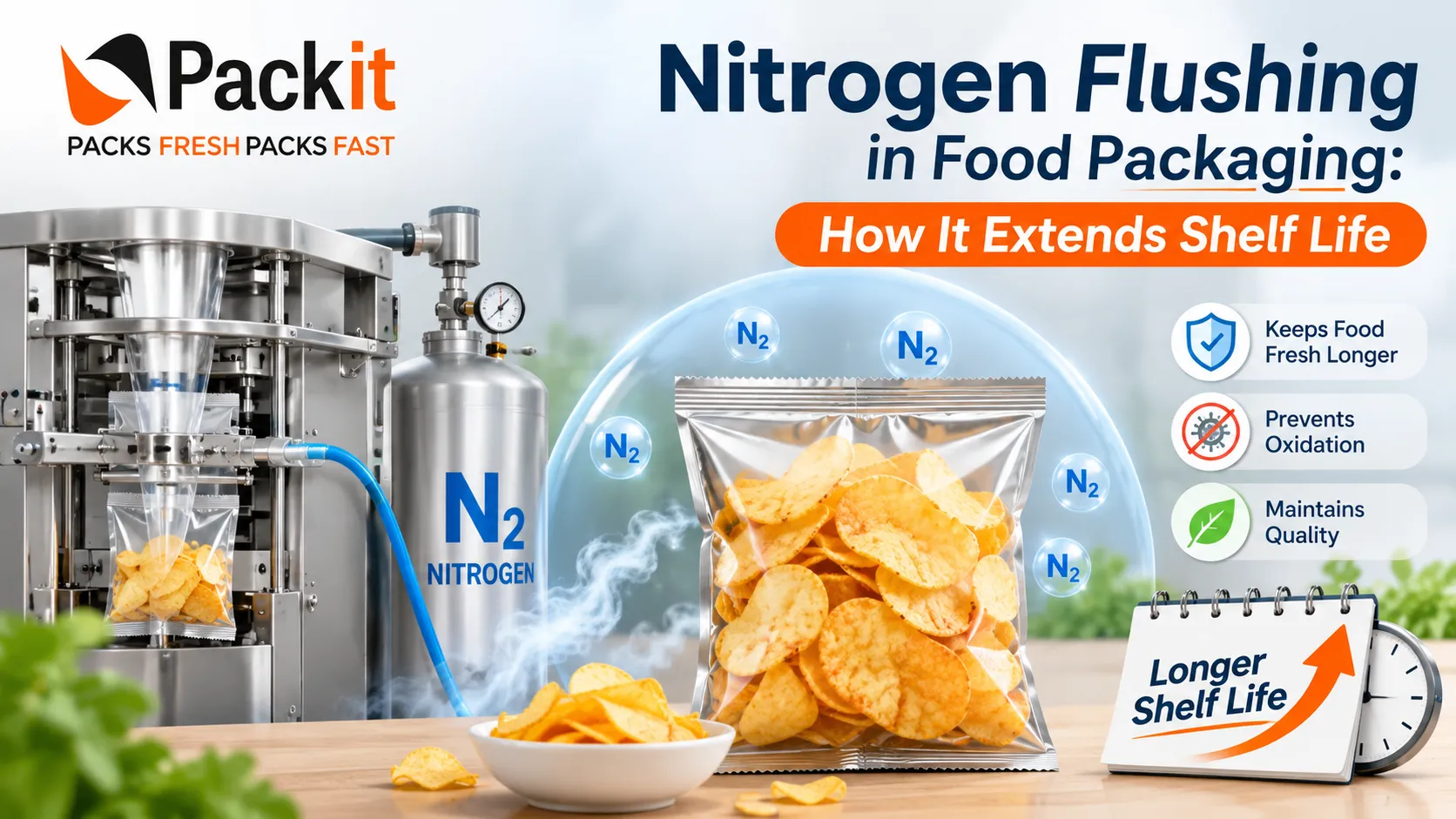
Open a packet of chips and you will notice that it is more air than chips, and that the air is not an accident. Most crisp snack packs are filled with nitrogen, not ordinary air. The gas protects the product from crushing and slows the chemical changes that make fried and oily foods taste stale. This guide explains how nitrogen flushing works, which foods benefit, how the process is done on a vertical form fill seal machine, what residual oxygen level to aim for and what to check before you invest in the option.
What Is Nitrogen Flushing?
Nitrogen flushing, also called gas flushing, is the practice of filling a pouch with nitrogen before it is sealed so that most of the air, and with it most of the oxygen, is pushed out. Ordinary air is about 78 percent nitrogen and 21 percent oxygen. Nitrogen is an inert gas: it does not react with food, it has no taste or smell and it is safe. Replacing oxygen with nitrogen creates a protective atmosphere around the product.
The process is a simple form of modified atmosphere packaging. It does not sterilise the food and it does not replace a good moisture barrier, but it removes the single biggest cause of quality loss in many snacks, which is oxygen.
Why Oxygen Spoils Snacks
Fried snacks, nuts and many dry foods contain oils and fats. When oxygen reaches these fats, they go through oxidation, which produces off flavours and smells that people describe as stale, rancid or cardboard-like. Light and heat speed the reaction. Oxidation also fades colour and, in some products, reduces vitamin content.
Air in the pack also supports the growth of some moulds and the activity of insects in grain and dry-fruit products, though moisture is usually the main driver there. Removing most of the oxygen slows all of these changes and keeps the product tasting fresh for longer.
The Second Job: Protecting the Product from Crushing
Nitrogen has a second, more visible role. A pouch filled with gas acts as a cushion. Chips, puffed snacks, fine sev and fryums are fragile, and a pouch with little gas lets them break in transit and on the shelf. Customers judge a snack pack by what is left when they open it, and a bag of crumbs causes complaints even when the flavour is fine. A well-flushed pack keeps its shape through cartons, trucks and shop shelves.
How Nitrogen Flushing Works on a VFFS Machine
On a vertical form fill seal machine, the film is formed into a tube around a forming collar and the product is dropped through the tube into the pouch. Nitrogen is added in one of two ways.
Gas flushing through the forming tube
A small tube runs alongside or inside the forming tube. Nitrogen flows through it continuously while the machine runs, so the pouch is filled with gas as the product falls. When the jaws close, the pack contains mostly nitrogen. This is the common method for snacks and it works well at normal packing speeds. It can be fitted to a standard machine and is the option behind our chips packing machine with nitrogen.
Why the dosing and the gas must be matched
The flow of nitrogen has to match the speed of the machine and the volume of the pack. Too little gas leaves too much oxygen. Too much gas wastes nitrogen, blows light products around and can even disturb the seal. A good machine lets the operator adjust the flow and stores the setting with the recipe for each product.
Getting the seal right
Nitrogen is only as good as the seal that holds it in. A pack with a weak or leaking seal will lose its gas within days, and the benefit disappears. This is why seal quality matters as much as gas flow. Our article on why seal quality matters in a chips packing machine explains what to check.
Which Foods Benefit from Nitrogen Flushing?
| Product | Benefit of nitrogen | Notes |
|---|---|---|
| Potato chips, banana chips, fryums | Strong: stops staling and crushing | Standard practice |
| Namkeen, sev, bhujia, mixture | Good: slows rancidity, protects fragile pieces | Most useful for oily and fine sev varieties |
| Nuts, dry fruits, roasted snacks | Good: slows oxidation of natural oils | Often paired with a high-barrier film |
| Puffed and extruded snacks | Strong: cushioning and crispness | Light products need gentle gas flow |
| Ground spices, tea, coffee | Some: protects aroma | Barrier film is usually more important |
| Flour, rice, pulses, sugar, salt | Low: moisture is the main risk | Rarely worth the added cost |
As a rule, nitrogen helps most where the product is oily, fragile or sensitive to oxygen, and least where moisture is the main threat. If your product is in the last group, spend the money on better film and seals first.
How Much Residual Oxygen Is Acceptable?
The measure that matters is residual oxygen, the percentage of oxygen left inside the sealed pack. Air starts at about 21 percent. Snack packers who flush well typically aim to bring residual oxygen well down, and a common target for chips and similar products is a few percent. Lower is better for shelf life, but the cost and complexity rise as the number falls, and a pouch machine with simple gas flushing has a practical limit. The right target depends on your product, your film and the shelf life you need.
You can measure residual oxygen with a small handheld gas analyser that draws a sample from the pack through a septum. Many snack plants check a few packs each shift. If your readings drift upward, look for a blocked gas line, a low supply pressure, a change in machine speed or a seal problem.
Film Matters as Much as Gas
Nitrogen cannot protect a pack that lets oxygen and moisture in through the film. Snack packs normally use a laminate with a metallised layer or a high-barrier layer, which blocks oxygen, moisture and light. A plain clear film may look fine but lets gas through, so the benefit of nitrogen fades. If you invest in gas flushing, match it with a film suited to the shelf life you want. Our guide to choosing a pouch packing machine explains how film choice interacts with the machine.
What Nitrogen Flushing Costs
The cost has three parts. First, the equipment: a gas flushing attachment on the machine, a regulator and a gas supply connection. Second, the gas itself: cylinders, a bank of cylinders or an on-site nitrogen generator. Third, the better film that makes the gas worthwhile. For a small plant, cylinders are the simplest route. As volume grows, an on-site generator can cut the per-pack gas cost, but it needs compressed air and maintenance. We do not quote a figure without your product and output, because the answer changes with pack size, speed and daily volume. Send us those details and we will give a clear estimate.
Common Mistakes with Nitrogen Flushing
- Flushing but not sealing well: a leaking pack loses its gas, so the cost is wasted.
- Using a low-barrier film: the gas escapes and oxygen creeps back in.
- Setting the flow too high: this wastes gas and can blow light products around the pouch.
- Never measuring: without a gas analyser you are guessing at the oxygen level.
- Using it where it is not needed: flour, sugar and rice gain little, and the money is better spent on film.
- Ignoring weight and fill: a pack with too much product leaves less room for gas and cushioning.
Practical Tips for Snack and Namkeen Makers
- Start with the weigher: gentle product handling reduces breakage before the gas ever helps. A multi-head weigher handles fragile snacks with care.
- Test with and without gas: pack a batch each way and compare freshness, shape and customer feedback over several weeks.
- Record settings by product: store gas flow, speed and temperature with each recipe.
- Check a few packs every shift: look at pack fullness and, if you can, measure oxygen.
- Keep the line clean: oil and crumbs on the jaws weaken seals and let gas leak out.
For a closer look at buying a chips line, read our guide on what to check before buying a potato chips packing machine and the potato chips packing machine page. For namkeen, see the namkeen packing machine page.
Is Nitrogen Flushing Right for You?
Ask four questions. Is my product oily, fragile or sensitive to oxygen? Do I need it to stay fresh for weeks or months on shelf and in transport? Is my film a high-barrier film, and are my seals reliable? And is my volume large enough to justify gas supply and equipment? If the answer is yes to the first three, nitrogen flushing is almost always worth it. If you are unsure, run a trial and compare.
Talk to VS Packit
VS Packit builds vertical form fill seal machines in Faridabad with optional nitrogen flushing for chips, namkeen and other snacks. Our vertical form fill seal machine page shows the platform. We can run a trial with your own product and film, with and without gas, so you can see the difference before you decide. Call +91 9811103573 or send your requirement online. Office hours are 9 am to 5 pm. Address: Plot No G-41, Block A, DLF Industrial Area, Sector 32, Faridabad, Haryana 121003.