
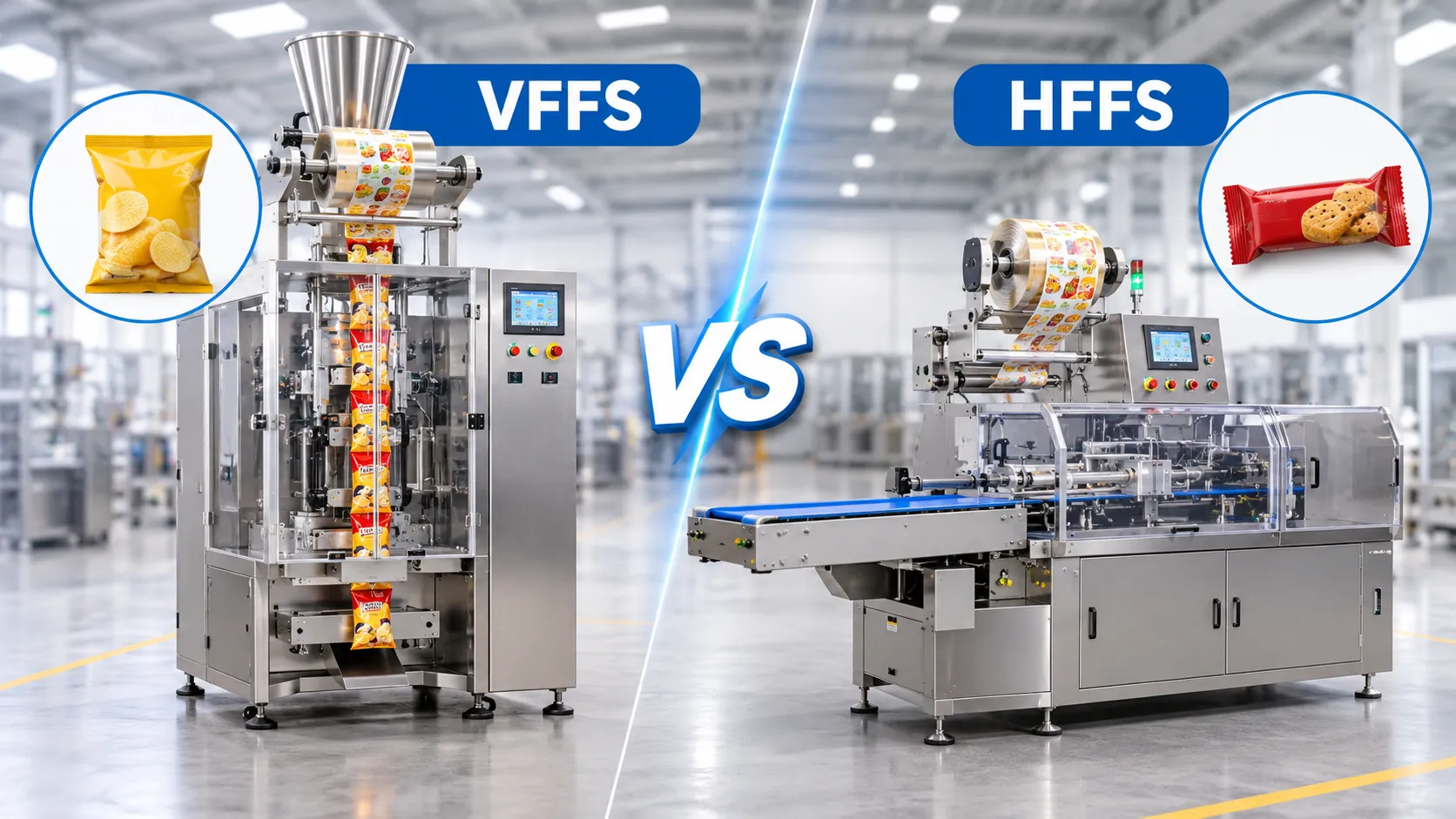
Both machines start with a flat roll of film and finish with a sealed pack, which is why buyers often assume the choice between VFFS vs HFFS is a matter of preference. It is not. The direction in which the pack is formed decides what the machine can handle, how much floor space it takes and how fast it can run.
This article is for production managers and packaging engineers who need to decide between a vertical and a horizontal form fill seal machine for a new line. It explains how each one works, which products suit which format, and the practical checks that settle the decision.
VFFS Full Form and What the Machine Does
VFFS stands for vertical form fill seal. The machine pulls film from a roll over a forming collar, which wraps it into a tube. A vertical sealing bar closes the back of the tube, a filler drops the product inside, and horizontal jaws seal and cut the top of one pouch and the bottom of the next in the same stroke. Gravity does much of the work, which is why the format suits products that fall freely.
Typical VFFS products are powders, granules, spices, flour, rice, pulses, namkeen, chips and other loose snacks. Our page on the vertical form fill seal machine shows the configurations we build for these products.
Step-by-Step: How a VFFS Machine Makes a Pouch
Seeing the sequence makes the difference between the two machine types clearer. On a vertical machine the film unwinds from a roll, and dancer rolls or brakes hold it at steady tension. The film passes over a forming collar and tube, which wrap it into a cylinder, usually round but sometimes oval or square. Heated jaws seal the back seam as a fin or lap seal. Servo-driven belts then pull the film down the tube. The machine sets bag length by counting servo revolutions or by reading a registration mark on printed film. Cross-seal jaws close below the tube, one set sealing the top of the filled bag and the other the bottom of the next bag, and a knife between them cuts the bag free. Gravity feeds product down the tube in the pause between seals.
How an HFFS Machine Works
An HFFS machine, also written as a horizontal form fill seal machine or horizontal FFS machine, forms the pack along a horizontal path. Product is placed on a conveyor, or into a formed pocket, and the film wraps around it before the ends are sealed. Because the product travels flat rather than falling through a tube, the format is much gentler on items that must not drop or tumble.
HFFS is common for single-serve bars, biscuits in a flow wrap, bakery items, confectionery bars and similar solid products. It can also pack heavier items and bags that carry closures such as zippers.
VFFS vs HFFS at a Glance
| Point of comparison | VFFS | HFFS |
|---|---|---|
| Direction of pack formation | Vertical, product drops into the tube | Horizontal, product travels flat on a conveyor |
| Best suited products | Powders, granules, liquids, loose snacks, grains | Solid, shaped or fragile items such as bars and bakery products |
| Pack styles | Pillow, gusseted, quad seal, sachet and stick pack | Flow wrap, pouches, and packs with closures |
| Floor space | Compact, taller than it is long | Longer line, needs more floor length |
| Speed potential | Fast, and continuous motion models go faster still | Can reach higher speeds on multi-lane, high-volume lines |
| Cost position | Usually lower to buy and run | Usually higher, justified by volume or product type |
Which Products Suit Which Format
Products that belong on a VFFS machine
If the product pours, flows or can be dosed by a weigher, a VFFS machine is almost always the better fit. Masala, atta, besan, protein powder, detergent powder, rice, dal, sugar, tea, chips and namkeen are all packed this way across India. A multi head weigher paired with a VFFS machine handles irregular snacks with very little giveaway.
Products that belong on an HFFS machine
If the product has a fixed shape and should not tumble, a horizontal machine protects it better. Protein bars, cereal bars, chocolate bars, cookies in a stack and bakery items are typical examples. Heavy products and packs that need a zipper or a spout also lean toward the horizontal format.
Products that could go either way
Some items, such as candy, can be packed in a VFFS pillow pack or in a horizontal flow wrap. Here the decision shifts to speed, pack appearance and budget. A candy brand chasing very high output on a single shape might prefer horizontal, while a regional brand packing several weights on one line will often prefer vertical for its flexibility.
Where Each Machine Is Most Cost-Effective
- Free-flowing and powdered products: vertical machines. Gravity does the work, the footprint is small and the cost per pack stays low.
- Snacks and chips: vertical pillow pouches, often nitrogen flushed to slow rancidity and cushion fragile pieces.
- Solid, individual items such as bars and biscuits: horizontal flow wrap, because items are placed in a line and must not be dropped or tumbled.
- Heavier items or pouches with zippers: horizontal or pre-made pouch systems.
- Liquids and pastes: vertical machines with a pump or piston filler, which handle hot or cold fill.
Footprint, Speed and Changeover
VFFS machines stand tall and narrow, so they fit in smaller plants and can be installed on a mezzanine over a weigher. HFFS lines run long, and a plant needs a clear stretch of floor for infeed, the machine and the outfeed conveyor.
On speed, both formats are available in intermittent and continuous motion designs. Continuous motion VFFS models such as our GT-5S are built for faster pillow-pack output. Changeover between pack sizes on a VFFS machine involves swapping the forming collar and adjusting jaw settings, while on an HFFS machine it often involves changing the infeed and pack length settings. Neither is quick for a very wide size range, so list the sizes you expect to run when you ask for a quote.
Cost: What the Price Difference Really Reflects
VFFS is generally the more economical format to buy because the mechanics are compact and the same machine can serve many products. HFFS costs more because of its longer frame, product handling and, on high-speed lines, the infeed system. The extra spend makes sense when the product genuinely needs gentle handling or when output volume is high enough to spread the cost. For a deeper look at what moves machine prices, see our guide to pouch packing machine price in India.
Questions to Ask Before You Decide
First, describe the product in physical terms: is it a powder, a granule, a piece, a liquid or a paste, and how fragile is it? Second, write down the pack sizes you sell today and expect to sell in two years. Third, decide the speed you need per minute and the number of shifts. Fourth, ask for a trial on your own product and film. A supplier who will test your actual product before you pay is usually confident in the machine.
A Simple Decision Checklist
- Does the product pour or fall freely, or can a weigher dose it? Choose VFFS.
- Does the product have a fixed shape that must stay flat or untouched? Choose HFFS.
- Is floor space limited? VFFS is easier to fit.
- Do you need several pack weights on one machine? VFFS offers more flexibility.
- Is your volume very high on a single shaped product? Look closely at HFFS.
Most food, spice, flour and snack manufacturers in India end up on VFFS for these reasons. If you are weighing both options for a new product, our guide on scaling faster with the right form fill seal packaging machine adds more context, and the overview page for the form fill seal machine range lists every format we build.
Tell us your product, pack size and daily output, and our team will say plainly which format fits and why. You can send us your requirement here.