

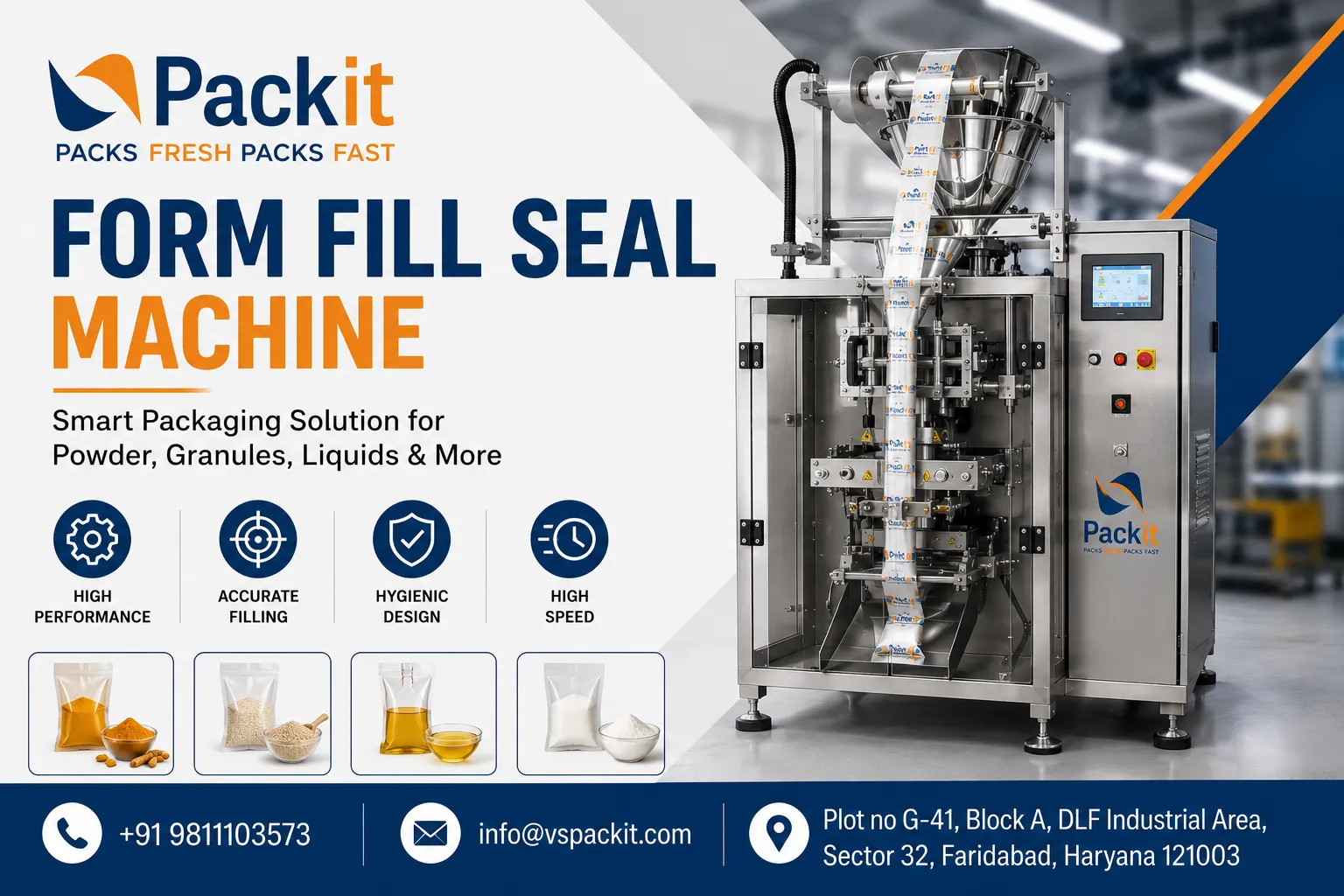
In my experience working with manufacturers across food, FMCG, and industrial sectors, the biggest confusion is not about what a form fill seal machine does, but about which configuration actually fits a specific product and production line. This page breaks down the working principle, types, components, and buying considerations so you can make that decision with confidence.
Quick Answer
A form fill seal machine, also called a form fill seal packaging machine, is an automated system that forms pouches from packaging film, fills them with a measured product, and seals them in one continuous process. It is used across food, pharmaceutical, and industrial sectors to replace manual packing with faster, more consistent output.
What Is a Form Fill Seal Machine
A form fill seal machine, sometimes written as form fill and seal machine or form fill seal bagging machine, automates three packaging steps that used to be done separately by hand: shaping a pouch, filling it, and sealing it shut. The machine works with a continuous roll of film rather than pre made pouches, which reduces material handling and speeds up production significantly compared to manual or semi automatic packing.
How a Form Fill Seal Machine Works
The core working principle stays consistent across most models, though the exact sequence varies slightly between vertical and horizontal configurations.
- Film unwinds from the reel and feeds through the machine
- A forming collar or forming set shapes the film into a tube or pouch cavity
- Sealing jaws join the film edges to create the pouch structure
- The filling system doses the measured product into the pouch
- Additional sealing jaws close the pouch completely
- The cutting mechanism separates finished pouches for discharge
I've noticed that manufacturers who understand this sequence in detail troubleshoot much faster on the floor, since most production issues trace back to one specific stage rather than the machine as a whole.
Vertical vs Horizontal Form Fill Seal Machines
Not every form fill seal machine works the same way, and choosing between vertical and horizontal configurations depends heavily on your product shape and packaging goals.
Vertical Form Fill Seal Machine
A vertical form fill seal machine forms the pouch vertically as film moves downward through the forming collar, making it the standard choice for free flowing or loose products like snacks, spices, powders, and granules. This configuration is compact, fast, and well suited to high volume production of standard pouch formats.
Horizontal Form Fill Seal Machine
A horizontal form fill and seal machine, on the other hand, moves film horizontally and is typically used for flat or pre shaped products that do not flow well through a vertical filling system, such as individually wrapped bars or certain solid items. It tends to suit different product categories than vertical systems, so the choice usually comes down to what you are actually packaging.
If you are still deciding which configuration fits your product line, our pages on vertical form fill seal machine and horizontal form fill and seal machine go deeper into the specific use cases for each.
Machines to Consider from VS PacKit
Different production scales and product types call for different machines. Here is where four commonly used models fit into the picture.
Komet 81
The Komet 81 is an intermittent motion form and seal bagmaking machine designed for manufacturers who want a dependable mid range solution without the complexity of a high speed continuous line. It suits businesses scaling up from smaller batch operations.
Indus 5000
The Indus 5000 is also built on an intermittent motion system, offering a cutting edge configuration for manufacturers who need reliable performance across a range of pouch sizes and product types.
GT-5S
The GT-5S is a high speed vertical form and seal bagmaking machine suited to manufacturers running larger production volumes who cannot compromise on consistent sealing quality even at faster line speeds.
Komet Sprint
The Komet Sprint offers steady, dependable output for manufacturers who prioritize simplicity and reliability over maximum speed, making it a solid fit for growing operations.
Comparison of Form Fill Seal Machine Types
| Type | Best Suited For | Motion Style |
|---|---|---|
| Vertical Form Fill Seal Machine | Snacks, spices, powders, granules | Continuous or intermittent |
| Horizontal Form Fill and Seal Machine | Flat or pre shaped solid products | Horizontal indexing |
| Komet 81 / Indus 5000 | Mid range production scaling up | Intermittent motion |
| GT-5S | High volume, high speed lines | Continuous motion |
Key Components of a Form Fill Seal Machine
- PLC and HMI control panel for recipe management
- Forming collar or forming set sized to pouch dimensions
- Servo driven vertical and horizontal sealing jaws
- Filling system, which may be volumetric, auger, or multihead weigher based
- Film unwind and tension control system
- Photo eye sensor for printed film registration
- Cutting and discharge mechanism
Packaging Materials Commonly Used
Film selection has a direct effect on seal quality and shelf life, so it deserves as much attention as the machine itself. Common materials include laminated polyester films, metalized BOPP, and multilayer barrier films that resist moisture and oxygen transfer, all chosen based on the product's sensitivity and required shelf life.
Benefits of Using a Form Fill Seal Machine
- Significantly higher output compared to manual packing
- Consistent pouch weight and seal quality across every cycle
- Reduced product contact, improving hygiene standards
- Lower long term labor dependency
- Flexibility to switch between pouch sizes and formats
- Reduced material waste through accurate filling control
From working with packaging lines transitioning from manual to automated systems, I have consistently seen giveaway percentages drop once accurate servo driven filling replaces manual dosing.
Buying Guide: What to Check Before Purchasing
One thing many factory owners overlook is testing the machine with their actual product rather than relying solely on manufacturer samples. Here is what else to evaluate before you commit.
- Confirm the filling system suits your product's density and flow characteristics
- Check pouch size flexibility for future SKU expansion
- Review sealing jaw build quality and temperature control precision
- Assess floor space and utility requirements against your facility
- Evaluate after sales support and spare parts availability in your region
- Match production capacity to your actual current and projected volume
For a broader look at scaling production with the right equipment, our guide on Scale Faster With the Right Form Fill Seal Packaging Machine covers this decision process in more detail, and our piece on Why a Form Fill Seal Packaging Machine Is in High Demand explains the market shift toward automated packaging across Indian manufacturing.
Common Mistakes to Avoid
- Selecting a machine based on speed alone without checking fill accuracy
- Ignoring film compatibility, leading to frequent sealing issues
- Underestimating future pouch size or product line changes
- Skipping operator training, which increases avoidable downtime
- Overlooking service response time before finalizing a purchase
Maintenance Guide
In my experience, most form fill seal machine breakdowns come from neglected routine maintenance rather than major mechanical failure.
- Clean forming collar and sealing jaws daily
- Check sealing temperature calibration on a weekly basis
- Inspect film tracking sensors for dust and residue buildup
- Lubricate servo and mechanical components per the maintenance schedule
- Replace worn gaskets and seals before they cause leakage
Safety and Industrial Standards
A form fill seal machine used for food or pharmaceutical products should meet FSSAI hygiene requirements for contact surfaces and follow BIS guidelines for electrical safety. Manufacturers that build machines aligned with ISO based quality frameworks, and reference benchmarks published by organizations like PMMI, tend to deliver equipment that performs reliably under continuous industrial use.
Automation and Latest Technology
Modern form fill seal machines increasingly rely on servo motors across filling, sealing, and film pulling functions, giving far finer control than older pneumatic systems. Touchscreen HMI panels with saved recipes, integrated checkweighers, and IoT based monitoring for seal temperature and fill deviation are becoming standard expectations rather than premium add ons.
Return on Investment
When I visited manufacturing facilities upgrading from manual or semi automatic packing to fully automated form fill seal machines, the payback period was almost always driven by reduced material waste and fewer product returns, more than by labor savings alone.
Future Trends
Expect continued movement toward recyclable mono material films, tighter integration between form fill seal machines and digital quality tracking systems, and growing demand driven by India's expanding food processing and FMCG export sectors.
Why Manufacturers Choose VS PacKit
VS PacKit has built its reputation over two decades around VFFS and pouch packaging machinery engineered for real production environments rather than brochure specifications. Businesses choose VS PacKit for the combination of manufacturing expertise, servo driven precision, and PLC based automation across models like the Komet 81, Indus 5000, GT-5S, and Komet Sprint.
Customization support across filling systems and pouch formats, backed by dependable after sales assistance, is another reason manufacturers return to VS PacKit as their production needs grow. If you are exploring specific machine categories, our pouch packing machine manufacturer page offers a broader view of the full product range.
Industry Applications
Form fill seal machines from VS PacKit support a wide range of sectors including food processing, snacks, spices, FMCG, pharmaceuticals, and industrial goods, making them suitable for businesses ranging from regional manufacturers to larger export focused operations.
Conclusion
A form fill seal machine is one of the most important investments a manufacturer will make, shaping everything from product freshness to daily output consistency. Whether you need a vertical form fill seal machine for free flowing products, a horizontal form fill and seal machine for pre shaped items, or you are comparing models like the Komet 81, Indus 5000, GT-5S, and Komet Sprint, the right choice comes down to matching the machine to your actual product and production goals. Reach out to VS PacKit to discuss which configuration fits your packaging line.