

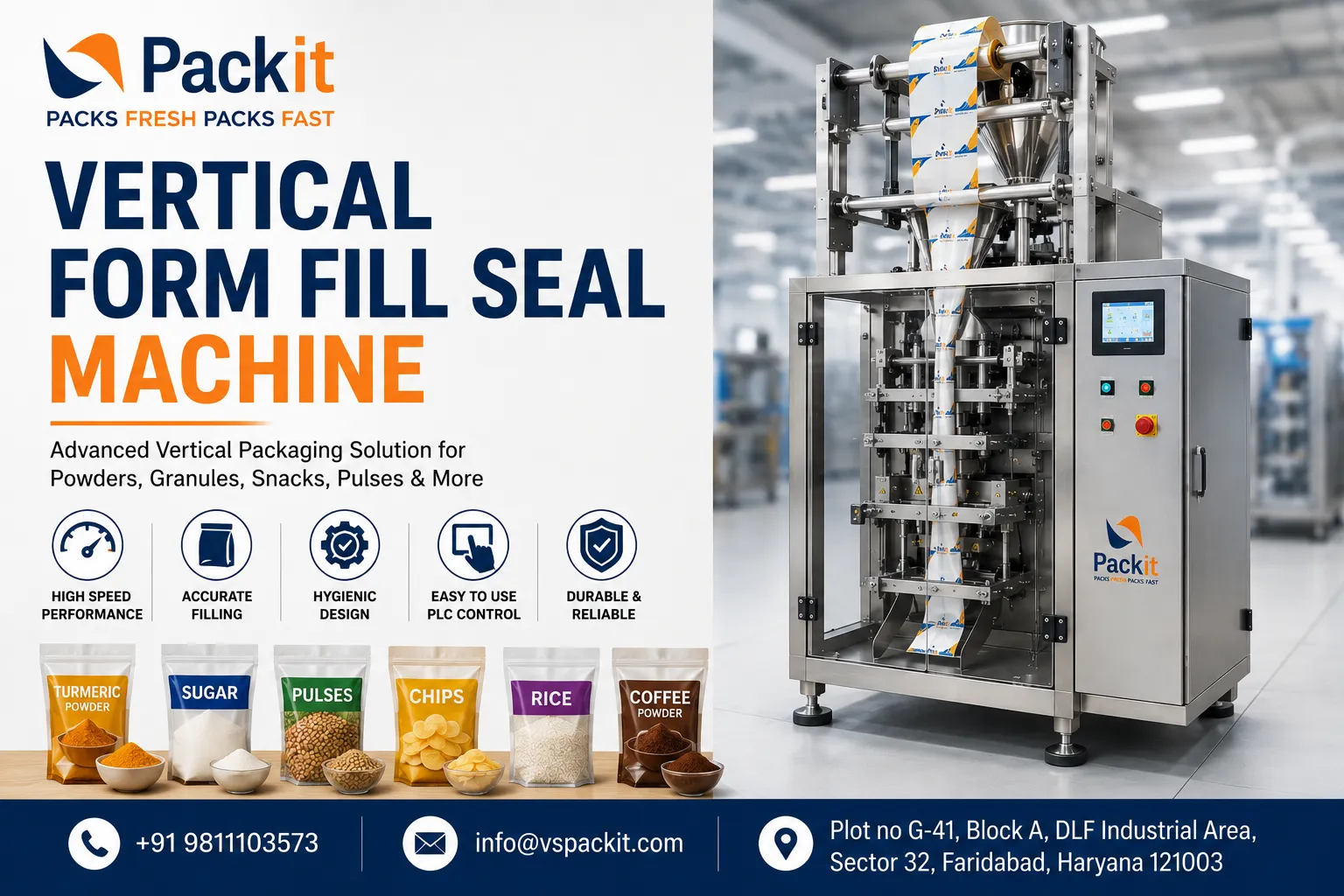
In my experience helping manufacturers choose between different packaging configurations, the vertical form fill seal machine wins out for free flowing products roughly nine times out of ten, simply because gravity does most of the work for you. This page covers how it works, which VS PacKit models fit which production need, and exactly what to check before you commit to a purchase.
Quick Answer
A vertical form fill seal machine, also known as a vertical form fill seal packaging machine, is an automated system that shapes a pouch vertically from a film roll, fills it with a measured product using gravity assisted filling, and seals it shut in a continuous downward motion. It is the standard choice for snacks, spices, powders, and granular products.
Why Vertical Motion Matters for Packaging
The word vertical is not just a design detail, it is the entire reason this machine type works so well for loose and free flowing products. As the film tube moves downward, gravity naturally pulls the product into the pouch cavity, which reduces the mechanical complexity needed compared to horizontal or flat pack configurations.
From working with packaging lines across food processing units, I have noticed that vertical systems also tend to have a smaller equipment footprint for the same output level, since the forming, filling, and sealing all happen along a single vertical axis rather than spreading across a wider horizontal frame.
How a Vertical Form Fill Seal Machine Works
Here is the step by step cycle that runs on nearly every vertical form fill seal machine, regardless of brand or model.
- Film unwinds from the reel and feeds over the forming collar
- The forming collar shapes the flat film into a vertical tube
- Vertical sealing jaws join the tube edges lengthwise
- The horizontal jaw seals the bottom of the pouch
- The filling system releases a measured quantity of product into the open pouch
- The horizontal jaw closes the top, sealing the pouch completely
- The cutter separates the finished pouch and drops it onto the discharge line
This cycle repeats continuously, and depending on whether the machine runs continuous or intermittent motion, the film either keeps moving throughout the cycle or pauses briefly during sealing.
Continuous Motion vs Intermittent Motion
One thing many first time buyers overlook is that vertical form fill seal machines are not all built the same way internally, even if they look similar from the outside.
Continuous motion machines keep the film moving at all times, which allows for higher speeds and suits high volume production lines. Intermittent motion machines pause briefly during each sealing cycle, which often gives more precise control at moderate speeds and works well for manufacturers scaling up from smaller batch operations.
Machines to Consider from VS PacKit
Choosing the right vertical form fill seal machine usually comes down to matching motion type and speed to your actual production volume.
Komet 81
The Komet 81 runs on an intermittent motion system and suits manufacturers who want dependable, controlled output without the added complexity of a continuous high speed line.
Indus 5000
The Indus 5000 also uses intermittent motion but is engineered for manufacturers who need a bit more flexibility across pouch sizes and product types as their production scales up.
GT-5S
The GT-5S is built for continuous motion, high speed production, making it a strong fit for manufacturers running larger volumes who cannot afford sealing inconsistency at higher line speeds.
Komet Sprint
The Komet Sprint delivers steady, dependable output for operations that prioritize simplicity and consistency over maximum throughput, which suits many growing snack and spice manufacturers well.
If your product does not flow well through a vertical system, our horizontal form fill and seal machine page covers the alternative configuration built for flat or pre shaped items instead.
Comparison of Vertical Form Fill Seal Machine Options
| Machine | Motion Type | Best Suited For |
|---|---|---|
| Komet 81 | Intermittent | Mid range production, scaling operations |
| Indus 5000 | Intermittent | Flexible pouch sizes, growing product lines |
| GT-5S | Continuous | High volume, high speed production |
| Komet Sprint | Intermittent | Steady output, simplicity focused operations |
Key Components of a Vertical Form Fill Seal Machine
- Forming collar sized to the specific pouch dimensions
- PLC and HMI control panel for recipe storage and monitoring
- Servo driven vertical and horizontal sealing jaws
- Filling system, typically volumetric cup, auger, or multihead weigher based
- Film unwind and tension control mechanism
- Photo eye sensor for printed film registration
- Cutting and discharge conveyor system
Packaging Materials Used
Film choice affects seal integrity and shelf life just as much as the machine's mechanical precision does. Vertical form fill seal machines commonly run laminated polyester films, metalized BOPP, and multilayer barrier films, selected based on how sensitive the product is to moisture, oxygen, and light exposure.
Benefits of a Vertical Form Fill Seal Machine
- Compact footprint relative to output capacity
- Gravity assisted filling reduces mechanical complexity
- Consistent pouch weight and seal quality across cycles
- Reduced manual product handling improves hygiene
- Flexibility across pouch sizes and film formats
- Lower long term labor dependency
Buying Checklist Before You Purchase
One thing many factory owners overlook is testing the machine on their own product before finalizing the order, since a demo run on a sample product rarely reflects real production conditions.
- Confirm whether continuous or intermittent motion suits your target speed
- Match the filling system to your product's density and flow behavior
- Check pouch size flexibility for future SKU expansion
- Review build quality of sealing jaws and forming collar
- Assess floor space and utility requirements against your facility layout
- Verify after sales support and spare parts availability in your region
- Compare production capacity claims against your actual daily volume
For a deeper walkthrough on scaling your production line with the right equipment, our guide on Scale Faster with the Right Form Fill Seal Packaging Machine covers this in more detail, and you can explore our broader Form Fill Seal Packaging Machine range if your product needs differ from a standard vertical setup.
Common Mistakes to Avoid
- Choosing continuous motion for a low volume operation where it adds unnecessary cost
- Ignoring film compatibility, leading to frequent sealing failures
- Underestimating future pouch size changes during initial machine selection
- Skipping operator training, which increases avoidable downtime
- Not checking spare parts availability before finalizing the purchase
Maintenance Guide
In my experience, most vertical form fill seal machine downtime comes from skipped routine maintenance rather than actual mechanical failure.
- Clean the forming collar and sealing jaws daily to prevent residue buildup
- Check sealing temperature calibration weekly
- Inspect film tracking sensors for dust accumulation regularly
- Lubricate servo drive components per the maintenance schedule
- Replace worn gaskets and seals before they cause leakage issues
Safety and Industrial Standards
A vertical form fill seal machine used for food products should meet FSSAI hygiene requirements for contact surfaces and follow BIS guidelines for electrical safety. Manufacturers whose build quality aligns with ISO based frameworks, and who reference benchmarks published by organizations like PMMI, tend to produce machines that hold up better under continuous industrial use.
Automation and Efficiency
Modern vertical form fill seal machines increasingly rely on servo motors across filling, sealing, and film pulling functions, offering far finer control than older pneumatic setups. Touchscreen HMI panels with saved recipes reduce changeover time significantly, especially for manufacturers running multiple pouch sizes or product types on the same line. For high output snack and namkeen production specifically, our High Speed VFFS for Namkeen Packing page covers a configuration built around that exact need.
Return on Investment
When I visited manufacturing facilities that upgraded from manual filling to a fully automated vertical form fill seal machine, the payback period was usually driven more by reduced material waste and fewer rejected pouches than by direct labor savings alone.
Future Trends
Expect growing adoption of recyclable mono material films, tighter integration with digital quality tracking systems, and continued demand growth as India's food processing and FMCG sectors expand their export focused production capacity.
Why Manufacturers Choose VS PacKit
VS PacKit has spent over two decades focused on VFFS and pouch packaging machinery engineered around real factory conditions rather than brochure specifications. The Komet 81, Indus 5000, GT-5S, and Komet Sprint each reflect this focus, offering servo driven precision, PLC based automation, and manufacturing expertise suited to a wide range of production scales.
Customization support across filling systems and pouch formats, backed by dependable after sales assistance, is another reason manufacturers rely on VS PacKit as their production needs evolve.
Industry Applications
Vertical form fill seal machines from VS PacKit support snacks, spices, powders, granules, cereals, dry fruits, namkeen, and a wide range of other free flowing FMCG and food products, making them suitable for both regional manufacturers and larger export focused production lines.
Conclusion
A vertical form fill seal machine remains the most practical choice for any business packaging free flowing products like snacks, spices, powders, or granules, largely because gravity does much of the filling work for you. Whether you need the steady reliability of the Komet 81 and Indus 5000, the high speed output of the GT-5S, or the simplicity of the Komet Sprint, matching the machine to your product and production volume is what actually determines long term success. Reach out to VS PacKit to discuss which vertical form fill seal machine fits your packaging line.