

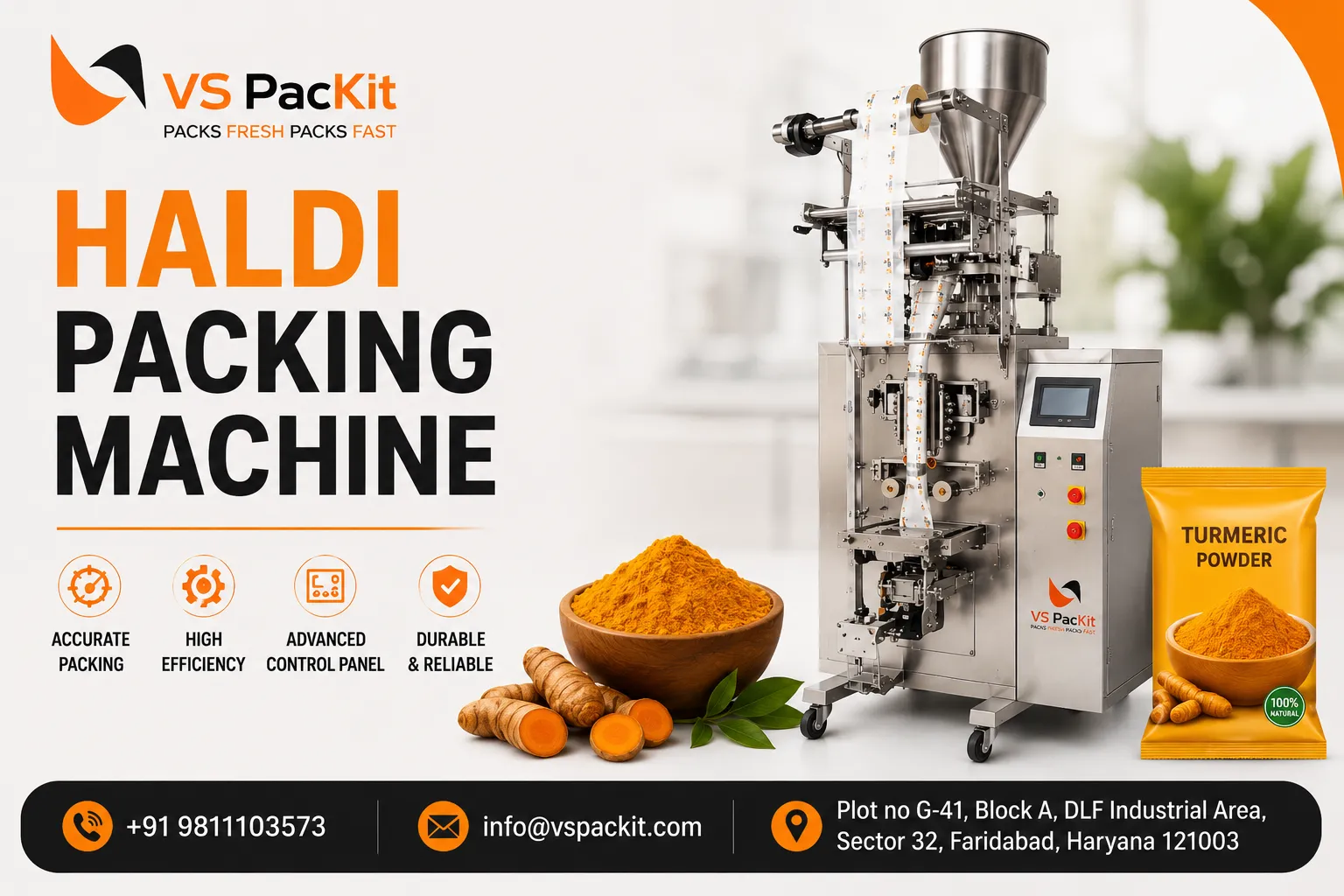
In my experience working with spice manufacturers across North India, haldi packing causes more filling accuracy complaints than almost any other powder, mainly because of its fine, slightly sticky texture and tendency to compact inside hoppers. A machine that handles red chilli or coriander beautifully can struggle with haldi if the filling system was not designed with that texture in mind.
This guide covers everything you need before buying: how a turmeric powder packing machine actually works, what drives haldi packing machine price, the difference between basic and fully automatic configurations, and the mistakes that lead to inconsistent haldi packing pouch weights down the line.
What Is a Haldi Packing Machine?
A haldi packing machine is an automated packaging system that measures, fills, and seals turmeric powder into pouches using a continuous form-fill-seal process, designed to handle haldi's fine, compact-prone texture accurately.
Most machines used for haldi packing in India are VFFS (Vertical Form Fill Seal) based, the same core technology used across the broader spice packing category. The machine forms film into a tube, fills a measured dose of haldi powder, and seals the pouch, all within a single continuous cycle. What changes between a generic spices machine and a dedicated turmeric powder packing machine is usually the filling head design, since haldi flows differently from coarser blends.
When I visited a turmeric processing facility near Sangli a few years ago, the production head pointed out something useful: haldi tends to clump slightly in humid weather, and a filling system without proper agitation can throw off your fill weight by the afternoon shift even if morning batches were perfect. That single detail tells you a lot about what to check before buying.
Featured Machine Types for Haldi Packing
Turmeric Powder Packing Machine (Haldi-Specific Configuration)
A turmeric powder packing machine is essentially a VFFS unit with a filling system tuned for haldi's particle size and slight compaction tendency. This usually means an auger filler with anti-bridging agitation built in, rather than a basic volumetric cup that can underfill once the hopper level drops.
Haldi Pouch Packing Machine (Sachet and Retail Pack Focus)
If you are packing smaller haldi packing pouch sizes for retail, 50g to 500g sachets common on grocery shelves, a haldi pouch packing machine built for that range runs faster and more consistently than a general-purpose line trying to do everything. This configuration is popular with manufacturers supplying kirana stores and regional retail chains.
Automatic Masala Packing Machine (Multi-Product Line)
Many manufacturers do not pack haldi alone. If your facility also runs other masala packing, an automatic masala packing machine that can switch between haldi powder packing machine settings and other spice profiles with minimal changeover time is worth considering over a single-purpose unit. This is also where masala pouch packing machine configurations overlap directly with haldi production lines, since the underlying mechanics are nearly identical.
One thing many factory owners overlook is buying a machine built purely for haldi when their actual production mix includes three or four spice types. A flexible automatic masala packing machine often makes more sense than a haldi-only unit, unless haldi is genuinely your sole product.
How a Haldi Packing Machine Works: Step-by-Step
A haldi packing machine forms a pouch from film, fills it with measured turmeric powder, and seals it in one continuous cycle.
- Film unwinding – Packaging film feeds from the roll through the forming collar
- Tube formation – The film wraps into a vertical tube shape
- Vertical sealing – The longitudinal seal closes the tube into a continuous sleeve
- Filling – Haldi powder is dosed through an auger or volumetric filling head, with agitation to prevent clumping
- Horizontal sealing and cutting – The bottom of the new pouch seals while the top of the previous one seals at the same time, then the pouch separates
- Discharge – The completed haldi packing pouch drops onto a conveyor or collection tray
This cycle runs continuously, and machine speed is rated in pouches per minute, same as the broader masala packing machine category.
What Affects Haldi Packing Machine Price
1. Filling System Suited to Haldi's Texture
This is the single biggest factor in haldi packing machine price. A basic volumetric filler costs less but struggles with consistency as haldi compacts in the hopper. An auger filler with anti-bridging features costs more upfront but holds accuracy far better across a full shift.
2. Automation Level
A semi-automatic haldi pouch packing machine needs an operator for film loading and certain triggers, keeping initial cost lower. A fully automatic haldi packing machine runs the entire cycle through PLC control, which raises price but significantly reduces labour dependency and improves consistency.
3. Production Speed and Pouch Range
Machines rated for higher pouches-per-minute output, and those built to handle a wider haldi packing pouch size range from small sachets to 1kg bags, cost more due to the added mechanical precision and adjustability required.
4. Build Quality and Components
Food-grade stainless steel construction, branded PLC and HMI panels, and servo-driven sealing systems extend machine life considerably. From working with packaging lines for years, I have noticed that machines with lower-grade filling components often pack haldi fine in a demo but lose accuracy within weeks of continuous use, since fine powder is harder on internal components than coarser spice blends.
5. Manufacturer Support and Location
Haldi powder packing machine price comparisons often miss this factor entirely. A manufacturer based closer to your facility means faster service response and easier access to spare parts, especially filling head components that see more wear from continuous fine-powder contact.
If you are also comparing options for other spices, the broader masala packing machine price range follows similar logic, since filling system and automation level remain the primary cost drivers across the category.
Haldi Packing Machine: Semi-Automatic vs Fully Automatic
| Factor | Semi-Automatic | Fully Automatic |
|---|---|---|
| Operator involvement | Required for loading and triggering | Minimal, mostly supervisory |
| Fill consistency for haldi | Depends on operator attentiveness | Consistent through PLC control |
| Speed | Lower | Higher |
| Best suited for | Small batch haldi packing | Continuous, high-volume haldi packing |
| Long-term labour cost | Higher | Lower |
| Typical buyer | Smaller turmeric units, limited budget | Scaling manufacturers, retail supply contracts |
If your haldi packing volume is modest and predictable, a semi-automatic haldi pouch packing machine may suit you well. If you are supplying retail chains consistently, a fully automatic configuration pays back through reduced labour and tighter weight control on every haldi packing pouch.
Key Specifications to Check Before Buying
- Filling accuracy tolerance, ideally within plus or minus 1 to 2 percent, which matters more for haldi than for coarser spices
- Anti-bridging or agitation mechanism in the filling hopper
- Pouch dimension range for your specific haldi packing pouch sizes
- Film compatibility, since haldi's fine particles can affect seal integrity if film thickness is mismatched
- Sealing temperature consistency across the full production run
- Changeover time if the same line also runs other masala packing
- Power consumption and floor space requirements
Which Industries Use Haldi Packing Machines
- Turmeric processing units packing raw haldi powder for retail and bulk supply
- Masala and spice manufacturers including haldi within a broader product range
- FMCG companies producing instant masala mixes containing turmeric
- Ayurvedic and wellness product manufacturers using turmeric powder
- Contract packaging units handling haldi powder packing machine runs for multiple client brands
What Materials and Pack Formats Can Be Handled
A well-configured turmeric powder packing machine typically handles:
- Pure ground haldi powder in fine particle form
- Haldi blended with small quantities of other spices
- Multiple haldi packing pouch formats, from small sachets to family-size packs
- Both standard polyethylene laminate film and other food-grade laminate options, depending on shelf-life requirements
Common Mistakes Buyers Make
- Assuming any spice machine handles haldi the same way – Haldi's compaction tendency means filling systems built for coarser powders often underperform
- Choosing the lowest haldi packing machine price without checking the filling head design – A cheaper unit often skips the agitation mechanism haldi needs for consistent dosing
- Ignoring after-sales support – Filling components wear faster with fine powders like haldi, so service access matters more here than with other spice categories
- Not testing with your actual haldi batch – Moisture content and grind fineness vary between suppliers, so a demo run with generic powder can be misleading
- Overlooking future product expansion – If you may add other masala packing later, a flexible automatic masala packing machine is often a smarter long-term choice
Expert Tips Before You Buy
- Always request a live trial using your own haldi powder, not a generic demo sample, since moisture and fineness vary by batch and supplier
- Ask specifically about anti-bridging or agitation features in the filling hopper
- Compare haldi packing machine price across at least two or three manufacturers, but weigh build quality and support equally with the number
- If you plan to expand into broader masala packing, ask whether the machine can be reconfigured rather than replaced
- Confirm spare parts lead time for filling components, since these wear faster on fine powders
Maintenance Guide
- Clean the filling hopper and auger daily, since haldi residue compacts faster than coarser spice powders
- Check agitation mechanisms weekly to confirm they are preventing clumping effectively
- Inspect sealing jaws regularly, since fine powder dust can interfere with seal quality if not cleaned properly
- Calibrate the filling system periodically against actual fill weights, not just machine settings
- Keep PLC panels protected from airborne haldi dust, which is finer and more pervasive than many other spice powders
One thing I have noticed across multiple haldi processing visits is that units cleaned and calibrated on a fixed schedule maintain far more consistent pouch weights than ones serviced only when something visibly goes wrong.
Safety Considerations
- Dust extraction near the filling area, since haldi powder is notably fine and can affect respiratory comfort and visibility around the machine
- Emergency stop access at all operator stations
- Regular electrical safety checks on PLC panels and servo components
- Proper operator training for film changes and clearing any filling head blockages safely
Following safety practices aligned with general industrial machinery standards, similar to BIS guidelines, protects your workforce and keeps the line running without unplanned stoppages.
Industry Standards and Compliance
Any haldi packing machine handling food-grade turmeric should support compliance with FSSAI norms, particularly around food-contact film safety and hygienic machine construction. Manufacturers following ISO-aligned production practices, and referencing frameworks similar to those promoted by PMMI for packaging machinery, tend to deliver more reliable build quality. Always confirm the food-contact components on any haldi powder packing machine meet relevant food safety requirements before finalising your order.
Latest Technology in Haldi Packing Machines
- Servo-driven sealing systems for consistent seal strength across long production runs
- PLC-based recipe storage allowing quick switching between haldi and other masala packing profiles
- Anti-bridging hopper agitation designed specifically for fine, compaction-prone powders like haldi
- Touchscreen HMI controls that simplify training and reduce operator error
- Nitrogen flushing options to extend shelf life where moisture sensitivity is a concern
ROI: Is a Fully Automatic Haldi Packing Machine Worth It?
Return on investment for a haldi packing machine typically comes from reduced labour dependency, fewer rejected pouches due to inconsistent fill weight, and higher sustained output. From working with packaging lines that upgraded from manual or semi-automatic haldi packing to fully automatic systems, the most consistent feedback is that accuracy improvements alone, especially on a powder as sensitive to compaction as haldi, recover the price difference faster than buyers initially expect.
Future Trends in Haldi and Turmeric Powder Packing
Expect continued movement toward IoT-enabled monitoring for predictive maintenance on filling components, modular machines that shift easily between haldi powder packing machine settings and broader masala packing configurations, and growing demand for recyclable film options as FMCG and wellness brands respond to sustainability expectations. Buyers investing in a turmeric powder packing machine today should ask whether the unit is upgrade-ready for these features rather than fixed to a single configuration.
How to Select the Right Haldi Packing Machine
- Confirm your daily haldi production volume and expected growth over the next two to three years
- Decide your primary haldi packing pouch size range, sachets, retail packs, or bulk bags
- Choose between a semi-automatic haldi pouch packing machine and a fully automatic configuration based on volume and labour availability
- Shortlist manufacturers with proven experience specifically in fine powder and haldi packing, not just generic spice machines
- Request a live trial using your own haldi batch before finalising
- Confirm after-sales support, spare parts lead time, and service response for your location
Why Manufacturers Choose VS PacKit
VS PacKit has spent over two decades engineering VFFS and pouch packaging machinery for food, spice, and FMCG manufacturers across India, with filling system expertise that extends directly into haldi and other fine-powder applications. What sets the approach apart is that servo-driven sealing and PLC automation come standard rather than as an upsell, so accuracy on a tricky powder like haldi is built into the base machine rather than added later at extra cost.
For manufacturers specifically focused on turmeric, VS PacKit configures its turmeric powder packing machine and broader automatic masala packing machine range around auger fillers with anti-bridging agitation, addressing exactly the compaction issue that causes inconsistent haldi packing pouch weights on lower-quality machines. With two design patents granted and manufacturing experience spanning food, FMCG, and pharmaceutical packaging, VS PacKit brings genuine engineering depth to a category where many suppliers simply rebrand generic machines without adjusting for haldi's specific handling needs.
Reliable after-sales support also matters more here than buyers initially realise, since filling components on any haldi powder packing machine see more wear from continuous fine-powder contact than they would packing coarser products.
Final Thoughts and Next Steps
A haldi packing machine needs to do more than just form, fill, and seal pouches. It needs a filling system that actually understands haldi's texture, otherwise you end up fighting inconsistent fill weights every time humidity shifts or a new batch of powder behaves slightly differently than the last. Whether you are evaluating a dedicated turmeric powder packing machine, a haldi pouch packing machine for retail sachets, or a flexible automatic masala packing machine that handles haldi alongside other products, understanding what drives haldi packing machine price puts you in a far stronger position to buy the right unit the first time.
Ready to get a haldi packing machine engineered around your actual production needs? Contact VS PacKit for a consultation, or explore the full range of packaging machines to find the right configuration for your line.