

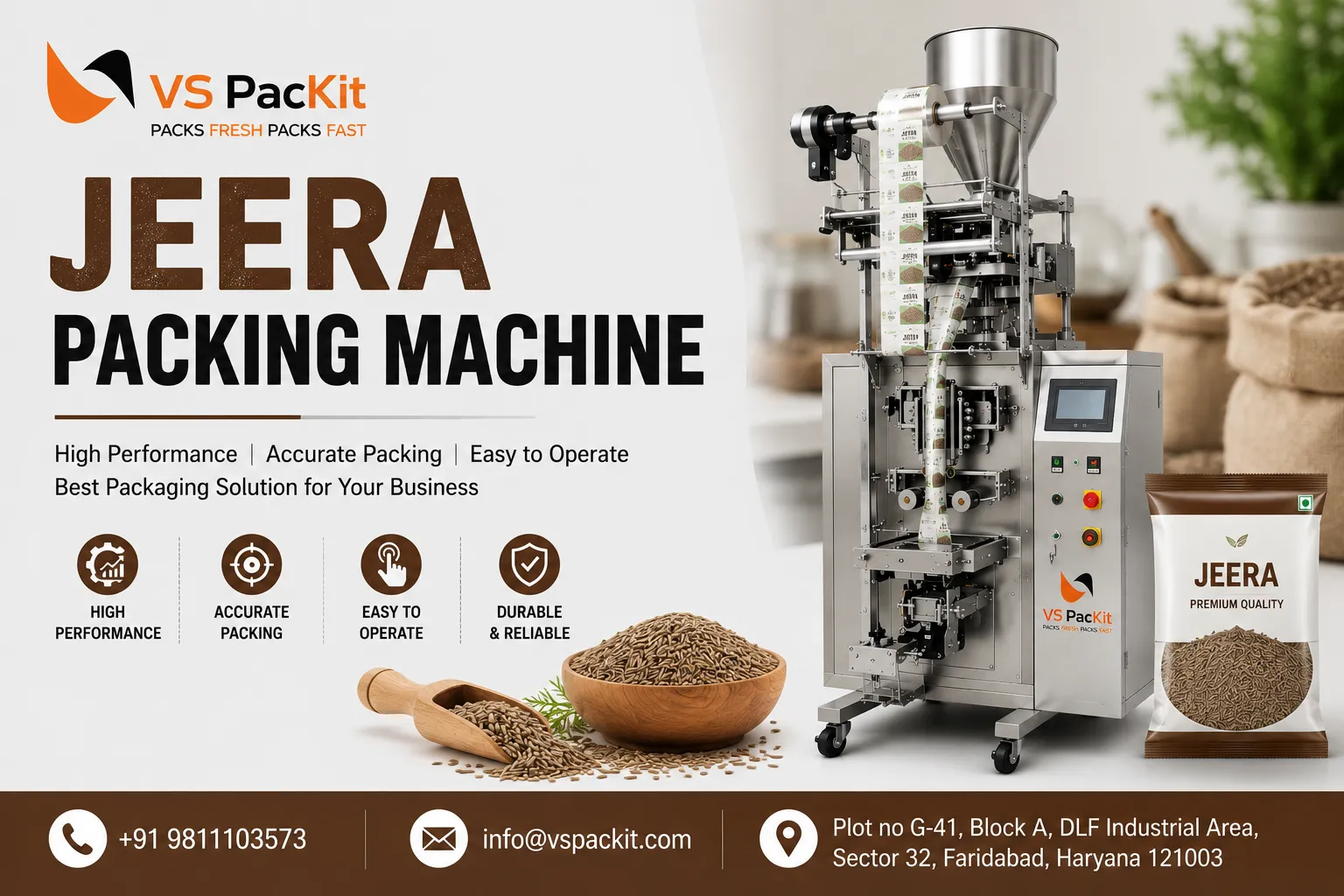
In my experience working with spice manufacturers across Delhi NCR, jeera packing causes a different kind of headache than powdered spices. Buyers often start by asking about the same auger-based machines used for turmeric or red chilli powder, only to find fill weights drifting because jeera seeds do not flow or settle the same way fine powder does. The seed's natural oil content also makes it cling slightly to metal surfaces inside a hopper, which a powder-tuned filling head was never designed to handle.
This guide walks through how a jeera packing machine actually works, what affects jeera packing machine price, why filling system choice matters more here than for most other spices, and what to check before choosing a manufacturer for your jeera packing line.
What Is a Jeera Packing Machine?
A jeera packing machine is an automated VFFS-based system that measures, fills, and seals whole cumin seeds into pouches using a continuous form-fill-seal process, built around a filling system suited to seed flow rather than powder flow.
Like most spice packaging equipment in India, a jeera packing machine is based on Vertical Form Fill Seal technology. Film unwinds from a roll, forms into a tube, gets filled with a measured quantity of jeera, and seals into a finished pouch in one continuous motion. What sets jeera apart from a typical masala packing machine built for ground spices is the filling head itself, since augers designed for fine powder often struggle with whole seeds that vary slightly in size and shape from batch to batch.
When I visited a spice trading and packing unit near Una a couple of years back, the operations manager told me something that stuck with me: jeera that has sat in storage through a humid monsoon season behaves differently on the line than fresh stock, since the seeds pick up a bit of moisture and cling together more than dry seeds do. That single observation explains why a machine that performed perfectly during a demo can suddenly need recalibration once seasonal stock changes.
How Jeera's Seed Structure Affects Machine Choice
This is the part most generic spice machine pages skip entirely, and it matters a lot for jeera specifically.
Why Volumetric and Vibratory Systems Often Outperform Augers for Jeera
Auger fillers excel with fine, free-flowing powders because the screw mechanism doses consistent volume per rotation. Jeera seeds are irregular, slightly oily, and prone to bridging in narrow auger channels, which can lead to inconsistent dosing. Many manufacturers prefer volumetric cup fillers or vibratory feed systems for jeera, since these handle irregular seed shapes and natural oil content more reliably without the seed-on-seed friction issues an auger can create.
Static Cling and Surface Oil Considerations
Jeera's natural oil content, the same oil responsible for its strong aroma, means seeds can stick lightly to stainless steel surfaces inside the hopper and filling head. A machine designed without this in mind sees seeds clumping at corners or feeding inconsistently, which shows up as variable pouch weight over a production run rather than a sudden, obvious failure.
One thing many factory owners overlook is assuming any masala packing machine handles jeera the same way it handles ground turmeric or chilli powder. The mechanics of a whole seed moving through a hopper are genuinely different from powder, and that difference should guide your filling system choice before anything else.
How a Jeera Packing Machine Works: Step-by-Step
A jeera packing machine forms a pouch, fills it with measured cumin seeds, and seals it in one continuous cycle.
- Film unwinding – Packaging film feeds from the roll through the forming collar
- Tube formation – The film shapes into a vertical tube
- Vertical sealing – The longitudinal seal closes the tube into a continuous sleeve
- Filling – Jeera doses through a volumetric cup, vibratory feeder, or specially adapted auger, depending on the machine configuration
- Horizontal sealing and cutting – The bottom of the new pouch seals while the top of the previous pouch seals simultaneously, then the pouch cuts free
- Discharge – The completed pouch drops onto a conveyor or collection point
This cycle runs continuously, with speed rated in pouches per minute, the same standard used across the broader masala packing machine category.
What Affects Jeera Packing Machine Price
1. Filling System Suited to Whole Seeds
This is the biggest factor in jeera packing machine price. A basic volumetric cup system costs less but can underperform on consistency if seed size varies between batches. A vibratory feed system, or an auger specifically adapted for seed flow rather than powder, costs more but holds accuracy better across varying jeera quality.
2. Automation Level
A semi-automatic jeera packing line needs operator involvement for film loading and certain triggers, which keeps initial cost lower for smaller operations. A fully automatic configuration runs the cycle through PLC control, raising price but reducing labour dependency and improving weight consistency.
3. Production Speed and Pouch Range
Machines rated for higher pouches-per-minute output, and those built to handle a wider pouch size range from small retail packs to bulk export bags, cost more due to the added mechanical precision needed.
4. Build Quality and Components
Food-grade stainless steel construction, branded PLC and HMI panels, and servo-driven sealing all extend machine life. From working with packaging lines for years, I have noticed that machines with lower-grade filling components sometimes look fine in a short demo using fresh, dry seeds but struggle once they encounter slightly oilier or more humid batches in real production.
5. Manufacturer Support and Location
Jeera packing machine price comparisons often miss this entirely. A manufacturer based closer to your facility means faster service response and easier access to spare parts, particularly filling head components that need adjustment as seed batches vary seasonally.
For context, this same logic carries across the wider category. A masala packing machine price comparison follows nearly identical drivers, since filling system suitability and automation level remain the dominant cost factors regardless of which spice you are running.
Jeera Packing Machine: Semi-Automatic vs Fully Automatic
| Factor | Semi-Automatic | Fully Automatic |
|---|---|---|
| Operator involvement | Required for loading and triggering | Minimal, mostly supervisory |
| Fill consistency across seed batches | Depends on operator attentiveness | More consistent through PLC control |
| Speed | Lower | Higher |
| Best suited for | Smaller jeera packing volumes | Continuous, high-volume jeera packing |
| Long-term labour cost | Higher | Lower |
| Seasonal seed variation handling | Manual adjustment needed | Easier recalibration via PLC settings |
If your jeera packing volume is modest, a semi-automatic line can work well. If you are running daily production or supplying retail and export clients consistently, a fully automatic masala pouch packing machine pays back through reduced labour and tighter weight control even as seed quality varies across the season.
Key Specifications to Check Before Buying
- Filling system suited to whole seeds, not just a generic powder-rated auger
- Filling accuracy tolerance, ideally within plus or minus 1 to 2 percent
- Hopper design that minimises seed clinging from natural oil content
- Pouch dimension range for your jeera packing pouch formats
- Film compatibility, since jeera's aromatic oils can interact with certain film types over time
- Changeover time if the line also handles other masala packing
- Power consumption and floor space requirements
Which Industries Use Jeera Packing Machines
- Spice traders and processors packing whole jeera for retail and bulk supply
- Masala manufacturers including jeera within a broader spice product range
- FMCG companies producing spice blends and seasoning mixes containing cumin
- Export-focused packaging units supplying jeera to international buyers
- Contract packaging units running jeera alongside other whole spice products
What Materials and Pack Formats Can Be Handled
A properly configured jeera packing machine typically handles:
- Whole cumin seeds in varying batch quality and moisture levels
- Jeera blended with small quantities of other whole spices
- Multiple pouch formats, from small retail sachets to bulk export bags
- Standard laminate films, though film choice should account for jeera's natural oil content over longer shelf periods
Common Mistakes Buyers Make
- Assuming a powder-rated machine works fine for jeera – Auger systems built for fine powder often struggle with whole seed flow and bridging
- Choosing the lowest jeera packing machine price without checking the filling head design – A cheaper unit may skip the hopper design needed to handle seed clinging
- Not accounting for seasonal seed variation – Jeera batches behave differently depending on moisture content and storage conditions
- Skipping a trial run with your actual jeera stock – A demo using ideal, dry seeds can be misleading compared to your real production batches
- Ignoring after-sales support – Filling components may need periodic adjustment as seed quality shifts, so service access matters
Expert Tips Before You Buy
- Always request a live trial using your own jeera stock, not a generic demo sample, since seed quality and moisture vary by season and supplier
- Ask specifically whether the filling system is designed for whole seeds or adapted from a powder-focused auger
- Compare jeera packing machine price across a few manufacturers, but weigh filling system suitability and support equally with the number
- If your facility runs multiple whole spices, ask whether the same masala packing machine can be reconfigured rather than needing a separate unit for each product
- Confirm spare parts lead time for filling head components, especially if you expect seasonal seed variation
Maintenance Guide
- Clean the filling hopper and filling head regularly, since jeera's natural oils can build up residue over time
- Inspect for seed clinging or bridging in the hopper, particularly after switching to a new batch
- Check sealing jaws regularly, since fine dust from jeera handling can interfere with seal quality if not cleaned properly
- Calibrate the filling system periodically against actual measured fill weights, especially when seed batches change
- Keep PLC panels protected from dust generated during jeera handling
One thing I have noticed across multiple spice processing visits is that units checked and recalibrated whenever a new jeera batch comes in maintain far more consistent pouch weights than ones left on fixed settings indefinitely.
Safety Considerations
- Dust extraction near the filling area, since jeera handling generates fine particulate even with whole seeds
- Emergency stop access at all operator stations
- Regular electrical safety checks on PLC panels and servo components
- Proper operator training for film changes and safely clearing any seed bridging in the filling head
Following safety practices aligned with general industrial machinery standards, similar to BIS guidelines, protects your workforce and keeps the line running without unplanned stoppages.
Industry Standards and Compliance
A jeera packing machine handling food-grade product should support compliance with FSSAI norms, particularly around food-contact film safety and hygienic machine construction. Manufacturers following ISO-aligned production practices, and referencing frameworks similar to those promoted by PMMI for packaging machinery, tend to deliver more reliable build quality. For export-bound jeera, confirm packaging materials and hygiene standards meet the destination market's import requirements alongside domestic FSSAI norms.
Latest Technology in Jeera Packing Machines
- Vibratory and adapted filling systems designed specifically for whole seed flow rather than powder
- PLC-based recipe storage allowing quick recalibration as jeera batch quality varies
- Servo-driven sealing systems for consistent seal strength across long production runs
- Touchscreen HMI controls that simplify training and reduce operator error
- Modular hopper designs that reduce seed clinging from natural oil content
ROI: Is a Fully Automatic Jeera Packing Machine Worth It?
Return on investment for a jeera packing machine usually comes from reduced labour dependency, fewer rejected pouches from inconsistent seed-fill weight, and more stable output even as seasonal seed quality shifts. From working with packaging lines that moved from manual or semi-automatic jeera packing to fully automatic systems, the most consistent feedback is that the accuracy improvement alone, especially across varying seed batches, recovers the price difference faster than buyers initially expect.
Future Trends in Jeera and Whole Spice Packing
Expect continued movement toward IoT-enabled monitoring for predictive maintenance on filling components, more adaptable filling systems that switch between whole seed and powder spice profiles on the same masala packing machine, and growing demand for recyclable film options as export buyers tighten sustainability expectations. Manufacturers investing in a jeera packing machine today should confirm the unit is upgrade-ready for these features rather than fixed to one filling configuration.
How to Select the Right Jeera Packing Machine
- Confirm your daily jeera production volume and expected growth over the next two to three years
- Decide your primary pouch format, retail sachets, family packs, or bulk export bags
- Choose between a semi-automatic line and a fully automatic masala pouch packing machine based on volume and labour availability
- Shortlist manufacturers with proven experience specifically in whole seed and jeera packing, not just generic powder spice machines
- Request a live trial using your own jeera stock before finalising
- Confirm after-sales support, spare parts lead time, and service response for your location
Why Manufacturers Choose VS PacKit
VS PacKit has spent over two decades engineering VFFS and pouch packaging machinery for food, spice, and FMCG manufacturers across India, with filling system expertise that extends to whole seed products like jeera, not just ground powders. Servo-driven sealing and PLC automation come standard on every masala packing machine rather than as an upsell, which means the filling consistency jeera needs across varying seed batches is built into the base design rather than added later at extra cost.
For manufacturers specifically packing jeera, VS PacKit configures its filling systems around the seed's flow characteristics rather than assuming a generic powder-rated auger will work, addressing the exact bridging and clinging issues that cause inconsistent fill weights on lower-quality machines. With two design patents granted and manufacturing experience spanning food, FMCG, and pharmaceutical packaging, VS PacKit brings genuine engineering depth to a category where many suppliers simply repurpose powder-focused machines without adjusting for whole seed handling.
After-sales support also matters more here than buyers initially realise, since jeera packing machine price comparisons rarely account for the recalibration support needed as seed batches shift seasonally.
Final Thoughts and Next Steps
A jeera packing machine needs to solve a problem that powdered spice machines never face: handling an irregular, slightly oily whole seed that flows and settles completely differently from fine powder. Whether you are weighing jeera packing machine price against a basic volumetric setup or a fully automatic masala pouch packing machine built for daily high-volume runs, the filling system's suitability for whole seeds matters more here than almost any other factor.
Ready to get a jeera packing machine engineered around your actual seed quality and production needs? Contact VS PacKit for a consultation, or explore the full range of packaging machines to find the right configuration for your line.