

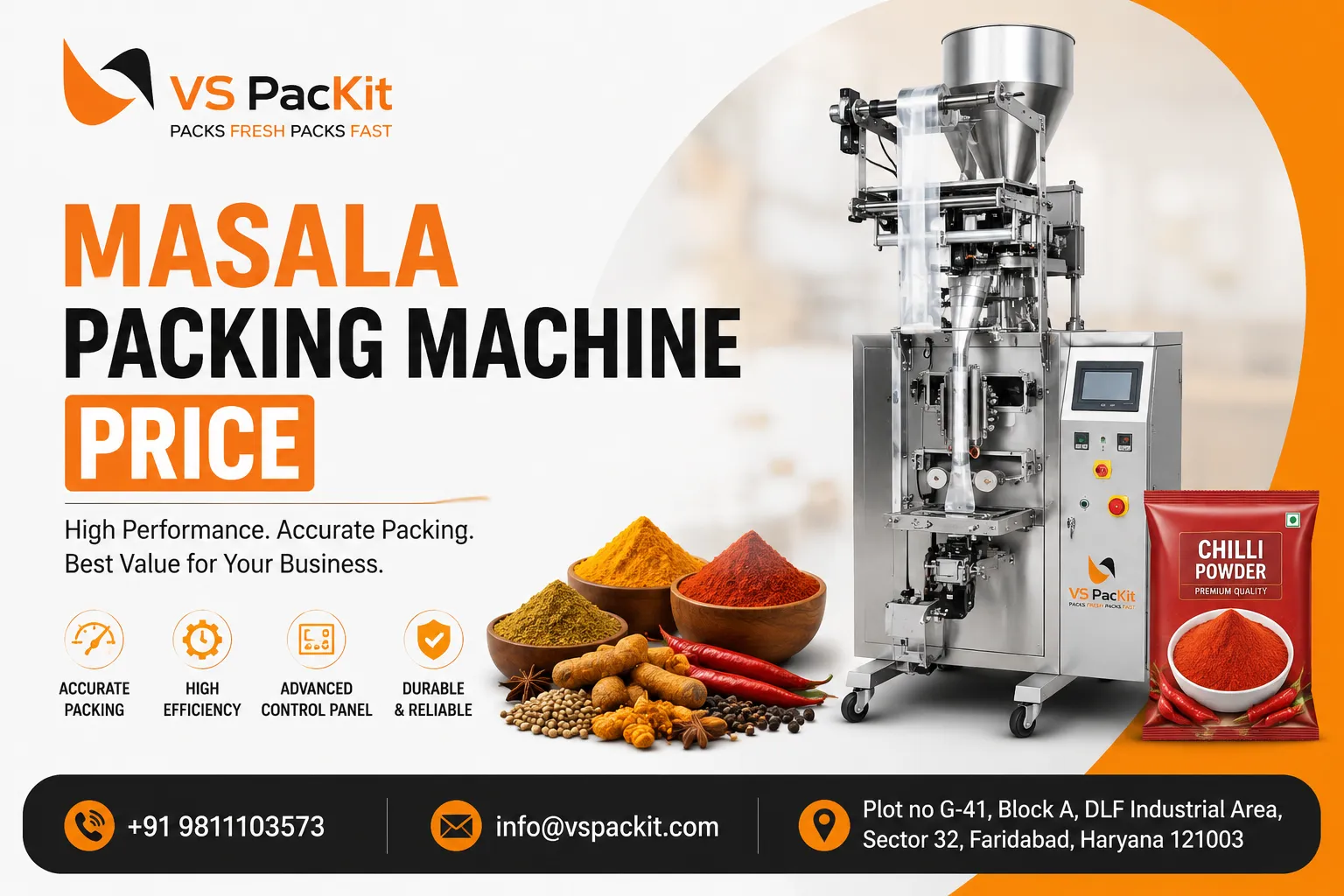
Here is the honest truth: there is no single fixed price you can put in a spreadsheet and walk away with. A small masala packing machine price for a basic sachet line looks nothing like a fully automatic masala packing machine price for a high-speed, multi-SKU setup. And if you are simply hunting for a masala packing machine low price option because budget is tight right now, you need to know exactly what you are giving up in accuracy and speed before you commit.
This guide walks you through everything that affects pricing, what to look for in a spices packing machine, why working with a masala packing machine manufacturer in Faridabad gives you a service advantage most outstation suppliers cannot match, and how to avoid the mistakes that cost manufacturers far more than the machine itself.
What Is a Masala Packing Machine?
A masala packing machine is an automated system that measures, fills, and seals spice powders or blends into pouches using a continuous form-fill-seal process, eliminating manual weighing and packing.
Most machines sold in India under this category, including the spices packing machine range built by VS PacKit, are based on VFFS (Vertical Form Fill Seal) technology. The machine pulls film from a roll, forms it into a tube, fills a measured quantity of masala into that tube, and seals it into a finished pouch, all in one continuous cycle.
When I visited a masala manufacturing unit in Faridabad last year, the owner told me something I now repeat to almost every client: "The machine is only as good as the filling system inside it." That is exactly where price differences, and performance differences, actually come from.
Featured Machine Types for Masala Packing
Before getting into pricing factors, it helps to know what you are actually choosing between.
Spices Packing Machine (General Purpose VFFS)
This is the standard configuration most masala manufacturers start with. A spices packing machine handles fine to medium powders like turmeric, red chilli, coriander, and garam masala blends, using an auger or volumetric filling system. The same base machine can usually be adjusted for multiple spice types with minor filling head changes.
Masala Packet Packing Machine (Sachet-Focused)
If your business runs on smaller sachets, 5g to 50g packs sold through kirana stores or retail counters, a masala packet packing machine built specifically for small pouch ranges is a better fit than a general-purpose line. If you are comparing a small masala packing machine price against a larger industrial line, this is usually the category you actually want, since it is tuned for higher cycle speed on smaller pouch sizes rather than raw throughput volume.
Fully Automatic Multihead Weigher Line
For masala blends with mixed particle sizes, whole spices, seeds, or leaves mixed into a powder, a multihead weigher paired with the form-fill-seal unit gives far better accuracy than a basic auger system. This is where the fully automatic masala packing machine price climbs highest, but it also pays back fastest through reduced product giveaway on inconsistent blends.
One thing many factory owners overlook is assuming all three of these do the same job. They do not. Matching the machine type to your actual product range is the first real pricing decision you make, before automation level or speed even enter the conversation.
What Affects Masala Packing Machine Price
1. Filling System Type
The filling mechanism is the single biggest cost driver across any spices packing machine.
- Auger fillers suit fine to medium powders and are common in mid-range machines
- Multihead weighers handle blends with mixed particle sizes more accurately but add to overall cost
- Volumetric cup fillers are simpler and more economical for consistent, free-flowing powders, often the choice for buyers chasing a masala packing machine low price without sacrificing too much accuracy
2. Automation Level
A semi-automatic masala packet packing machine still needs an operator to load film or trigger certain functions, which keeps the small masala packing machine price lower for buyers starting out. A fully automatic masala packing machine runs the entire cycle through PLC control with minimal manual input, which is where the fully automatic masala packing machine price rises noticeably above semi-automatic options.
3. Production Speed and Pouch Capacity
Machines are rated by pouches per minute. A unit built for 30 to 40 pouches per minute costs less than one engineered for 80 to 100 pouches per minute, since higher speed needs more precise servo motors and tighter mechanical tolerances.
4. Pouch Size and Type
A masala packet packing machine built only for small sachets is priced differently from one that also needs to handle larger 500g to 1kg bags. Multiple SKUs mean you need adjustable pouch length and width settings, which adds engineering complexity.
5. Build Material and Components
Food-grade stainless steel construction, branded PLC and HMI panels, and servo-driven sealing all add to cost but extend machine life. From working with packaging lines for years, I can tell you machines built with lower-grade components often look identical on paper but fail two to three times more often within the first year. This is exactly the trap buyers fall into when chasing the lowest masala packing machine low price quote without checking what is inside the panel.
6. Manufacturer Location and Support Structure
This is the factor most buyers underrate. Working with a masala packing machine manufacturer in Faridabad, rather than a distant supplier, means faster service visits, easier spare parts access, and shorter downtime when something needs attention. For a daily production line, that proximity has real financial value even though it never shows up as a separate line item on the price quote.
Fully Automatic vs Semi-Automatic Masala Packing Machine
| Factor | Semi-Automatic (Lower Price) | Fully Automatic (Higher Price) |
|---|---|---|
| Operator involvement | Required for loading/triggering | Minimal, mostly supervisory |
| Output consistency | Depends on operator skill | Consistent, PLC-controlled |
| Speed | Lower | Higher |
| Best suited for | Small batch, limited SKUs | Continuous production, multiple SKUs |
| Long-term labour cost | Higher | Lower |
| Typical buyer | Looking for small masala packing machine price | Comparing fully automatic masala packing machine price |
If you run a small operation with one or two masala varieties, a semi-automatic masala packet packing machine at a more modest price point might serve you well for now. If you are supplying retail chains or scaling up, paying more for a fully automatic spices packing machine pays for itself through consistency and reduced labour dependency.
How the Machine Works: Step-by-Step
A masala packing machine forms, fills, and seals pouches in one continuous cycle controlled by a PLC system.
- Film unwinding – Packaging film is pulled from the roll through the forming collar
- Tube formation – The film is shaped into a vertical tube
- Vertical sealing – The longitudinal seal closes the tube into a continuous sleeve
- Filling – Masala is dosed through the filling system (auger, weigher, or volumetric cup)
- Horizontal sealing and cutting – The bottom of the new pouch seals while the top of the previous pouch seals simultaneously, then the pouch is cut free
- Discharge – The finished pouch drops onto a conveyor or collection tray
This cycle repeats continuously, which is why pouches-per-minute is the standard rating for any masala packet packing machine.
Key Specifications to Check Before Buying
- Filling accuracy tolerance (should be within plus or minus 1-2%)
- Pouch dimension range the machine can handle
- Film compatibility (laminate types, thickness range)
- Sealing temperature control and seal strength consistency
- Changeover time between different pouch sizes or products
- Power consumption and electrical load requirements
- Footprint and floor space needed for the machine and film roll changes
Which Industries Use Masala Packing Machines
- Spice and masala manufacturers running ground spices, blends, and curry powders
- Namkeen and snack producers packing seasoning sachets
- FMCG companies packing instant mix powders
- Dry fruit and food processing units needing pouch-based packaging
- Contract packaging and co-packing units serving multiple brands
This versatility is also why many manufacturers who start with a single masala packet packing machine eventually expand into other powder-based products using the same base platform.
What Materials Can Be Packed
Depending on the filling system fitted, a typical spices packing machine can handle:
- Fine powders (turmeric, red chilli, coriander)
- Granular blends (garam masala, mixed spice blends)
- Free-flowing seasonings and instant mix powders
- Coarser textures with small whole spice pieces, with the right filling adjustment
Common Mistakes Buyers Make
- Chasing the lowest masala packing machine low price without checking build quality – A cheaper quote often means thinner components that fail within a year
- Choosing speed over accuracy – A faster machine with poor filling accuracy leads to product giveaway that erodes margins over time
- Ignoring after-sales support – A machine without reliable local service support becomes expensive the day something breaks
- Buying for current volume only – Not leaving room for future SKU expansion or speed upgrades
- Skipping a trial run – Not testing the machine with your actual masala blend before finalising
- Overlooking film compatibility – Assuming any laminate film will work without checking compatibility with the sealing system
Expert Tips Before You Buy
- Always ask for a live demo using your actual masala blend, not a generic powder sample
- Request filling accuracy data, not just maximum speed figures
- If a quoted masala packing machine low price seems too good compared to others, ask specifically what components were downgraded to hit that number
- Check whether the manufacturer is locally based, this is where a masala packing machine manufacturer in Faridabad has a clear edge for buyers in Delhi NCR
- Ask about spare parts availability, especially for sealing jaws and filling components
- Compare total cost of ownership including maintenance, not just the upfront machine cost
Maintenance Guide
- Clean the filling system daily to prevent powder buildup affecting accuracy
- Inspect sealing jaws weekly for wear, since worn jaws cause weak or inconsistent seals
- Lubricate moving parts as per the manufacturer's schedule, not on guesswork
- Calibrate the weighing or filling system periodically to maintain accuracy within tolerance
- Keep PLC and HMI panels free from dust, especially in spice packing environments where fine powder is airborne
One thing I have noticed across multiple factory visits is that the units with the fewest breakdowns are almost always the ones following a documented maintenance schedule, not necessarily the most expensive machines.
Safety Considerations
- Proper dust extraction near the filling station to reduce airborne powder
- Emergency stop accessibility at all operator-facing points
- Regular electrical safety checks on PLC panels and servo drives
- Operator training on safe film roll changes and jaw clearing procedures
Following safety norms aligned with general industrial standards, similar to BIS guidelines for machinery safety, protects both your workforce and your production uptime.
Industry Standards and Compliance
Packaging machines used for food products like masala should support compliance with FSSAI packaging norms, particularly around food-contact film materials and hygienic construction. Manufacturers who follow ISO-aligned manufacturing practices and reference frameworks similar to those promoted by industry bodies like PMMI for packaging machinery tend to deliver more consistent build quality. Always confirm food-contact components meet relevant food safety norms before finalising a purchase.
Latest Technology in Masala Packing Machines
- Servo-driven sealing for precise, consistent seals across the production run
- PLC-based automation allowing recipe storage for multiple pouch sizes and products
- Touchscreen HMI panels that simplify operator training and reduce errors
- Nitrogen flushing systems to extend shelf life for moisture-sensitive masala blends
- Auto film splicing to reduce downtime during film roll changes
ROI: Is a Fully Automatic Machine Worth It?
Return on investment for a masala packing machine usually comes from three places: reduced labour dependency, lower product giveaway through accurate filling, and higher consistent output. From working with packaging lines that switched from manual or semi-automatic setups to fully automatic ones, the most common feedback is that labour savings combined with reduced wastage recover the higher fully automatic masala packing machine price faster than most buyers initially expect.
Future Trends in Masala Packing
Expect more machines with IoT-based remote monitoring for predictive maintenance, modular filling systems that let one spices packing machine handle multiple powder types, and increasing demand for sustainable, recyclable film compatibility as FMCG brands respond to packaging waste concerns. Buyers planning a purchase today should ask manufacturers whether their machines are upgrade-ready for these features.
How to Select the Right Masala Packing Machine
- Define your current daily production volume and expected growth over the next two to three years
- List all pouch sizes and masala varieties you currently pack or plan to pack
- Decide whether a semi-automatic masala packet packing machine at a small masala packing machine price or a fully automatic spices packing machine suits your labour and budget situation
- Shortlist manufacturers with proven experience in spice and masala packing specifically
- Request a live trial with your own product before finalising
- Confirm after-sales support, spare parts availability, and response time for service calls
Why Manufacturers Choose VS PacKit
VS PacKit, a masala packing machine manufacturer in Faridabad, has spent over two decades focused specifically on VFFS and pouch packaging machinery for food, spice, and FMCG manufacturers. What sets the approach apart is engineering depth: every spices packing machine is built with servo-driven sealing and PLC automation as standard, not an expensive add-on, which means accuracy and consistency are built in rather than sold separately.
For masala and spice manufacturers specifically, the masala packet packing machine can be configured around auger fillers, multihead weighers, or volumetric cup fillers depending on the exact product, so you are not stuck adapting your product to a fixed machine design. With two design patents granted and a strong manufacturing track record across food, FMCG, and pharmaceutical packaging, VS PacKit brings real engineering experience to a category where a lot of suppliers simply resell generic machines at an attractive masala packing machine low price and cut corners elsewhere.
Being based in Faridabad also means faster service response for buyers across Delhi NCR, which matters more in this category than buyers initially realise, since masala packing runs daily and downtime is expensive.
Final Thoughts and Next Steps
Understanding what drives masala packing machine price puts you in a much stronger position than chasing the lowest quote you can find. Whether you are comparing a small masala packing machine price for a sachet line, weighing a fully automatic masala packing machine price against your production targets, or simply hunting for a masala packing machine low price within a tight budget, the filling system, automation level, and build quality all determine what you actually get for that number.
Working with an established masala packing machine manufacturer in Faridabad gives Delhi NCR buyers a genuine service advantage that distant suppliers simply cannot match once the machine is running daily production.
Ready to get a masala packing machine built around your exact production needs? Contact VS PacKit for a consultation, or explore the full range of packaging machines to see which configuration fits your operation best.