

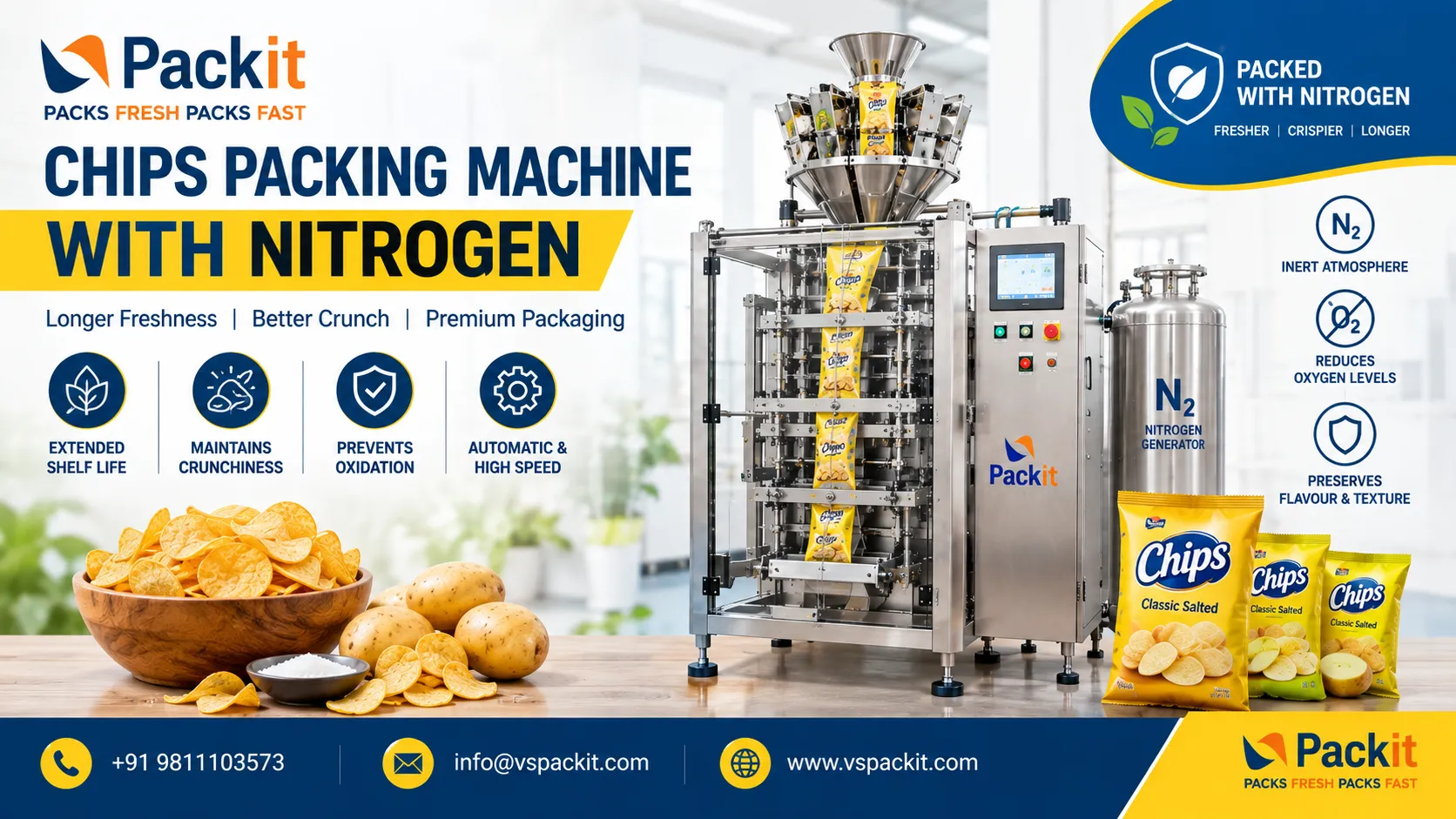
This article will discuss the technical characteristics of nitrogen flushing, and how they factor into the workings of a chips packing machine. We'll also briefly review some of the considerations that go into choosing this machinery.
What Is a Chips Packing Machine with Nitrogen?
A chips packing machine with nitrogen is a VFFS (vertical form fill seal) packaging machine that replaces oxygen with nitrogen gas when sealing the package. This process prevents the fried, crunchy snack from becoming rancid and from losing its crispness. At the same time, it makes the bag’s content more resilient to physical damage during transit and storage.
It is not an optional addition but a necessity for any producer that distributes their goods nationwide or only stores them for an extended period before selling them. After a month in storage, a bag of chips without nitrogen would smell and taste significantly worse than the one with nitrogen in it.
Why Fried Chips Require Nitrogen Flushing Specifically
The fried snacks contain oil on the surface of each piece, and oil tends to oxidize on exposure to oxygen. Not only does it make the once-edible item taste rancid over time, but it also degrades the texture, making it mushy, after weeks of being sealed in a pouch, correctly or incorrectly.
It is the single biggest packaging issue when it comes to the fried snacks, as I saw during my years-long visits to manufacturing units in North India for clients. Even the best-fried, crispiest, and most-seasoned products can fail at the retail level because the buyer in a shop two or three states away finds the taste and aroma of the product to be significantly off. This is almost never due to a manufacturing error.
Nitrogen is an inert gas that displaces oxygen, which in turn prevents oxidation of the product. This is the principle behind the modified atmosphere packaging, or MAP, used in the global fried snacks and dry food manufacturing sector.
How Nitrogen Flushing Works Inside The Machine
In short: as the pouch forms and the product falls in, a nitrogen flush valve is opened just before the pouch reaches the bottom seal bar to push out the air, and hence the oxygen, which would otherwise become trapped inside.
Here's how it fits into the rest of the packing sequence:
- Film forming – Packaging film is formed into a vertical tube around the former.
- Vertical sealing – The edges of the tube are joined to form a pouch shell.
- Product filling – Chips are fed into the pouch from above via a gentle delivery chute.
- Nitrogen injection – Before the bottom of the pouch is sealed, a burst of nitrogen gas is injected to displace the oxygen rich air from inside the pouch.
- Horizontal sealing – The pouch is then sealed shut with heated sealing jaws.
- Cutting and discharge – Lastly the sealed pouch is cut away from the former and discharged onto a take-away conveyor belt.
How the nitrogen is injected into the pack is crucial to the success of the process. Too little nitrogen and you've displaced too little air to make a significant difference. Too much, and you risk distorting the pouch and getting gas escaping at the wrong point to contaminate the seal. This is where machine engineering makes a big difference to a consistent product.
Machine Components That Make Nitrogen Flushing Work Properly
A nitrogen flushing feature can be only as good as the components, which allow it to function correctly. Below are the critical elements, which determine the machine’s ability to consistently produce nitrogen-flushed pouches:
- Calibrated nitrogen flush valve – provides the exact amount of gas needed to achieve a proper nitrogen flush every time.
- Servo-driven sealing jaws – make it possible to time the seal opening to match the nitrogen cycle.
- Gentle product delivery – reduces the chance of damaging the product during filling, which would create more surface area for oxygen to adhere.
- PLC recipe storage – allows the machine to store different nitrogen flow rates for different products and sizes.
- Food-grade stainless steel gas lines and contact surfaces – prevent contamination and degradation due to years of exposure to oils.
- Oxygen residual monitoring (on some lines) – high-end commercial machines can be equipped with sensors, which ensure there is no oxygen in the pouch after flushing.
GT-5S plus Multi Head Weigher: A Winning Combination for Chips Production
Within VS PacKit’s product range, the combination of GT-5S and Multi Head Weigher is one of the most popular among the chips manufacturers seeking to achieve speed and precision when filling nitrogen-flushed pouches.
GT-5S is a high-speed continuous motion VFFS machine with five independent servo drives for vertical sealing, vacuum belt traction, nip roller control, and horizontal sealing, and it offers the most advanced solution for nitrogen-flush packaging.
This packaging technology requires an extremely precise correlation of the flush sequence and seal process, and the five-axis servo control of the GT-5S ensures the required level of repeatability throughout the entire production cycle. In terms of performance, it is suitable for integration with multi-head weighers, auger fillers, and cup fillers.
On the other hand, the Multi Head Weigher allows achieving the next level of accuracy in terms of product weight. With multiple product heads, it enables the simultaneous measurement of various portions of the product, allowing the machine to select the most accurate combination for the fill weight. This technology is especially useful for products that are challenging to measure using traditional volumetric methods.
Such products include chips, which are not only small in shape but often fragile as well, making them challenging to fill without risking breakage and achieving the desired fill weight. In turn, the high level of precision provided by Multi Head Weigher dramatically reduces the percentage of overfilled packs, thus helping to minimize losses that occur due to overfilling on a large scale of production. Together, these two technologies are perfectly suited for the production of chips, being able to address the two critical stages of the production process with high precision.
Quick Comparison: What Each Machine Contributes
| Function | GT-5S | Multi Head Weigher |
|---|---|---|
| Primary role | High-speed forming, filling, sealing | Precision weight measurement |
| Nitrogen flushing | Integrated flush and seal sequencing | Not applicable (upstream of sealing) |
| Best suited for | High-volume continuous production | Irregular, fragile products needing weight accuracy |
| Speed impact | Maintains speed without sacrificing seal quality | Feeds product to the bagger at matched speed |
Benefits of Nitrogen Flushing Apart from Freshness
While freshness is the most evident advantage of nitrogen flushing, there are some benefits that manufacturers tend to forget when dealing with packaging machinery for snacks producers.
Longer shelf life. Due to the reduced risk of oxidation, the product will stay fresh for a longer time, which is beneficial in terms of logistics.
Proper cushioning. The gas prevents the bag from bursting under the pressure of other packages during transportation.
Fewer returns. The likelihood of a customer returning the product in the case of damage or spoilage is dramatically reduced.
Enhanced brand image. Consistent quality and freshness of the purchased goods contribute to the establishment of a positive brand image and help gain customer loyalty.
Buying Guide: What to Ask Before Investing
- Ensure that the flush is in sync with the sealing process and not just a feature. Ask the manufacturer to showcase the timing precision, not simply declare that the machine 'has nitrogen flushing'.
- Request a trial-run with your product to evaluate the outcome. The chip, oil level, and pouch size are determinants of the amount of nitrogen displaced in the packaging.
- Inquire about the gas consumption efficiency. A poorly calibrated system would waste the gas, which could add up as an additional expense in the long run.
- Ask about the food-grade certifications of the machine's gas-contact surfaces. This is essential to ensure that the equipment does not introduce contaminants to the food product.
- Evaluate the flexibility of the recipe-storage system. If you have multiple pouch sizes or products, ensure that you can quickly change the parameters related to each.
- Ascertain the after-sales support for the gas system. Valves and flow controllers are precision instruments, and you must have a reliable channel to request replacements and servicing.
- Request information about the industry and food-safety standards that the equipment meets. This is critical to understand the credentials and credibility of the supplier. A good benchmark is the FSSAI food-safety guidelines and ISO manufacturing practices.
Common Mistakes Made by Manufacturers
One common mistake that people tend to make is to consider nitrogen flushing as an on/off function. You must know that the rate of flushing largely depends on the size of the pouch, density of the product, and line speed. So, it is critical to choose the appropriate setting to achieve the required shelf life.
Another frequent error is not testing the machine with the real product and only considering its nominal packing speed. The oil content and size of chips can substantially differ depending on the type of product. For instance, I have noticed that banana chips require different settings as compared to potato chips or extruded snacks.
Finally, many manufacturers focus solely on the speed of packing without asking specific questions about nitrogen and do not consider the rate of displacement. Clearly, there is no point in packing the product faster if it will still go bad due to improper flushing.
Maintenance of Nitrogen Flushing Systems Essay
Unlike the typical sealing line, the nitrogen flushing system requires additional maintenance procedures:
- the flush nozzle should be inspected and cleaned regularly to avoid oil deposits.
- the valves’ calibration should be checked periodically.
- the seal jaw timing should be controlled on a regular basis since it’s as critical as the flush.
- nitrogen pressure should be monitored to ensure there are no inconsistencies in the displacement process during continuous production.
- the product delivery line should be cleaned on a shift basis to prevent oil and crumbs from clogging the seal area.
Industrial Standards and Safety
The nitrogen flushing systems must be installed and operated in accordance with industrial gas safety standards, including proper storage of gas cylinders, pressure regulation, and ventilation around the packing line area. At the same time, food safety manufacturers should identify equipment and manufacturing processes that employ FSSAI standards for food-grade machinery and general ISO-quality management system requirements as the preferred criteria for evaluating the manufacturing capability of a potential supplier.
Latest Technology and Future Trends
The latest technology used in nitrogen flushing is closer to servo-controlled sealing, allowing manufacturers to achieve greater consistency and repeatability in gas displacement than was possible with earlier pneumatic systems. Some manufacturers are now incorporating real-time oxygen content monitoring to provide more immediate feedback on the efficacy of the flush than is available from traditional shelf-life tests. Looking ahead, more manufacturers in the chips industry are likely to embrace recipe-driven flush control, while the use of sustainable, recyclable barrier films in conjunction with nitrogen flushing is expected to grow in the coming years.
ROI Nitrogen Flushing Argument Essay
There are three ways in which a firm that uses nitrogen flushing can benefit from the investment in the equipment. The first is the obvious reduction in losses due to product breakage during transportation. The second is the lower rate of distributor returns of stale products. The third is the expanded range that the company can use, due to the longer shelf life that nitrogen flushing grants the product. The first two combined usually are enough to offset the costs for firms that distribute their goods beyond local markets, while the third is an important selling point for those that compete with larger regional producers and need to assure their buyers of the product’s quality.
Reasons Why Manufacturers Choose VS PacKit
VS PacKit, the packaging machinery brand of V.S. International, has been engineering VFSS solutions from its Faridabad manufacturing base for over two decades now. For chips and fried snack applications, that means developing machines that do more than promise: actual precision in terms of timing of nitrogen flush, servo-based sealing consistency, and food-grade construction of all gas-contact surfaces.
Beyond the machine specification sheet, what makes VS PacKit different is its commitment to customization for challenging products, after-sales support in case of any line service requirement, and two design patents granted, as opposed to modified generic design practices. For manufacturers looking to compare options, our related read on What Makes a Chips Packing Machine Worth the Investment contains the wider evaluation criteria in addition to this nitrogen-focused guide. One may also look at our Snacks Packing Machine range; or evaluate cost considerations on our Chips Packing Machine Price, Potato Chips Packing Machine Price in India, and Banana Chips Packing Machine Price in India pages for multi-product line considerations.
Ready to protect your chips with proper nitrogen flushing
If your company’s chips brand is suffering from customer complaints about stale products, broken packages during transit, and varying shelf life, it may be time to request a call from a manufacturer that understands nitrogen food packing as an exact science and is willing to take a closer look at your production process. Contact VS PacKit to learn more about our nitrogen flushing trials with your product.