

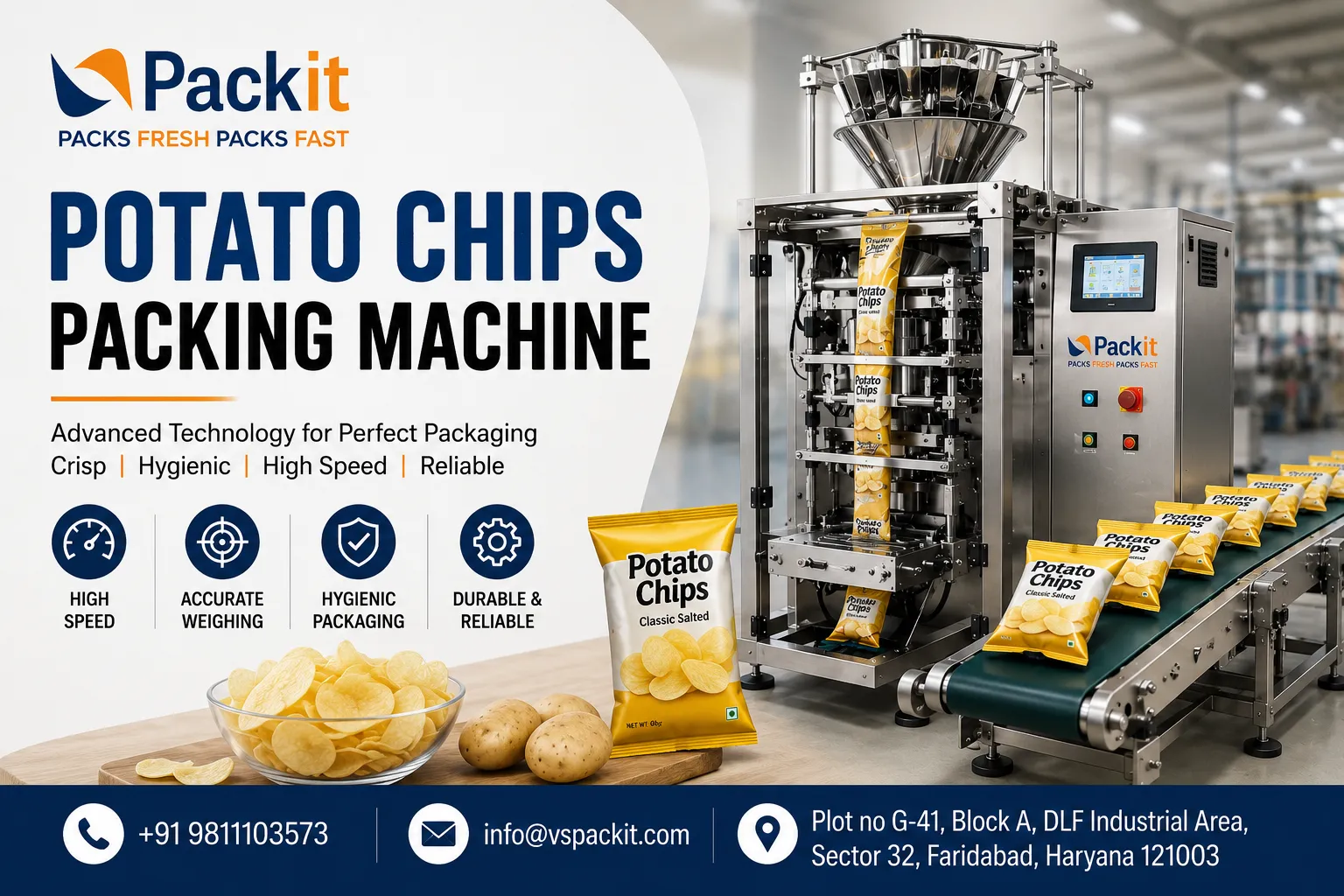
This page walks you through what actually matters when picking a potato chips packing machine, including how the machine works, which models suit which production scale, and the checklist you should run through before placing an order.
Quick Answer
A potato chips packing machine is an automatic Vertical Form Fill Seal machine that forms a pouch, fills it with a measured volume of chips, flushes it with nitrogen or gas to prevent oxidation, and seals it, all without crushing the product. The best machines balance gentle handling with consistent fill accuracy.
Why Chips Are Harder to Pack Than Most Products
Most packaging machines are built to handle weight. Chips break that assumption because they are almost entirely volume with very little density. A kilogram of chips takes up far more space than a kilogram of namkeen or flour, which means the filling system has to be tuned for volume accuracy rather than just weight accuracy.
There is also the fragility problem. From working with packaging lines that switched from manual to automatic filling, I have seen how a poorly designed drop chute or an oversized free fall height can turn perfectly good chips into broken fragments before they even reach the pouch. That is why the internal geometry of a potato chips packing machine matters as much as its speed rating.
How a Potato Chips Packing Machine Works
The core cycle follows the standard VFFS process, but with adjustments specific to chips.
- Film unwinds from the reel and passes over the forming collar
- The forming collar shapes the film into a tube and vertical jaws seal the sides
- The volumetric filling system doses a measured volume of chips based on bag size
- Nitrogen or gas flushing displaces oxygen inside the pouch before sealing
- The horizontal jaw seals the bottom, then the top, completing the pouch
- The cutter separates the finished pouch and drops it onto the discharge conveyor
One thing many factory owners overlook is that the gas flushing stage is not optional for chips the way it might be for a drier product like namkeen. Skipping or under calibrating this step is one of the fastest ways to end up with customer complaints about stale, soggy chips reaching the market late.
Machines Suited for Potato Chips Packaging
Not every VFFS machine handles chips equally well. Two models from VS PacKit are commonly configured for potato chips lines depending on production scale and pouch requirements.
GT-5S
The GT-5S is built as a high speed vertical form and seal bagmaking machine, suited for manufacturers running larger volumes who need consistent output without compromising on gentle product handling. Its servo controlled sealing system helps maintain pouch integrity even at higher line speeds, which matters when you are running chips continuously across a full shift.
Komet Sprint
The Komet Sprint is designed for manufacturers who need reliable, steady output with straightforward operation. It works well for units that are scaling up from smaller batch production and want a dependable intermittent motion system without the complexity of a fully continuous high speed line.
If your production also covers other snack formats, you can compare this against a banana chips packing machine, since banana chips need a slightly different filling approach due to their density and oil content.
Myth vs Fact: What People Get Wrong About Chips Packing Machines
Myth: A faster machine always means better output.
Fact: Speed only helps if the filling accuracy and seal quality hold up at that pace. A fast machine that gives inconsistent pouch weight ends up costing more in giveaway than a slightly slower, well calibrated one.
Myth: Any VFFS machine can pack chips if you adjust the settings.
Fact: Chips need a filling system and drop chute designed for low density, high volume product. Forcing a machine built for powders or granules to pack chips usually leads to breakage and inconsistent fill.
Myth: Gas flushing is only needed for export products.
Fact: Even domestic chips lose crunch fast without proper nitrogen or gas flushing, especially in humid regions. Shelf life complaints are one of the most common issues when this step is skipped.
Key Components to Look For
- Volumetric or gas flushing filling system matched to chip volume
- Gentle bucket elevator or conveyor to minimize product free fall
- Servo driven sealing jaws with adjustable temperature control
- PLC and HMI panel for recipe storage across different pouch sizes
- Photo eye registration for printed film alignment
- Nitrogen flushing nozzle integrated into the filling cycle
Comparison of Key Considerations
| Factor | Why It Matters for Chips |
|---|---|
| Filling accuracy | Prevents overfill or underfill on a low density product |
| Gas flushing | Preserves crunch and extends shelf life |
| Free fall height | Reduces breakage of fragile chip pieces |
| Sealing consistency | Prevents oxygen entry and pouch leakage |
| Pouch size flexibility | Supports multiple SKUs without major changeover time |
Buying Checklist Before You Order
Before you finalize a potato chips packing machine, run through this checklist rather than relying on a brochure alone.
- Test the machine with your actual chip variety, not a sample product
- Confirm the gas flushing system is calibrated for your target shelf life
- Check the drop chute design for minimal breakage
- Ask about pouch size flexibility for future SKU changes
- Review the filling system type against your product's bulk density
- Verify after sales support availability in your region
- Compare production capacity against your actual daily volume needs
For a more detailed breakdown of this evaluation process, our page on What to Check Before Buying a Potato Chips Packing Machine covers each of these points in depth.
Common Mistakes to Avoid
- Choosing based on speed without testing actual fill accuracy
- Ignoring free fall height and ending up with high breakage rates
- Underestimating gas flushing requirements for shelf life
- Buying a fixed pouch size machine when SKU expansion is likely
- Not checking spare parts and service response time before purchase
Maintenance Guide
I've noticed that machines running chips need slightly more frequent cleaning than those running powders, simply because oil residue from the product builds up on contact surfaces faster.
- Clean the drop chute and filling bowl daily to prevent oil buildup
- Check sealing jaw temperature calibration weekly
- Inspect gas flushing nozzles for blockage regularly
- Lubricate servo drive components as per the maintenance schedule
- Replace worn film tracking sensors before they cause registration errors
Safety and Industrial Standards
A potato chips packing machine handling food product should meet FSSAI hygiene requirements for contact surfaces and follow BIS electrical safety norms. Manufacturers that align their build quality with ISO based quality frameworks and reference PMMI packaging benchmarks tend to produce machines that hold up better under continuous industrial use.
Automation and Efficiency
Modern chips packing lines increasingly rely on servo motors for both filling and sealing, giving finer control over pouch consistency than older pneumatic systems. Touchscreen HMI panels with saved recipes also reduce changeover time significantly when switching between pouch sizes or chip varieties.
Return on Investment
When I visited manufacturing facilities that upgraded from older pneumatic machines to servo driven systems, the biggest ROI driver was almost always reduced product giveaway rather than labor savings. Even a small improvement in fill accuracy adds up quickly across a full production shift.
Future Trends
Expect more chips manufacturers to adopt recyclable mono material films as sustainability pressure grows, along with integrated checkweighers that catch fill deviations in real time before pouches reach the case packing stage.
Why VS PacKit for Potato Chips Packing Machines
VS PacKit brings over two decades of manufacturing expertise specifically in VFFS and pouch packaging machinery, with engineering built around real production challenges rather than brochure claims. The GT-5S and Komet Sprint models reflect this focus, offering servo driven precision and PLC automation suited to the specific handling needs of fragile, low density products like chips.
Businesses also choose VS PacKit for the customization support available across filling systems and pouch formats, backed by dependable after sales assistance that keeps chip production lines running with minimal downtime. If cost planning is part of your evaluation, our chips packing machine price page can guide your budgeting conversation.
Industry Applications
Beyond potato chips, this machine category supports banana chips, kurkure, extruded snacks, and other fried or baked products where gentle handling and gas flushing are equally important for shelf life.
Conclusion
A potato chips packing machine has to do more than move product quickly through a pouch. It needs to protect a fragile, low density product, maintain shelf life through proper gas flushing, and hold consistent fill accuracy shift after shift. Whether you are evaluating the GT-5S, the Komet Sprint, or comparing against a banana chips packing machine for a broader product line, the right choice comes down to matching the machine to your actual product and production goals. Reach out to VS PacKit to discuss which configuration fits your chips packaging line.