
Today's dairy industry demands speed, hygiene, and reliability. Consumers expect fresh milk packaged safely, while manufacturers need equipment that supports continuous production with minimal downtime. Modern packaging systems combine precise liquid dosing, strong sealing, intelligent automation, and food-grade construction to meet these expectations.
If you are comparing different Packaging Machine Suppliers, understanding how these machines work and which features matter most will help you make a smarter investment. Companies such as VS PacKit offer advanced vertical packaging systems that can be configured with liquid filling technology for dairy and other liquid packaging applications.
What Is a Milk Pouch Filling Machine?
Featured Snippet Answer
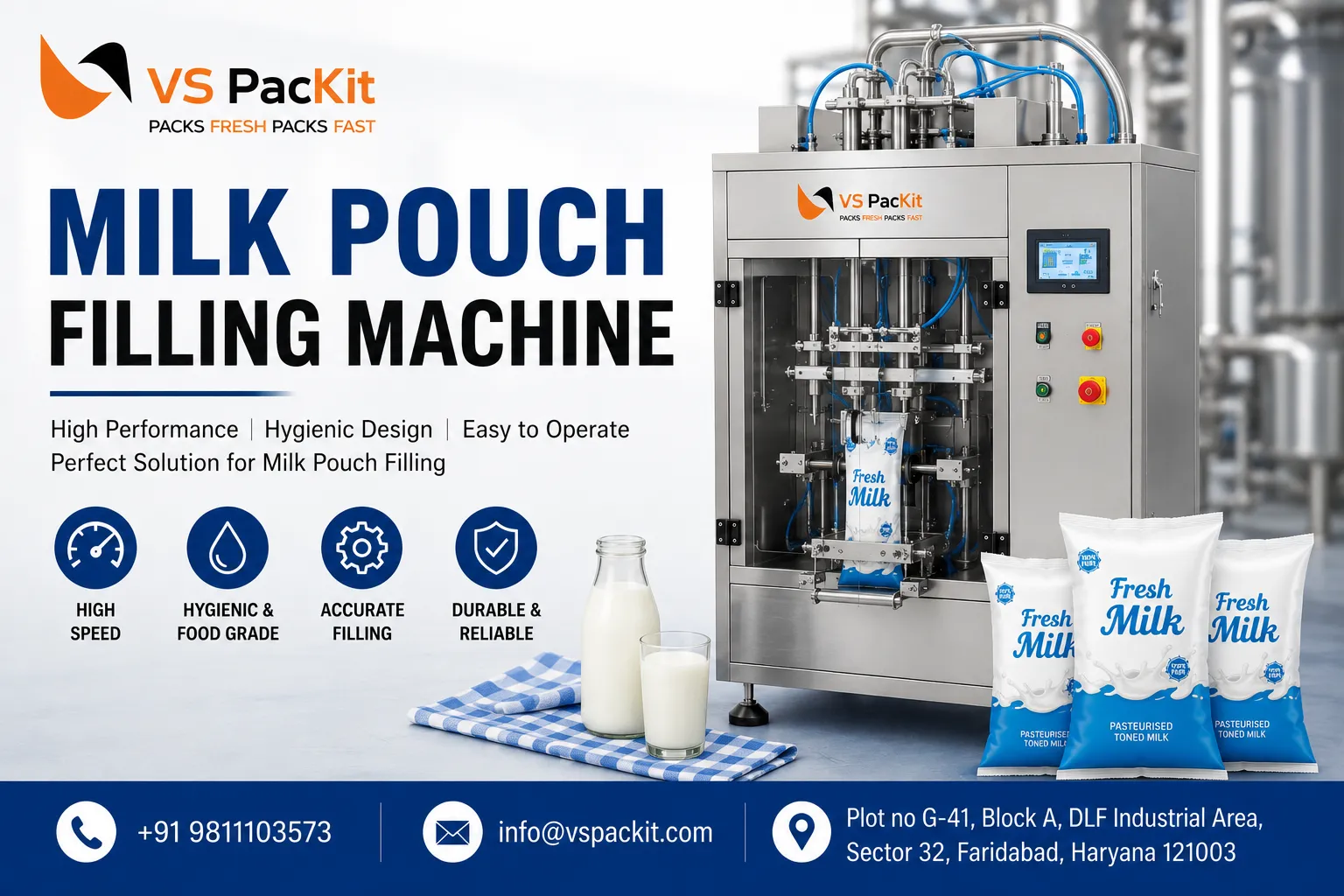
A milk pouch filling machine is an automated system that measures a preset quantity of liquid milk, forms a pouch from packaging film, fills it hygienically, seals it securely, and cuts individual pouches for distribution. It helps dairy businesses achieve high production efficiency, consistent filling accuracy, and improved food safety.
A milk pouch filling machine is widely used in dairy plants to package:
- Pasteurized milk
- Toned milk
- Double-toned milk
- Full cream milk
- Flavoured milk
- Buttermilk
- Lassi
- Other low-viscosity dairy beverages
Modern machines are designed to reduce manual intervention while maintaining strict hygiene standards expected in food processing facilities.
Why Is a Milk Pouch Filling Machine Important for Dairy Businesses?
Quick Summary
An automated milk pouch filling machine improves production speed, packaging consistency, hygiene, and operational efficiency while reducing labour requirements and product loss.
In my experience, many dairy businesses initially focus only on filling speed. However, long-term success depends equally on sealing quality, hygiene, machine reliability, and ease of maintenance.
An automated system provides several advantages:
- Consistent pouch weight
- Leak-proof sealing
- Reduced product wastage
- Improved production efficiency
- Better hygiene standards
- Lower manual handling
- Continuous production capability
- Uniform package appearance
These benefits become increasingly valuable as production volumes grow and customer expectations rise.
How Does a Milk Pouch Filling Machine Work?
Featured Snippet Answer
A milk pouch filling machine works by converting roll film into pouches, filling each pouch with a measured quantity of milk, heat-sealing the pouch, and automatically cutting finished packs. Sensors and control systems ensure accurate filling, proper sealing, and continuous operation.
Although machine configurations vary, the basic process remains similar.
Step 1: Film Feeding
A roll of food-grade packaging film is loaded onto the machine. Servo-controlled rollers feed the film smoothly through the forming section.
Step 2: Pouch Formation
The machine shapes the flat film into a tube using a forming collar before preparing it for filling.
Step 3: Liquid Filling
A hygienic liquid filling system dispenses the required quantity of milk into each pouch. Precision filling minimizes overfilling and underfilling.
Step 4: Heat Sealing
Temperature-controlled sealing jaws create strong, leak-resistant seals that protect product freshness during transportation and storage.
Step 5: Cutting and Discharge
The machine cuts individual pouches automatically before transferring them for collection, secondary packaging, or dispatch.
From working with packaging lines, I've noticed that proper synchronization between filling and sealing significantly reduces product leakage and improves overall production efficiency.
Main Components of a Milk Pouch Filling Machine
Every machine consists of several critical components that work together to ensure smooth operation.
Liquid Filling System
Accurately dispenses milk into each pouch while maintaining production consistency.
Forming Collar
Shapes the packaging film into the desired pouch structure.
Servo Motor
Controls film movement with high precision, reducing packaging errors.
Heat Sealing Unit
Creates strong, hygienic seals that prevent leakage.
PLC Control System
Manages machine functions through programmable automation for reliable operation.
Touchscreen HMI
Allows operators to adjust filling volume, sealing temperature, production speed, and machine settings easily.
Photoelectric Sensors
Detect printed registration marks to maintain accurate pouch alignment.
Stainless Steel Construction
Food-grade stainless steel supports hygienic production and simplifies cleaning procedures.
Applications of a Milk Pouch Filling Machine
Milk pouch filling machines are suitable for packaging a wide variety of liquid dairy products.
Common applications include:
- Fresh milk
- Pasteurized milk
- Standardized milk
- Toned milk
- Double-toned milk
- Flavoured milk
- Buttermilk
- Lassi
- Dairy beverages
- Other free-flowing food-grade liquids
Many dairy processing plants also configure similar systems for packaging edible oils, fruit beverages, and other liquid food products using appropriate filling technology.
Industries That Use Milk Pouch Filling Machines
Quick Summary
Although primarily developed for the dairy sector, these machines are also used in several food and beverage industries that require hygienic liquid packaging.
Industries include:
- Dairy processing plants
- Milk cooperatives
- Food manufacturing companies
- Beverage manufacturers
- Contract packaging companies
- Export-oriented food businesses
- Institutional food suppliers
- Liquid food processing units
When I visited manufacturing facilities handling liquid food products, one thing many factory owners overlook was the importance of choosing a machine that can be upgraded as production increases. A scalable packaging solution often delivers better long-term value than replacing equipment every few years.
Advanced Packaging Solutions from VS PacKit
Manufacturers looking for reliable packaging automation often evaluate machines based on production requirements, available floor space, product type, and future expansion plans.
For liquid packaging applications, VS PacKit offers advanced vertical packaging systems that can be configured with suitable liquid filling technology. Depending on production capacity and operational requirements, businesses may consider:
| Machine | Best Suited For | Key Highlights |
|---|---|---|
| Komet 81 | Small to medium dairy operations | Compact design, PLC automation, servo-driven performance |
| Indus 5000 | High-volume production | Continuous operation, advanced automation, consistent sealing |
| Duplex Packaging Systems | Large-scale dairy plants | Dual-lane packaging for significantly higher productivity |
| Various Filler Systems |
Liquid dairy products and customized filling applications | Supports accurate liquid filling, integrates with VFFS machines, ensures hygienic dosing, adaptable for different pouch sizes and production requirements |
These machines reflect the company's focus on engineering quality, automation, customization, and long-term reliability for industrial packaging applications.
Benefits of Using a Milk Pouch Filling Machine
Quick Summary
A modern milk pouch filling machine helps dairy businesses improve productivity, maintain hygiene, reduce product loss, and achieve consistent packaging quality. It also supports business growth by increasing output without compromising accuracy.
As the dairy industry becomes more competitive, manufacturers need packaging systems that deliver reliable performance every day. Investing in automation is no longer just about speed. It is about ensuring consistent quality, reducing operational costs, and meeting food safety expectations.
Some of the key benefits include:
- High filling accuracy with minimal product wastage
- Faster production compared to manual filling
- Hygienic packaging with reduced human contact
- Consistent pouch size and sealing quality
- Lower labour dependency
- Reduced production downtime
- Easy operation through PLC and touchscreen controls
- Better product shelf life through secure sealing
From working with packaging lines, I've noticed that businesses often recover their investment faster when they focus on reducing wastage and improving production efficiency rather than simply increasing machine speed.
Why Automation Matters in Dairy Packaging
Featured Snippet Answer
Automation improves the performance of a milk pouch filling machine by controlling filling, sealing, film movement, and cutting with high precision. This results in consistent pouch quality, higher production capacity, reduced manual intervention, and better operational efficiency.
Automation also provides greater flexibility for changing pouch sizes, adjusting filling volumes, and monitoring production parameters.
Modern automated systems offer:
- PLC-based machine control
- Servo-driven film feeding
- Automatic pouch length adjustment
- Digital temperature control
- Touchscreen Human Machine Interface (HMI)
- Error detection and alarms
- Production monitoring
- Consistent sealing performance
For dairy manufacturers operating multiple shifts, automation significantly reduces operator fatigue while improving overall production consistency.
Featured VS PacKit Machines for Milk Pouch Packaging
Depending on your production requirements, different packaging systems offer different advantages.
Komet 81
The Komet 81 is an excellent choice for small and medium-scale dairy businesses looking to automate liquid pouch packaging.
Highlights
- Compact footprint
- PLC automation
- Servo-controlled operation
- Easy maintenance
- Reliable sealing quality
- Flexible production
This machine is suitable for businesses planning gradual production expansion without requiring a large installation area.
Indus 5000
The Indus 5000 is designed for continuous industrial production where higher output and operational reliability are essential.
Ideal For
- Large dairy plants
- High-volume milk processing
- Continuous production environments
Advantages
- Stable high-speed performance
- Accurate filling synchronization
- Strong sealing consistency
- Lower operational interruptions
In my experience, larger dairy plants usually benefit from machines that prioritize continuous production over maximum speed alone. Consistent uptime often contributes more to productivity than occasional peak output.
Duplex Packaging Systems
For manufacturers requiring significantly higher production volumes, Duplex Packaging Systems provide dual-lane packaging capability.
Benefits
- Simultaneous pouch production
- Increased daily output
- Better production efficiency
- Lower cost per packaged unit
- Suitable for expanding dairy businesses
These systems are especially useful for organizations supplying large retail networks, institutional buyers, and government milk distribution programs.
Comparison of Featured Machines
| Feature | Komet 81 | Indus 5000 | Duplex Packaging Systems |
|---|---|---|---|
| Production Scale | Small to Medium | Medium to Large | Large Scale |
| Automation | High | Advanced | Advanced |
| Servo Technology | Yes | Yes | Yes |
| PLC Control | Yes | Yes | Yes |
| Continuous Operation | Yes | Excellent | Excellent |
| Best For | Growing Dairy Units | Industrial Production | High-Volume Manufacturing |
| Expansion Capability | Good | Very Good | Excellent |
Production Capacity Considerations
Quick Summary
The ideal production capacity depends on your daily milk output, operational shifts, and future business growth rather than simply choosing the fastest machine available.
Before selecting a machine, evaluate:
- Daily milk production
- Expected future demand
- Available factory space
- Number of production shifts
- Utility availability
- Labour resources
- Maintenance support
Choosing a machine with room for future expansion can help avoid unnecessary equipment replacement later.
Packaging Materials Used
A milk pouch filling machine is compatible with food-grade flexible packaging materials designed to protect milk from contamination while maintaining freshness.
Common packaging materials include:
- LDPE (Low-Density Polyethylene)
- Multi-layer laminated films
- Food-grade plastic films
- Printed packaging films
- Heat-sealable flexible films
The selection of packaging material should comply with applicable food safety regulations and be suitable for dairy packaging applications.
How to Choose the Right Milk Pouch Filling Machine
Featured Snippet Answer
Choose a milk pouch filling machine based on production capacity, automation level, filling accuracy, hygiene standards, machine reliability, after-sales support, and future scalability. A machine that matches both current and future production requirements provides better long-term value.
Important Buying Factors
1. Production Volume
Estimate your current and projected daily packaging requirements.
2. Filling Accuracy
Consistent filling reduces product loss and improves customer satisfaction.
3. Hygienic Design
Food-grade stainless steel construction simplifies cleaning and supports hygienic operations.
4. Automation Features
Look for PLC controls, servo motors, touchscreen interfaces, and automated diagnostics.
5. Machine Reliability
Consistent production with minimal downtime is more valuable than occasional high-speed operation.
6. Customization Options
Different dairy businesses may require varying pouch sizes, filling volumes, and production capacities.
7. After-Sales Support
Reliable technical assistance, spare parts availability, and operator training are essential for uninterrupted production.
Many businesses choose VS PacKit because of its engineering expertise, customization capabilities, and technical support, allowing manufacturers to configure packaging systems according to specific production needs rather than relying on a one-size-fits-all solution.
Industry Standards and Food Safety
Maintaining food safety is critical in dairy packaging.
Manufacturers should ensure their packaging operations align with relevant standards and guidelines from organizations such as:
- FSSAI for food safety compliance in India
- BIS for applicable quality standards
- ISO quality management practices
- PMMI for global packaging industry knowledge and best practices
Proper cleaning procedures, routine inspections, and preventive maintenance help ensure safe and hygienic packaging operations.
Customization Options
Every dairy plant has unique production requirements.
A packaging system can often be customized for:
- Different pouch sizes
- Adjustable filling volumes
- Production speed requirements
- Integration with existing processing lines
- Printing and coding systems
- Conveyor integration
- Batch coding equipment
- Inspection systems
I've noticed that businesses planning future product diversification often benefit from selecting machines that can be adapted to new packaging formats instead of purchasing separate equipment later.
Preventive Maintenance Guide for a Milk Pouch Filling Machine
Quick Summary
Regular preventive maintenance improves the performance, hygiene, and lifespan of a milk pouch filling machine. It also minimizes unexpected downtime and helps maintain consistent packaging quality.
A well-maintained machine delivers reliable results shift after shift. In my experience, preventive maintenance is far more cost-effective than dealing with emergency repairs during production.
Daily Maintenance
- Clean all product contact parts thoroughly after production.
- Inspect sealing jaws for residue or wear.
- Check filling nozzles for blockages.
- Verify the air pressure and pneumatic connections.
- Wipe down the machine using approved food-grade cleaning agents.
- Inspect the packaging film path for dust or debris.
Weekly Maintenance
- Lubricate moving components as recommended by the manufacturer.
- Inspect belts, rollers, and bearings.
- Check sensor alignment and calibration.
- Examine electrical connections for loose wiring.
- Test emergency stop functions.
Monthly Maintenance
- Inspect servo motors and drives.
- Check PLC settings and machine parameters.
- Verify filling accuracy through calibration.
- Replace worn sealing elements if required.
- Review overall machine performance and production reports.
Maintaining a preventive maintenance schedule reduces production interruptions and supports compliance with food safety practices.
Pros and Cons of a Milk Pouch Filling Machine
| Pros | Cons |
|---|---|
| High production efficiency | Higher initial investment compared to manual systems |
| Accurate filling volume | Requires trained operators |
| Excellent sealing consistency | Preventive maintenance is essential |
| Improved hygiene | Needs a stable power supply |
| Lower product wastage | Regular calibration is required |
| Reduced labour costs | Production stops if maintenance is ignored |
| Better packaging quality | Machine selection must match production needs |
For most dairy businesses, the operational advantages significantly outweigh the limitations when the equipment is selected and maintained correctly.
Common Mistakes to Avoid When Buying a Milk Pouch Filling Machine
Many businesses focus only on machine speed and overlook factors that have a greater impact on long-term performance.
Avoid these common mistakes:
Choosing Only on Price
The least expensive machine may not provide the reliability, support, or efficiency needed for long-term production.
Ignoring Future Expansion
Choose a machine that can support increased production as your business grows.
Overlooking Hygiene Standards
Food-grade construction and easy cleaning are essential in dairy processing.
Not Evaluating After-Sales Support
Reliable technical support and spare parts availability are just as important as the machine itself.
Selecting the Wrong Filling Technology
The filling system should be designed specifically for liquid products like milk.
Ignoring Operator Training
Even advanced automation requires trained operators to achieve consistent performance.
One thing many factory owners overlook is the importance of preventive operator training. Well-trained operators often identify minor issues before they become costly repairs.
Expert Tips Before Purchasing
Choosing the right machine is a strategic investment.
Here are some practical recommendations:
- Assess both current and future production capacity.
- Prioritize machine reliability over maximum speed.
- Verify the quality of components and control systems.
- Request demonstrations whenever possible.
- Ensure the machine complies with food industry standards.
- Consider the availability of local service support.
- Evaluate energy efficiency.
- Ask about customization options for future product variations.
When I visited manufacturing facilities with successful packaging operations, I found that companies investing in reliable engineering and responsive technical support experienced fewer production disruptions over time.
Return on Investment (ROI)
Quick Summary
A milk pouch filling machine contributes to long-term profitability by improving production efficiency, reducing product loss, lowering labour dependency, and maintaining consistent packaging quality.
ROI is influenced by factors such as:
- Daily production volume
- Reduced milk wastage
- Lower manual labour requirements
- Faster packaging cycles
- Consistent sealing quality
- Reduced maintenance costs through preventive servicing
- Improved customer satisfaction
Instead of focusing solely on production speed, evaluate how the machine supports overall operational efficiency and business growth.
Future Trends in Milk Pouch Packaging
The dairy packaging industry continues to evolve with advances in automation and digital manufacturing.
Emerging trends include:
- Smart PLC-based monitoring
- Remote diagnostics
- Industry 4.0 integration
- Energy-efficient servo systems
- Predictive maintenance
- Improved food-grade automation
- Sustainable packaging materials
- Better production data analytics
- Enhanced traceability through digital coding systems
Manufacturers adopting modern automation are better positioned to improve productivity while meeting evolving food safety expectations.
Conclusion
Selecting the right milk pouch filling machine is about more than increasing production speed. It is about improving hygiene, ensuring packaging consistency, reducing product wastage, and preparing your dairy business for future growth.
Whether you operate a growing dairy unit or a large-scale processing plant, choosing a machine that combines reliable engineering, intelligent automation, and dependable technical support can significantly improve long-term operational efficiency.
Businesses evaluating Packaging Machine Suppliers often look for manufacturers with proven engineering expertise, customization capabilities, and responsive after-sales support. VS PacKit offers advanced packaging solutions such as Komet 81, Indus 5000, and Duplex Packaging Systems, which can be configured with appropriate liquid filling technology to meet varying production requirements.
Investing in the right packaging solution today helps build a more efficient, reliable, and scalable production process for tomorrow.
Why Choose VS PacKit?
Manufacturers across India choose VS PacKit because of its focus on:
- Advanced engineering and manufacturing expertise
- Customizable packaging solutions
- Reliable automation technologies
- Consistent machine quality
- Strong technical support
- Long-term operational reliability
- Solutions tailored to different production capacities
Rather than offering a one-size-fits-all approach, VS PacKit works with businesses to configure packaging systems that align with their production goals and future expansion plans.