

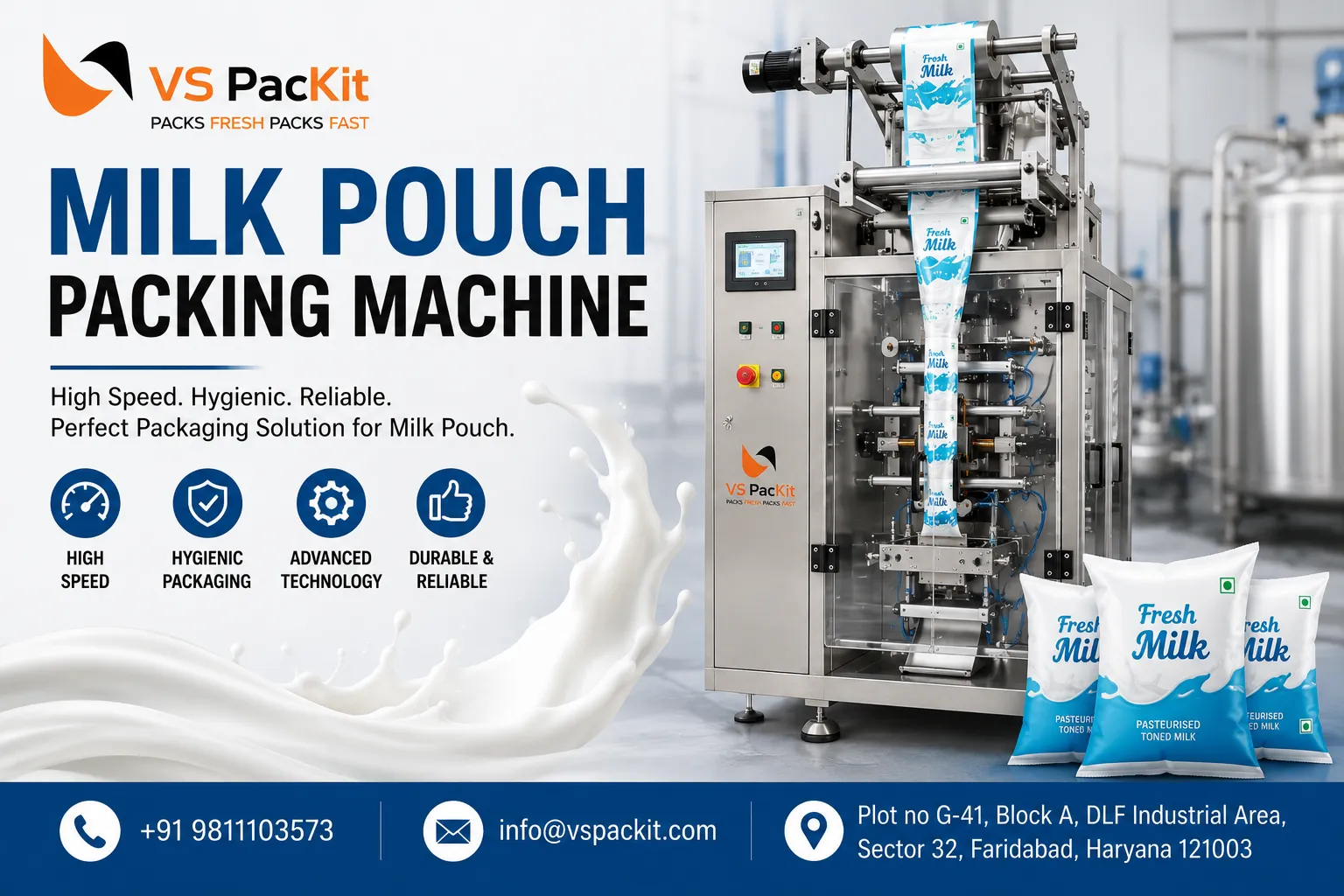
Getting it right means clean seals, consistent fill weights, and throughput you can actually depend on.
This guide covers everything you need to know before choosing a milk pouch packing machine for your facility, whether you are setting up a new dairy plant or upgrading an existing packing line.
What Is a Milk Pouch Packing Machine?
A milk pouch packing machine is a fully automatic packaging system that forms a pouch from a roll of laminated film, fills it with a precise quantity of liquid milk, and seals it airtight, all in one continuous operation. These machines fall under the broader category of Vertical Form Fill Seal (VFFS) machines and are specifically engineered to handle liquid products with high speed and zero contamination.
In my experience working with dairy manufacturers across India, the biggest mistake I see is treating a milk packing machine as a commodity purchase. The reality is that machine type, filling system, sealing technology, and film compatibility together determine your actual output, hygiene compliance, and long-term cost per pouch.
How Does a Milk Pouch Packing Machine Work?
The working principle follows a five-stage automated sequence:
- Film Unwinding The packaging film roll (typically a food-grade LDPE or coextruded film) is loaded onto the unwind stand. The film feeds into the forming section automatically.
- Pouch Formation A forming collar or tube shapes the flat film into a vertical tube. The fin sealer or back seal unit bonds the film edges together to create the pouch body.
- Bottom Sealing Horizontal sealing jaws seal the bottom of each pouch before filling begins. This is a critical step where seal integrity determines whether the pouch will leak.
- Liquid Filling A flow meter, piston filler, or gravity-based volumetric system dispenses the exact quantity of milk into the formed pouch. Most industrial machines use a flow meter for accuracy at high speeds.
- Top Sealing and Cutting The top of the filled pouch is heat-sealed and cut from the film tube, producing a finished, sealed milk pouch that drops onto a conveyor or collection tray.
The entire cycle repeats several times per minute, depending on the machine model and pouch volume.
Types of Milk Pouch Packing Machines
Understanding the variants helps you match the machine to your actual production environment.
Intermittent Motion VFFS Machines
In intermittent motion systems, the sealing jaws stop during the seal cycle, then release and repeat. This gives longer dwell time on the seal, which works well for thicker films and larger pouch formats. From working with packaging lines at mid-size dairy cooperatives, I have found intermittent machines to be more forgiving when film quality varies, which is common in India's supply chain.
The VS PacKit Komet 81 is a flagship intermittent motion form and seal bag-making machine designed for exactly this kind of application. It handles varied pouch sizes reliably and is built for sustained high-volume use in food and dairy environments.
The VS PacKit Indus 5000 is another strong intermittent motion option, engineered for versatility across product types including liquid dairy products. It is particularly suited for manufacturers who need to run multiple SKUs on the same line with minimal changeover time.
Continuous Motion VFFS Machines
Continuous motion machines run the film and sealing jaws simultaneously, achieving significantly higher throughput. They are the preferred choice for large dairy plants packing hundreds of thousands of pouches per shift.
The VS PacKit GT-5S is a high-speed continuous motion VFFS machine built for exactly this kind of high-throughput environment. One thing many factory owners overlook is that at high speeds, seal quality depends on precise jaw pressure and temperature control, and the GT-5S addresses this with servo-driven control systems that maintain consistency even at peak production rates.
Duplex and Multi-Lane Systems
When a single-lane machine can no longer meet your output targets, duplex configurations allow two lanes to run simultaneously on the same footprint, effectively doubling throughput without doubling floor space.
The VS PacKit Duplex Packaging Systems is designed for exactly this requirement. Dairy plants running large-scale operations with multiple SKUs across 500ml and 1-litre formats often find duplex systems the most cost-efficient path to scaling output.
Key Components of a Milk Pouch Packing Machine
Knowing the components helps you evaluate machine quality and ask the right questions before purchasing.
Forming Collar and Tube Converts flat film into a vertical tube. Material quality here directly affects pouch shape consistency.
Servo Drive System Controls jaw movement, film feed, and sealing with electronic precision. Servo-driven machines offer far better accuracy and lower mechanical wear than older cam-based systems.
PLC Control System The programmable logic controller is the brain of the machine. A good touchscreen HMI lets operators adjust parameters, run diagnostics, and switch between saved product recipes quickly.
Horizontal Sealing Jaws Apply controlled heat and pressure to form the top and bottom seals. Jaw temperature, dwell time, and pressure must be precisely balanced for leak-free milk pouches.
Flow Meter or Volumetric Filler Determines fill accuracy. For milk, flow meters are preferred at high speeds because they compensate for slight viscosity variations without requiring manual recalibration.
Film Tracking and Tension System Keeps the film aligned during high-speed operation. Misaligned film causes skewed seals and wastage.
Which Industries Use Milk Pouch Packing Machines?
While dairy is the primary application, VFFS liquid packing machines are used across several related sectors:
- Dairy cooperatives and private dairies packaging full-cream, toned, double-toned, and skimmed milk
- Flavoured milk and UHT milk processors
- Curd and buttermilk producers adapting VFFS lines for semi-liquid products
- Fruit juice and drink manufacturers using the same machine format for non-carbonated beverages
- Edible oil processors packaging small-format oil sachets using similar liquid VFFS systems
- Institutional and food service suppliers packaging bulk liquid formats for hotels, canteens, and catering businesses
When I visited manufacturing facilities across Haryana and Punjab, I noticed that many mid-size dairy processors were also running the same machine for packaging jeera water and flavoured milk, making machine flexibility a genuine commercial factor, not just a brochure point.
Packaging Materials Used in Milk Pouch Packing
Milk pouch packing machines work with specific film structures. The choice of film affects shelf life, seal integrity, and machine compatibility.
LDPE (Low-Density Polyethylene) The standard material for milk pouches in India. Food-grade LDPE is heat-sealable, moisture-resistant, and FSSAI-compliant for direct food contact.
Coextruded Films Multi-layer structures combining LDPE with barrier layers for extended shelf life. Used for pasteurised milk with longer refrigerated shelf requirements.
Laminated Films Where branding or oxygen barrier properties are needed, laminated structures are used, though these are less common for basic milk pouches.
FSSAI regulations require all food contact packaging materials to meet safety standards for migration and chemical composition. It is worth verifying film supplier compliance before finalising your packaging specification.
Benefits of Automating Your Milk Packaging Line
I have noticed that dairy operations that delay automation often underestimate how much manual packaging costs them beyond direct labour. Here is the full picture:
Speed and Output Consistency An automatic milk pouch packing machine can run at speeds ranging from 30 to over 100 pouches per minute depending on model and pouch size. Manual filling cannot approach this consistently.
Fill Accuracy Flow meter-based filling delivers consistent fill weights that reduce product giveaway. Even a 2ml overfill per pouch across a million pouches per month adds up to significant product loss.
Hygiene and Contamination Control Closed-loop filling with food-grade contact parts dramatically reduces contamination risk compared to open manual filling. This is critical for FSSAI compliance and export eligibility.
Reduced Packaging Film Wastage Servo-driven film feed systems minimise film waste during startup, changeover, and end-of-roll transitions.
Labour Efficiency One operator can supervise an automatic line that would otherwise require six to eight manual workers, freeing labour for higher-value tasks.
Buying Guide: How to Choose the Right Milk Pouch Packing Machine
Define Your Production Volume
Start with your required output per shift. Work backwards from pouches per minute, accounting for scheduled maintenance stops and changeovers. Undersizing the machine is a common and costly mistake.
Pouch Formats and Sizes
Identify your full range of pouch sizes now and in the next three years. A machine that only handles your current 500ml format may limit you when you add a 200ml or 1-litre SKU.
Filling System Compatibility
For liquid milk, ensure the machine uses a food-grade flow meter or verified volumetric filling system. Ask specifically about fill accuracy tolerances and how the system behaves with slight temperature variations in the milk.
Hygiene and Cleanability
Dairy environments require regular cleaning and sanitising. Look for stainless steel contact parts, accessible cleaning zones, and CIP (clean-in-place) compatibility where applicable.
After-Sales Support and Spare Parts
This is one area where packaging machinery manufacturers in India vary significantly. Evaluate service response time, spare parts availability, and whether the supplier has a trained service team in your region. VS PacKit, based out of Faridabad, serves manufacturing customers across India including Delhi, Mumbai, Pune, Ahmedabad, Hyderabad, Chennai, and Noida, with support infrastructure across these territories.
Regulatory Compliance
Ensure the machine and its food-contact components meet FSSAI material safety requirements. For export-oriented dairies, ISO and BIS compliance in the manufacturing process is also worth verifying with your packaging machine suppliers.
Common Mistakes Dairy Manufacturers Make When Buying a Milk Packing Machine
Choosing machine speed without accounting for efficiency loss Published speeds are usually theoretical maximums. Real-world efficiency typically runs at 75 to 85 percent of rated capacity. Build this into your planning.
Ignoring film compatibility Not all machines handle all film types. Confirm that your preferred film supplier's specifications match the machine's sealing temperature and tension requirements.
Skipping operator training The most capable machine performs poorly in the hands of an undertrained team. Insist on commissioning and training as part of the purchase agreement.
Overlooking changeover time If you run multiple pouch sizes, ask specifically how long a size changeover takes. Thirty minutes of changeover twice a shift adds up to meaningful lost production time over a year.
Expert Tips for Getting the Best Out of Your Milk Pouch Packing Machine
Tip 1: Standardise your film reel specifications Variations in film width, core diameter, or thickness across batches create alignment issues. Work with a single qualified film supplier.
Tip 2: Monitor jaw temperature consistently Seal failures in milk pouches are almost always temperature-related. Set up a daily jaw temperature verification protocol rather than relying on the machine's internal sensor alone.
Tip 3: Schedule preventive maintenance before peak seasons Dairy demand peaks around festivals and summer. Schedule your machine service at least four weeks before anticipated peak periods.
Tip 4: Document your product changeover recipes in the PLC Modern machines allow you to save product recipes. Use this feature to eliminate human error during SKU changeovers.
Maintenance Guide for Milk Pouch Packing Machines
Regular maintenance extends machine life and prevents costly unplanned downtime.
Daily: Clean all product-contact surfaces after each shift. Check jaw temperature calibration. Inspect film tracking and tension settings. Check for wear on sealing jaw inserts.
Weekly: Lubricate all mechanical joints as per the manufacturer schedule. Inspect belts and drive components for wear. Clean the forming collar and tube thoroughly.
Monthly: Full inspection of servo drives and electrical connections. Check film unwinding brake tension. Inspect all pneumatic fittings for leaks.
Quarterly: Professional service visit from the machine manufacturer or authorised technician. Review and update PLC parameters if production requirements have changed.
Future Trends in Milk Pouch Packing Technology
The packaging machinery industry globally, tracked by organisations like PMMI (Packaging Machinery Manufacturers Institute), continues to shift toward smarter and more connected machinery. In India, this trend is accelerating through the government's push for manufacturing modernisation under programmes supporting industrial automation.
Key trends to watch in milk pouch packaging:
IoT-Connected Machines Real-time monitoring of fill weights, seal integrity, and machine health through connected dashboards.
Energy-Efficient Servo Systems Newer servo architectures reduce power consumption by 20 to 30 percent compared to older pneumatic drive systems.
Smart Reject Systems Vision-based inspection and automatic rejection of underfilled or poorly sealed pouches, reducing customer complaints downstream.
Sustainable Film Compatibility Growing demand for thinner-gauge and mono-material LDPE films that maintain recyclability without sacrificing seal performance.
Why Manufacturers Choose VS PacKit
VS PacKit, the packaging machinery brand of V.S. International, has been manufacturing VFFS packaging solutions for over two decades from their facility in Faridabad, Haryana. With two granted design patents and an ongoing focus on engineering innovation, VS PacKit develops machines built for real production environments, not just demonstration floors.
Their client base includes some of India's most recognised FMCG and food brands, which reflects the kind of reliability that large-scale buyers require. As one of the leading packaging machinery manufacturers in India, VS PacKit offers a full product line covering intermittent motion, continuous motion, duplex, and specialty filling configurations, along with application-specific customisation and after-sales support across major Indian cities.
For dairy manufacturers evaluating packaging machine suppliers, VS PacKit offers factory visits, machine demonstrations, and application consultations before purchase, which is the right way to make a machinery decision of this scale.
Ready to Upgrade Your Dairy Packaging Line?
If you are evaluating milk pouch packing machines for your dairy facility, the right decision comes down to matching machine capability to your actual production environment, not just choosing the fastest or cheapest option on paper.
VS PacKit's team of packaging engineers is available to discuss your specific application, recommend the right machine from their range, and arrange a demonstration. Whether you are in Delhi, Pune, Ahmedabad, Mumbai, Hyderabad, Chennai, or anywhere across India, VS PacKit's support network is built to serve manufacturers at scale.