

I have spent years working closely with food manufacturers across India, and the brands that choose their machine partner carefully grow faster, waste less, and build stronger retail presence. The ones who rush the decision often spend the next two years dealing with downtime, inconsistent packaging, and suppliers who have moved on.
This guide covers what you need to know about food packaging machine manufacturers before you sign anything, from the machine types available to the questions that actually reveal whether a manufacturer is worth your money.
Not sure which machine fits your product line?
Talk to our team and get a straight answer.
Why the Manufacturer Matters More Than the Machine Itself
Two factories can buy the exact same model of packaging machine. One runs it smoothly for five years. The other deals with constant issues from month three. The difference is almost never the machine, it is the manufacturer behind it.
A good manufacturer does not just sell you equipment. They help you choose the right machine for your specific product and production volume, install it properly, train your operators, and pick up the phone when something goes wrong at two in the morning before a major order ships.
According to a study by the Indian Packaging Institute, over 60 percent of packaging line downtime in small and medium food businesses is caused by inadequate after-sales support rather than machine failure itself. That number should tell you where your research energy should go.
Food Products That Need Specialised Packaging Machines
Not every food product can go into the same machine. Here is how different food categories behave on a packing line and what they need.
Snacks and Namkeen
Chips, bhujia, mixture, and similar snack products are fragile, irregularly shaped, and sensitive to moisture and oxygen. They need a VFFS machine with a gentle multi-head weigher that minimises product breakage during filling. Nitrogen flushing is essential for extending shelf life and maintaining crunch.
When I tried running a standard volumetric cup filler on a batch of bhujia, it resulted in inconsistent fill weights and significant product breakage at the bottom of every bag. The multi-head weigher solved both problems immediately.
Powders and Flour
Atta, besan, spice powders, and masala blends are fine and dusty. They need dust-controlled auger fillers that measure precise quantities without spillage or clogging. An auger filler paired with a VFFS machine is the standard solution for most flour and powder manufacturers in India.
Confectionery and Candy
Hard candies, toffees, and similar confectionery products need count-based filling rather than weight-based filling. Twist wrap machines and flow wrap systems handle individual pieces, while VFFS machines with counting systems manage multi-piece packs.
FMCG and Mixed Products
Dry fruits, seeds, protein powders, and mixed snacks often combine different shapes and densities in a single pack. These need advanced multi-head weighers with enough heads to accurately calculate the right combination of pieces for every bag.
What Separates Good Manufacturers From Great Ones
In my experience working across dozens of food factory setups, a few things consistently separate the manufacturers worth partnering with from the ones to avoid.
- Industry-specific experience. A manufacturer who has built machines specifically for Indian snack products understands the challenges of bhujia clogging a filling system or chips breaking during a high-speed drop in a way that a generic machine builder simply does not. Look for manufacturers who can show you machines running on products similar to yours.
- Transparent product trials. Any manufacturer worth trusting will offer a live trial with your actual product before you commit. If a supplier is reluctant to run a trial, that reluctance tells you something important.
- Proven sealing technology. The seal is where most packaging fails. Great manufacturers invest in servo-driven sealing systems that maintain consistent temperature, pressure, and timing regardless of production speed or ambient factory conditions. This is the difference between a seal that holds in a showroom and one that holds after eight hours of continuous production in a Rajasthan summer.
- PLC automation and digital control. A machine with PLC control lets operators store settings for different products and pouch sizes. Changeover between product runs becomes faster and more reliable, and operators with minimal training can run the line confidently.
- Food safety and hygiene compliance. Since the machine directly touches food, ask whether it is built to GMP guidelines and whether contact parts are food-grade stainless steel with no crevices where product can collect. This matters for FSSAI audits and for any retailer or export buyer who asks for proof of a compliant production line.
After-sales commitment. Ask every manufacturer you speak to for references from customers who have been running their machines for at least two years. What happens eighteen months after installation is the real test of a manufacturer's reliability.
The Machines India's Food Packaging Manufacturers Produce
Understanding the main machine types helps you have a more informed conversation with any manufacturer you approach.
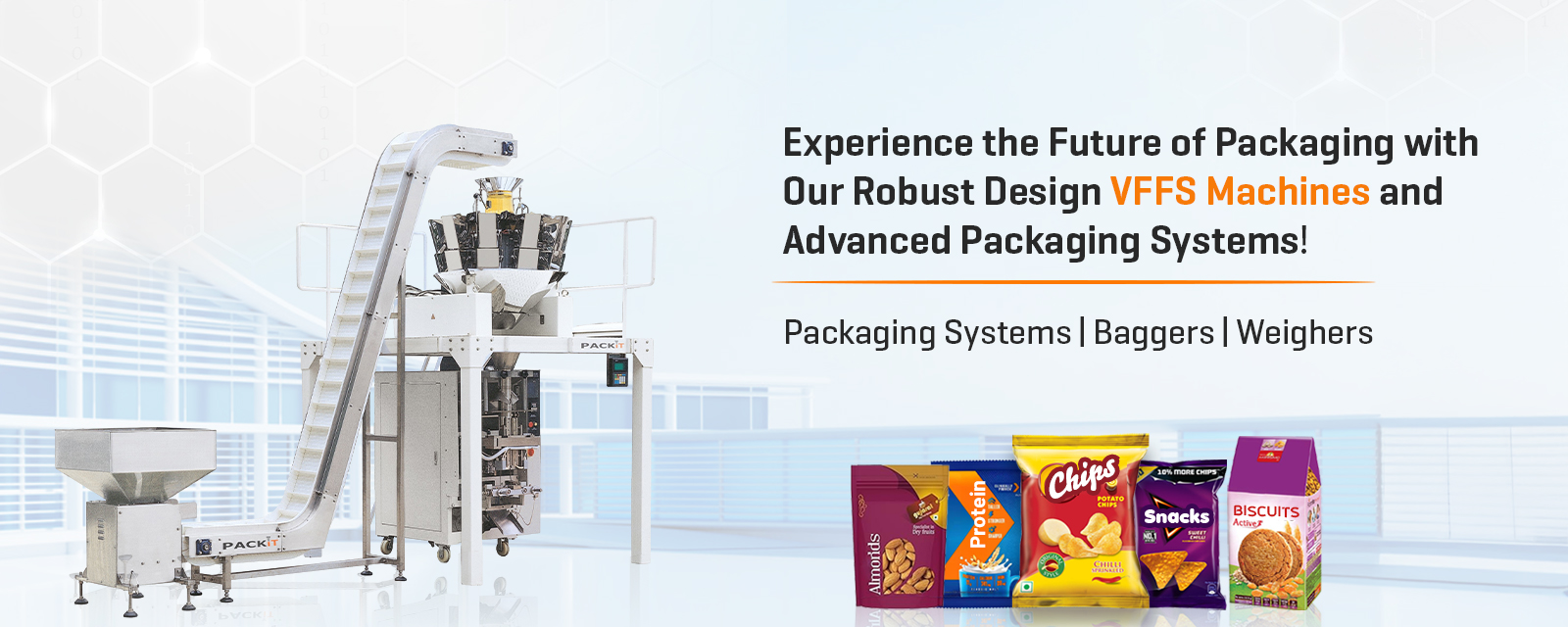
VFFS Machine: is the workhorse of Indian food packaging. It forms a pouch from a roll of packaging film, fills it with product, and seals it in one automated sequence. It handles everything from chips and namkeen to atta and spices, and is available in configurations ranging from entry-level models to high-speed lines capable of producing thousands of pouches per hour. If you want to understand what to look for in a VFFS Packaging Machine Manufacturer in India specifically, that guide breaks it down further.
Multi-Head Weigher: is not a standalone machine, but it transforms the performance of any VFFS line. It calculates fill weights with far greater accuracy than cup fillers and handles the product variation that is normal in snack manufacturing.
Premade Pouch Packing Machine: fills and seals pouches that are already formed. It supports premium packaging formats like stand-up pouches and zipper bags that are increasingly important for modern retail and export markets.
Auger Filler: is the standard solution for powder products. It uses a rotating screw mechanism to dispense precise quantities of flour, spice, or powder into the forming tube of a VFFS machine.
VS PacKit: A Name Indian Food Manufacturers Have Come to Trust
VS PacKit by V.S. International has been manufacturing high-performance packaging machines for over two decades from its facility in Faridabad, Haryana. If you want a closer look at what makes a manufacturer based here worth choosing, our piece on the Packaging Machine Manufacturer in Faridabad covers it in more detail.
What sets VS PacKit apart is the combination of advanced VFFS technology, servo-driven sealing precision, and a genuine understanding of the specific challenges that Indian food products present on a packaging line.
VS PacKit machines are used by some of India's recognised snack and FMCG brands, and the company continues to invest in packaging innovation that raises the standard for Indian manufacturing.
In my experience, VS PacKit stands out not just for the machines but for the level of support they provide after installation. Operator training, spare parts availability, and technical responsiveness are areas where many manufacturers fall short. VS PacKit takes a different approach, and it shows in the long-term satisfaction of their customer base.
VS PacKit offers solutions for every scale of food manufacturing, from startups packing their first commercial batch to large factories running multi-line high-speed operations.
How to Evaluate a Manufacturer Before You Commit
Here is a practical checklist for your conversations with any food packaging machine manufacturer.
Ask to see the machine running on a product similar to yours, not a demonstration product. Request references from customers who have been using the machine for at least eighteen months. Verify the availability of spare parts and the average delivery time for critical components. Ask specifically about the sealing system and whether it is servo-driven or mechanically driven. Confirm the PLC brand and whether local technical support is available for that control system. Ask whether the machine and its contact parts meet GMP and food-grade requirements. Get clarity on the installation timeline, operator training process, and who is responsible for commissioning.
These questions feel basic, but in my experience the answers reveal more about a manufacturer's reliability than any brochure or demo video ever will.
Common Mistakes Food Manufacturers Make
- Choosing based on the lowest quote. The cheapest option almost always reveals its true cost within the first year through higher maintenance frequency, parts that are difficult to source, and technical support that is slow or unavailable.
- Skipping the product trial. A machine that performs beautifully with a demonstration product may struggle with your specific namkeen density or your atta moisture content. Always insist on a trial with your actual product.
- Ignoring scalability. A machine that perfectly matches your current daily output will likely become a bottleneck within two years if your business grows as planned. Always buy with your three-year production target in mind.
- Overlooking film compatibility. Different packaging films have different thickness, material, and barrier properties. Confirm that your chosen machine handles the specific films your product and brand require before committing.
- Underestimating training needs. Even the best machine underperforms when operators do not know how to run it properly. Confirm that the manufacturer provides hands-on operator training as part of the installation process.
The Future of Food Packaging Machine Manufacturing in India
India's food packaging industry is growing rapidly. Rising domestic consumption, expanding modern retail infrastructure, and growing export ambitions are all driving demand for more sophisticated, reliable, and efficient packaging machinery.
Food packaging machine manufacturers who invest in servo technology, PLC automation, and energy-efficient systems are the ones who will define the next decade of Indian food manufacturing. The shift from manual and semi-automatic packaging to fully automated lines is accelerating, and the manufacturers who understand both the technology and the specific needs of Indian food products are best positioned to support that shift.