
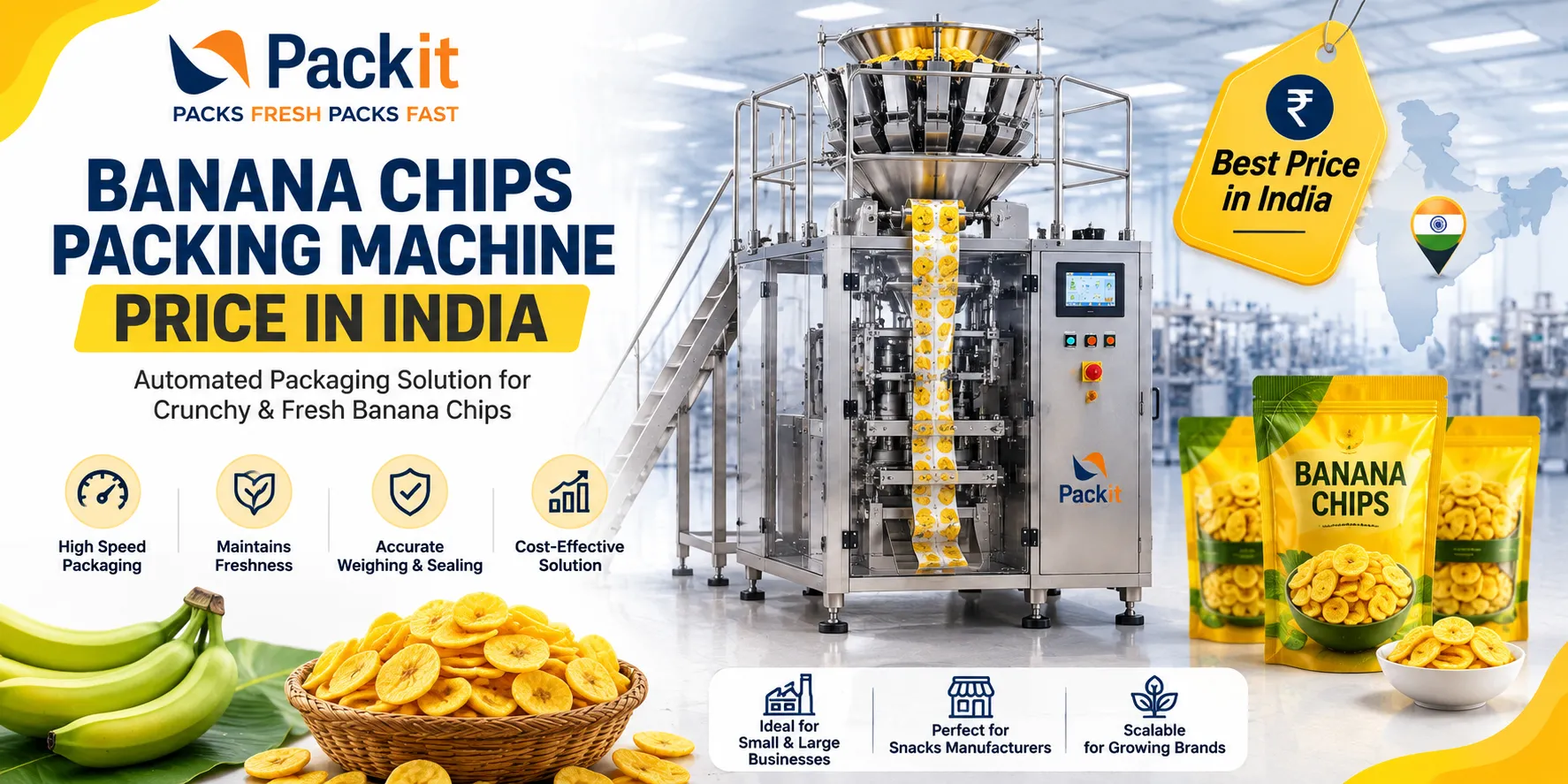
People always search for a figure first. However, I have interacted with various snack manufacturers across the country, and I can tell you with full confidence that you must know what goes into a machine that can handle banana chips before shortlisting prices. This popular snack has specific needs that are difficult to fulfill. It can be bulky, uneven in shape, oily, and more. Hence, here we will begin our search: what a packing machine needs to do to fulfill your banana chips packing needs.
This guide has everything you need to know before you buy a packing machine for banana chips. No fluff, no generic descriptions, just what you need to know.
What Is a Banana Chips Packing Machine?
A banana chips packing machine is an automated machine which makes a pouch, fills it in with a certain amount of banana chips, and finally closes the bag in a single cycle. A banana chips packing machine is a kind of chips packing machine that is specially designed for packing fragile, irregular chips without damaging them.
Compared to a powder packing machine or a granule packing machine, the banana chips packing machine needs a more gentle filling system, a broader filling pathway, and a proper seal jaw pressure. Its main goal is to make sure banana chips can be filled into the package with an appropriate weight, and the bag is well-sealed.
How Does a Banana Chips Packing Machine Work?
The operation consists of five basic steps.
- The chips are fed into a hopper or some form of feeding mechanism by means of a weigher.
- A film roll is unwound to form a tube around a forming collar.
- The weighed amount of product is dropped into the tube.
- Vertical and horizontal sealing jaws seal the top, bottom, and sides of the bag.
- The bag is then cut and discharged for further cartoning and dispatch.
This whole process takes place repeatedly many times per minute depending on the capacity of the machine. While touring a snack unit near Faridabad, that had been using an old semi-automatic packing machine, I saw how they were manually handling each and every step in the packaging process. It was absolutely a new world for me when they showed me the working of their new fully automatic packaging machine; I was speechless seeing that the production rate had almost doubled without using much manpower.
What Determines Banana Chips Packing Machine Cost in India
This is the question on every buyer’s lips. While we cannot present the exact figures (because each manufacturer has its own criteria), we can discuss the factors that determine banana chips packing machine price in India.
First of all, it depends on the productivity rate. If you need 30-40 packs per minute, the equipment will be more expensive than a similar one with a lower output. The engine power, the type of movement, and the sealing mechanism also affect the price.
It is crucial to define the bag type as well. Pillow-shaped bags are the simplest and the cheapest to produce. Other options, such as gusseted, stand up pouches, or zipper bags, require additional mechanisms.
Next, the filling system. Most often, for banana chips packing, it is necessary to use a weigher filler rather than a simple volumetric cup, because chips have an irregular shape and size. A multi-head weigher will allow to achieve the required accuracy of weight and, therefore, will be preferred over a volumetric filler. Note that multi-head weighers are significantly more expensive.
Equally important is the level of automation. A fully automatic machine with a touchscreen and a PLC controller will be more expensive than a semi-automatic one with a manual change of rolls of packaging film.
The price also depends on the components used: for example, on whether the frame is made of food-grade stainless steel or not, on the brand of servo motors and PLC controllers. Although such details require a more significant purchase budget, they will reduce the need for maintenance and service.
Most importantly, equipment with a good reputation, excellent technical support, and serviceability is always more expensive. And if, at first glance, the cheapest machine will save you money, in reality, it will turn out to be the most expensive due to the lack of spares and failures. As my experience shows, 3 years is a period after which equipment needs major maintenance.
Suitable Machines for Banana Chips Packing
There are two types of products that are suitable for banana chips packing. On the basis of the characteristics of the product, two types of packing machines that are appropriate for this product category are recommended.
GT-5S
GT-5S is primarily designed for high-speed continuous-motion packaging with a high rate of bags per minute. This equipment is suitable for high-volume production of banana chips with a stable daily output and absence of interruptions in the process. It is also suitable for a variety of bag widths and is recommended for use in conjunction with weigher-based filling systems, which are particularly relevant for the production of banana chips due to the significant impact on the weight of the product on the seller’s margins.
Komet Sprint
This machine is designed for high-performance packing with a moderate speed level that is sufficient for the majority of producers. It is recommended for moderate-volume production of banana chips, and it can be selected as an alternative for regional brands that aim to replace manual or semi-automatic packing with a consistent and reliable solution. The machine offers reliable sealing and film-forming capabilities and can be equipped with additional features such as a dust collection system, nitrogen flushing, and coding.
Both recommended machines can be customized on the basis of the specific needs of the business. In particular, the majority of modern Indian producers of packaged snacks opt for dust collection systems, nitrogen flushing technology, and coding, and these technologies can be installed on the selected machines.
Packaging Materials for Banana Chips
It is vital to choose appropriate packaging materials for banana chips due to the product’s sensitivity to moisture and oil migration, which is why the choice of laminates is at least as important as the machine itself.
Metalized BOPP is the most common material for its good barrier properties and visual appeal, but other options can be better depending on the storage conditions.
For instance, laminated multi-layer film provides an excellent moisture and oxygen barrier. One should also consider the choice between matte and glossy surface during the selection process, although it has lesser importance. A reliable manufacturer will always advise you on the most suitable film thickness and laminate configuration in accordance with your shelf life requirements and regional distribution peculiarities. This way, you will avoid common mistakes that lead to packaging defects like wrinkling or delamination, which are often wrongly attributed to the machine malfunction.
Industries and Applications
While this article is about banana chips, the same machine category (often the same machine) also serves a wider snack food packing machine role for:
- Potato chips and wafers
- Banana chips and jackfruit chips
- Namkeen and bhujia
- Roasted and salted nuts
- Extruded snacks and puffs
- Multigrain and healthy snack mixes
So if you are intending to move into other snack food categories later, you will want to think of a machine that can adapt its bag widths and filling systems to suit different products.
Buying Guide: Points to Consider While Purchasing
Having worked with multiple packaging lines both at small and large scales, I have a buying guide that I would like to share with you, based on my experience.
The machine must be tested with the chip one is going to pack. It is better not to go for a demonstration with a different chip variety as every chip manufacturer has a specific size and oil content.
- The weight accuracy must be enquired about. A slight overfill that occurs consistently can add up to a significant amount of loss over time.
- The temperature maintenance of the sealing jaw needs special consideration. A faulty seal leads to rejections and customer complaints, which is much dearer than the cost of the machine itself.
- The change over time for different pouch sizes has to be calculated. If change over time is a problem, enquire about the required tooling at the time of purchase. It is better to obtain this information beforehand rather than during an emergency.
- The service coverage is also something that one must be apprised of beforehand. Enquire about the distance of the nearest service center and their response time.
- Finally, it is better to ask about spare parts pricing before purchasing. This removes the unpleasant surprise of exorbitant bills for minor repairs.
- Machines that are made with food-grade approved parts that follow certain hygienic and safety standards (similar to the FSSAI guidelines that packaged food item manufacturers must adhere to) can prevent future hassles.
Common Mistakes Made by Buyers
In my experience, the same mistakes are made by different companies in different industries.
- The search for a quick and simple solution. A seemingly quick and convenient machine may turn out to be too powerful and hence wasteful.
- Neglecting film testing. If the film is not tested, improper sealing may occur.
- Failure to conduct operator training. An improperly trained operator can reduce the performance of the best machine to the level of the worst.
- Not considering the maintenance schedule. A machine not serviced according to the specified schedule will have a significantly reduced service life.
- And finally, not taking into account the value of purchased equipment. The cost and hence the value of equipment can vary considerably for seemingly similar configurations. Differences in the brand and performance of individual components, such as motors, can be significant.
Maintenance Guide
Although it is not hard to keep the banana chips packing machine well-maintained, it requires some regular but not serious maintenance activities.
- Firstly, remember to clean the parts where the processed product touches the machine every day to prevent oily deposits from accumulating there.
- Further, check the condition of the sealing jaws at least once a week and replace them if necessary, since they are the most common reason why the pouches are not properly sealed.
- Additionally, lubricate all rotating parts according to the schedule provided by the manufacturer.
- Moreover, it is essential to ensure that the filling weight of the produced bags is consistent to guarantee that the produced bags meet the quality requirements.
- Finally, remember to have a stock of sealing edges in case any of the existing ones needs to be replaced.
Pros and Cons of Automatic Banana Chips Packing Machine
Pros
- Higher production rate than manual packing
- Consistent sealing for better visual appeal on shelves
- Minimized wastage due to accurate filling
- Less dependence on labor in the long run
- Enhanced shelf life due to effective sealing and nitrogen flushing (optional)
Cons
- Higher initial investment than manual packing
- Need for trained manpower for operators
- Need for regular maintenance for continued high production
ROI and Future Trends
The ROI of the banana chips packing machine is justified through decreased wastage, increased production volumes on a daily basis, and reduced reliance on manual labor. In my experience, these factors usually allow businesses to recoup the investment in such equipment in a significantly short time period after the initial transition from manual packing due to the reduction of weight giveaway and the need for rework.
I believe that the future of the packing machine market lies in more automated solutions. Expect to see features such as automatic film splicing, IoT enabled performance analysis, and AI driven quality assurance to become standard in the future rather than optional upgrades. The global packaging industry trends pointed out by PMMI suggest that automation will take over a larger portion of the food packaging market in the near future, and I expect Indian snack manufacturers to follow suit soon enough.
Why Businesses Choose VS PacKit
VS PacKit has been engineering the form fill seal technology for over 20 years, and their dedication to the craft is evident in the careful design of the machines. What stood out to me when looking into their manufacturing process was the emphasis on the build quality through the use of food grade stainless steel and dependable servo systems, as well as the level of customization that the company provides based on the individual needs of the products being packed and not a one size fits all approach.
In the case of banana chips, this is a crucial consideration as each product has unique characteristics such as bulk density, size variance, bag style, and others that must be taken into account by the engineering team at VS PacKit when determining the most suitable configuration, instead of a generic solution. Coupled with the domestic manufacturing and parts availability, it makes the company an attractive option for a business that is looking to make the form fill seal machine a staple in its daily operations.
If you want to explore the full lineup, the chips packing machine price and Snacks Packing Machine pages walk through configurations suited to different production scales. You can also read our related blog on What Makes a Chips Packing Machine Worth the Investment for a deeper look at long term value versus upfront cost.
Final Thoughts
The key to comprehending banana chips packing machine price in India is understanding what you want the machine to do for you. Speed is important, but accuracy, seal quality and long term reliability matter more. If you are serious about growing your banana chips business, you need to test your product on the machine, ask the right questions and choose a company that understands the challenges of packing a delicate, irregular product.
To talk about what configuration you need to grow your production, visit our Contact page or check out our entire line on the Home and About pages.