

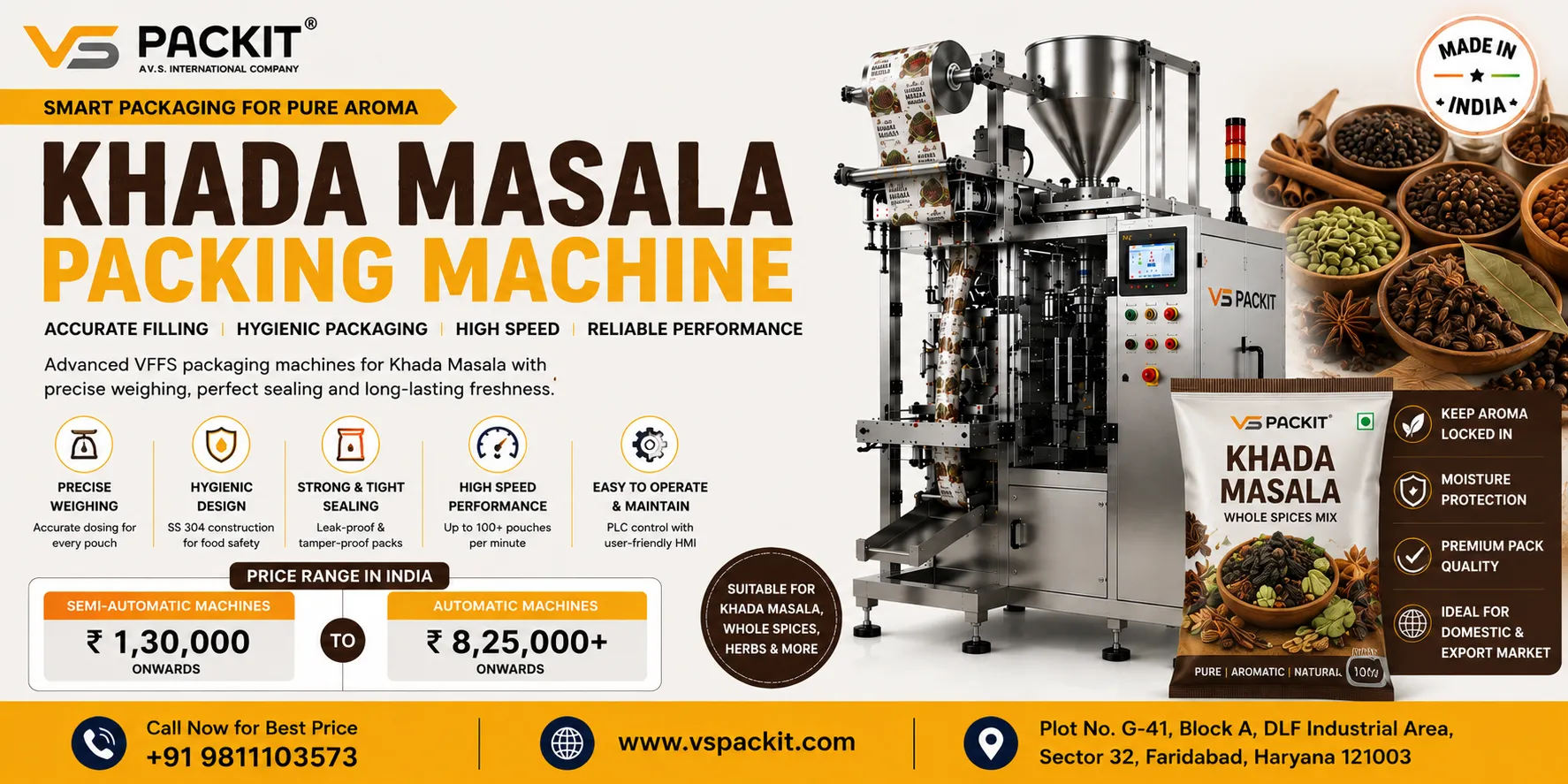
Khada masala, the whole spice blends like whole garam masala, sabut dhaniya mixes, chai masala with whole cardamom and cinnamon sticks, or achaar masala with mustard and fennel seeds, behaves nothing like fine powder when it comes to packing. Anyone who has actually run a spice line knows this the hard way. The moment you try to run whole spices through a machine built for powder, you get jams, uneven fill weights, and pouches that look messy on the shelf.
This is exactly why a khada masala packing machine is built differently from a standard powder packer, and why choosing the right one matters far more than most first-time buyers expect. Having spent years around spice packing units, both small family run operations and larger export focused manufacturers, the pattern is always the same: businesses that understand the difference between whole spice packing and powder packing early on save themselves a lot of rework, wasted product, and unhappy retailers.
This guide walks through how khada masala packing machines work, the different formats of khada masala packing pouch used in the market today, what actually drives khada masala packing machine price, and how to avoid the common mistakes buyers make.
Not sure which machine configuration fits your spice blend? Talk to our team and get a recommendation based on your pouch size, volume, and budget.
Why Khada Masala Packing Is Different From Powder Packing
Whole spices bring their own set of packing challenges that a powder line simply is not designed to handle:
- Irregular shapes and sizes: A mix of cinnamon sticks, bay leaves, cardamom pods, and cloves does not flow through a machine the same way fine powder does. Filling systems need to be built for volume based dosing rather than the tight auger-based weight control used for powder.
- Bulk density variation: Whole spice mixes have inconsistent density from batch to batch depending on moisture content and the ratio of ingredients. A packing machine needs some flexibility in its filling mechanism to keep weights accurate despite this variation.
- Larger pouch openings needed: Whole spices need a wider forming collar and bigger filling tube diameter compared to fine powder pouches, or you end up with pieces getting stuck at the neck of the pouch during sealing.
- Visual appeal matters more: Khada masala is often sold in transparent or semi-transparent pouches so customers can see the whole spices inside. This means the sealing has to be clean and consistent since any spillage or crooked seal is immediately visible on the pack.
A machine designed specifically as a khada masala packing machine accounts for all of this, typically using cup filling or volumetric filling systems instead of auger fillers, paired with a wider neck forming tube.
How a Khada Masala Packing Machine Works
The basic working principle follows the same form-fill-seal logic used across the packing industry, but with adjustments made for whole spice handling:
- Film unwinding and forming: Packing film unwinds and passes over a forming collar, shaping it into a tube or pouch structure. For khada masala, this collar is typically wider than what is used for powder to prevent whole pieces from jamming at the fold.
- Filling: Cup fillers or volumetric cup systems measure out a set volume of the whole spice mix and drop it into the pouch. Since whole spice pieces vary in size, volumetric filling tends to give more consistent results than weight-based systems alone, though many modern machines combine both for better accuracy.
- Sealing: Vertical and horizontal jaws seal the pouch. Because whole spice pieces can sometimes sit right at the seal line and cause a weak seal, good machines use extra dwell time or double sealing passes at this stage to keep the pack airtight.
- Cutting and discharge: The finished khada masala packing pouch is cut and dropped onto a conveyor for further packing into cartons or boxes.
The entire cycle typically runs a bit slower than powder packing lines simply because whole spice dosing needs a touch more precision, but the difference is minor once the machine is properly calibrated for the specific spice mix.
Types of Khada Masala Packing Pouch Formats
The choice of pouch format matters a lot for how the final product looks on shelf and how well it protects the spice.
1. Pillow Pouches
The most common and economical format. Works well for both retail packs and bulk institutional packs. Simple to produce at high speed.
2. Center Seal Pouches
Popular for khada masala because the seal runs down the center back of the pouch, giving a cleaner front face for branding and a transparent window if needed.
3. Stand-Up Pouches with Zipper
Increasingly used for premium khada masala brands. The zipper closure lets customers reseal the pack after opening, which matters a lot for whole spices that are often used in small quantities over several weeks.
4. Gusseted Pouches
Used when the pack needs to stand upright on shelf and hold slightly larger volumes without the pouch looking overstuffed or misshapen.
If you want to compare pouch formats and filling mechanisms suited to different production volumes, this page on masala pouch packing machine covers the range of configurations commonly used across the industry.
What Affects Khada Masala Packing Machine Price
This is usually the deciding factor for most buyers, so it helps to understand what actually moves the number up or down:
- Filling mechanism: Volumetric cup fillers are generally more affordable than combination weigh-and-volume systems, but the latter gives tighter accuracy for premium products.
- Automation level: Semi-automatic machines, where an operator loads pouches manually, sit at the lower end of the price range. Fully automatic form-fill-seal machines cost more but reduce labour dependency significantly over time.
- Pouch size flexibility: Machines that can handle a wide range of pouch sizes, say from small 20 gram sachets to large 500 gram family packs, are priced higher than machines fixed to a single size range.
- Sealing quality features: Double sealing, extra dwell time control, and pneumatic sealing systems all add to cost but reduce field complaints about leaking or torn pouches, which matters a lot for whole spice products sold on visual appeal.
- Speed and output: Higher throughput machines with servo motor control cost more upfront but make sense once daily order volumes justify the investment.
- Build material and after sales support: Food grade stainless steel construction and reliable local servicing are worth paying extra for, since a spice packing line running non-stop needs quick support when something goes wrong.
Entry-level semi-automatic khada masala packing machines sit at the more accessible end of the market, while fully automatic servo-controlled machines with combination filling systems occupy the higher end. Rather than chasing the cheapest option or the most feature-loaded one, the smarter approach is to size the machine to your current daily volume and pick something with room to scale as orders grow. For a closer look at how pricing breaks down across capacity and automation levels, this resource on masala packing machine price is a useful reference point before finalizing a budget.
Common Mistakes Buyers Make With Khada Masala Machines
A few patterns show up again and again across different spice units:
- Buying a powder machine and expecting it to handle whole spices: This is probably the single most common and costly mistake. Auger fillers built for fine powder simply cannot handle irregular shaped whole spices without constant jamming.
- Ignoring the forming collar size: Even machines marketed for masala packing sometimes come with a standard powder-sized neck. Always confirm the collar and filling tube diameter can handle your specific spice mix before purchase.
- Not testing with the actual product blend: Every khada masala mix has a different combination of pieces, sizes, and density. A machine that works fine for one blend might jam or underfill with another. Always insist on a live trial run with your exact product before finalizing.
- Overlooking pouch resealability: For premium or export focused khada masala brands, skipping a zipper closure option to save cost can hurt repeat purchase rates, since customers often complain about spices going stale in a plain pouch that cannot be resealed properly.
- Underestimating operator training needs: Even semi-automatic machines need an operator who understands how to adjust cup fill volume when switching between different spice blends. Budget time and effort for proper training after installation.
Conclusion
A khada masala packing machine is a fundamentally different investment from a standard powder packing line, and treating it the same way during the buying process usually leads to disappointment. Whole spice mixes need wider filling systems, careful pouch format selection, and sealing that can handle irregular shapes without compromising on airtightness.
Whether you are packing small retail sachets or bulk institutional packs, matching the machine's filling mechanism and pouch handling capability to your actual spice blend is the single most important decision in the buying process. Compare khada masala packing machine price against real throughput and after sales support rather than the sticker price alone, and always run a trial with your own product before committing. Getting this right the first time saves a lot of downtime and rework down the road.