
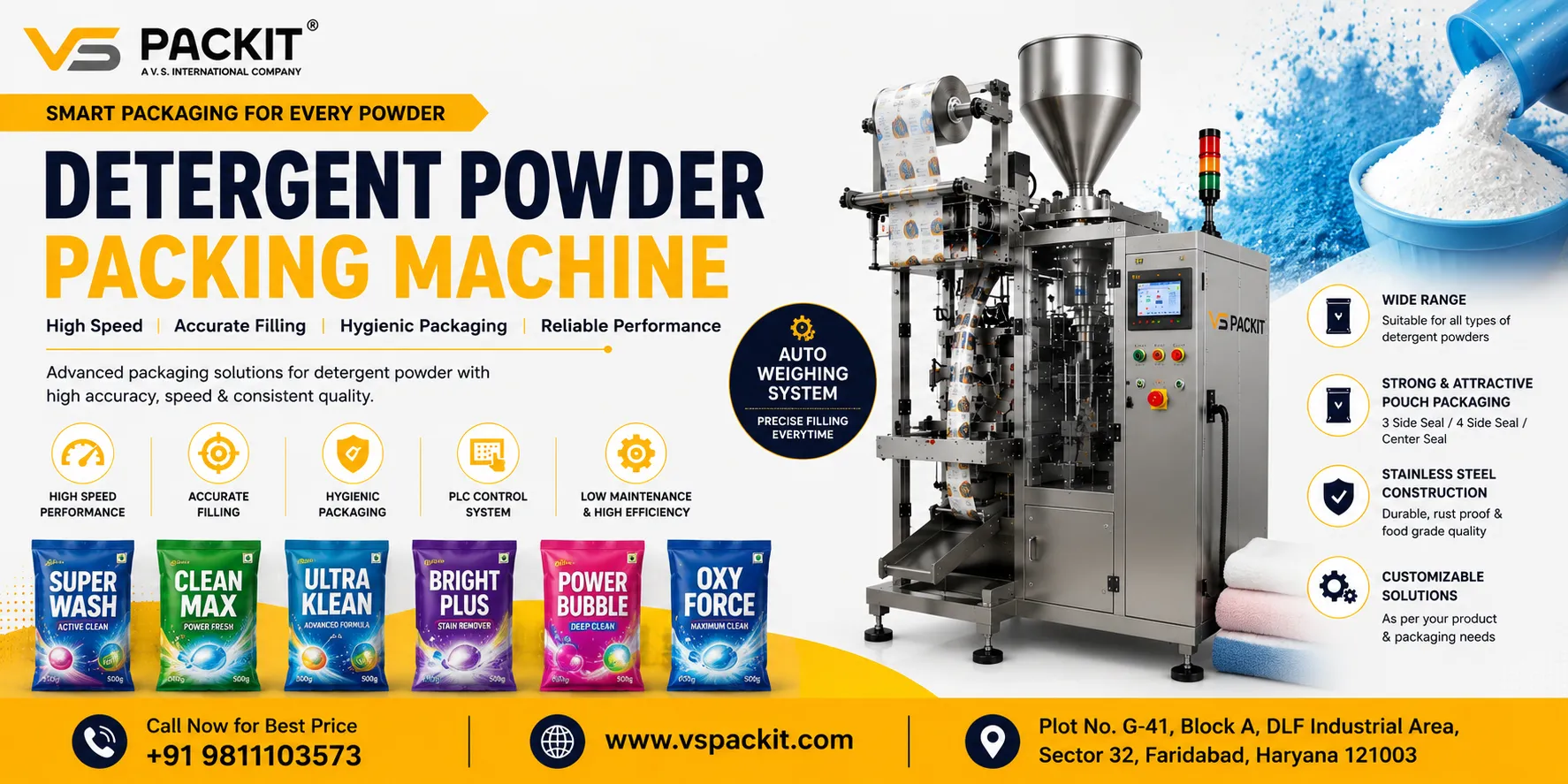
Anyone who has run a detergent manufacturing unit knows the packaging line is where a lot of small inefficiencies quietly pile up. A slightly inconsistent seal here, a bit of powder spillage there, a slower than expected fill rate on a busy day. None of it looks like a big deal on its own, but by the end of the month it shows up as wasted product and missed dispatch targets. This is exactly the gap a good detergent powder packing machine is built to close.
Whether you are setting up a new detergent unit or upgrading an ageing line, this guide walks through how these machines work, what to look for, what they cost, and which configurations are worth considering for different production scales.
What Is a Detergent Powder Packing Machine?
A detergent powder packing machine is equipment designed to measure, fill, and seal detergent powder into pouches or sachets at consistent weight and speed. It handles free flowing and slightly clumpy powders alike, which matters because detergent powder behaves differently from grains or liquids and needs a filling mechanism built specifically for it.
These machines are also referred to as detergent packaging machines, washing powder packaging machines, or detergent pouch packing machines depending on the manufacturer. Regardless of the name, the core job stays the same: accurate dosing, clean sealing, and high repeatable speed across thousands of pouches a shift.
You will find these machines in use across detergent manufacturing units, contract packaging facilities, and FMCG plants producing everything from small 10 gram sample sachets to bulk 1 kg or larger packs.
How Does a Detergent Powder Packing Machine Work?
Most detergent powder packing machines run on a Form Fill Seal (FFS) process, similar in concept to machines used for other powdered products, but tuned specifically for detergent's flow characteristics.
- Film forming: A roll of packaging film is pulled through a forming collar and shaped into a tube.
- Dosing: A volumetric cup filler or auger filler measures out the exact quantity of powder. Auger fillers work particularly well for detergent powder since they handle density variation and reduce dusting during the fill.
- Filling: The measured powder drops into the formed pouch through a filling tube.
- Sealing: Vertical and horizontal sealing jaws close the pouch using heat and pressure, creating an airtight seam that keeps moisture out.
- Cutting and discharge: The sealed pouch is cut free and dropped onto a conveyor or directly into a carton.
Depending on the machine, this cycle repeats anywhere from 20 to over 130 pouches a minute, which is why automation matters so much once your production volume grows past a certain point.
Types of Detergent Powder Packing Machines
Not every manufacturer needs the same setup. Machines generally fall into a few categories based on automation and filling mechanism.
Manual and semi-automatic machines: Suited for smaller units producing lower daily volumes, where an operator still handles part of the loading or bag placement process.
Fully automatic detergent powder packing machine: Built for continuous, high speed operation with minimal manual intervention. These typically include PLC control, digital weight display, and automatic film roll changeover, and are the standard choice for mid to large scale detergent units.
Cup filler machines: Use a volumetric cup to measure powder by volume. Cost effective and reliable for consistent density powders.
Auger filler machines: Use a rotating screw mechanism to dose powder, which handles varying density and reduces product bridging inside the hopper. This is often the better choice for detergent powder specifically, since it manages compaction and clumping more precisely than a simple cup system.
Collar type and chute type machines: Differ mainly in how the pouch is formed around the powder stream, with collar type generally suited to smaller pouches and chute type to slightly larger pack sizes.
Key Features to Check Before Buying
A specification sheet can look impressive without actually telling you how the machine performs on your factory floor. Here is what genuinely affects output quality day to day.
Dosing accuracy: Detergent is sold by weight, so consistent dosing directly protects your margins. Look for machines that hold accuracy within a few grams across the full filling range.
Auger or cup filler suited to your powder: If your detergent powder tends to clump or vary in density, an auger filler will serve you better than a basic cup system.
Stainless steel build: All product contact parts should be stainless steel, both for durability against detergent's mildly abrasive nature and for consistent long term performance.
PLC control with digital display: This allows quick changeovers between pack sizes and gives operators real time visibility into speed, weight, and fault alerts.
Dust management: Detergent powder generates fine dust during filling, which can affect seal quality and workplace cleanliness if the machine does not manage it well. Look for models with enclosed filling chutes or dust extraction provisions.
Speed matched to your production: A machine rated for 130 pouches a minute is wasted capacity if your daily output does not need it. Match the machine's speed rating to your realistic volume, with some buffer for growth.
Film compatibility: Confirm the machine works well with the film width and thickness you plan to use, since mismatched film handling leads to frequent jams and downtime.
Detergent Powder Packing Machine Price in India
Pricing depends heavily on automation level, filling mechanism, and output speed. Here is a practical price breakdown based on current market rates.
| Machine Type | Price Range (INR) | Typical Speed | Best For |
|---|---|---|---|
| Basic manual/semi-automatic | 55,000 to 1.5 lakh | 20 to 40 pouches/min | Small units, low daily volume |
| Automatic cup filler machine | 1.5 lakh to 2.75 lakh | 30 to 60 pouches/min | Mid size units with steady output needs |
| Automatic auger filler machine | 2.25 lakh to 3.6 lakh | 20 to 60 pouches/min | Units packing varying density or clumpy powder |
| Fully automatic high speed machine | 3.6 lakh to 5.5 lakh and above | 60 to 130 pouches/min | Large scale detergent manufacturing plants |
These figures are indicative and can shift based on pouch size range, customisation, and the manufacturer you choose. If your daily volume is modest, there is little reason to overspend on a high speed machine built for bulk production lines. On the other hand, if you are supplying retail chains at scale, investing in a fully automatic detergent powder packing machine usually pays back quickly through reduced labour dependency and higher consistent output.
Why the Right Machine Matters for Detergent Manufacturers
Detergent is a high volume, price sensitive category, which leaves little room for waste anywhere in the process. A machine with inconsistent dosing either under-fills, which invites regulatory and consumer trust issues, or over-fills, which quietly eats into your margin on every single pouch. Weak seals lead to powder leakage during transport and storage, resulting in damaged stock and unhappy distributors.
A well matched packing machine also affects how your product looks on the shelf. Consistent pouch weight, clean seals, and neat pouch dimensions all contribute to how professional your brand appears next to competitors, which matters more than most manufacturers initially expect in a crowded FMCG category.
Machines Worth Considering
If you are shortlisting machines for a detergent packing line, a few configurations are worth evaluating closely.
The Komet Sprint is built for units that need fast, dependable pouch packing without frequent stoppages, making it a solid fit for detergent manufacturers running consistent daily batches.
For manufacturers dealing with detergent powder that varies in density or tends to clump, Servo Auger Fillers offer precise, servo controlled dosing that handles these variations far better than a standard cup filler.
If your production line covers multiple pack sizes or SKUs, Duplex Packaging Systems provide a dual lane setup that increases output without doubling your floor space or machine count.
And for manufacturers who pack more than one powdered or granular product on the same line, Various Filler Systems offer the flexibility to switch between products with minimal changeover time.
If your operations extend beyond detergent into other powdered products, it is also worth looking at options like a milk powder packing machine, since many of the same dosing and sealing principles apply across powder categories.
Choosing a Reliable Supplier
Buying a detergent powder packing machine is as much about choosing the right partner as it is about the machine itself. Look for packaging machinery manufacturers in India with a genuine service track record, since a packing line sitting idle due to unavailable spare parts costs far more than the machine itself over time. Ask about warranty terms, average response time for service calls, and whether the manufacturer offers operator training as part of the purchase.
A transparent quotation should clearly state the model, filling range, output speed, film compatibility, and what is covered under warranty. Taking the time to compare a few suppliers on these specifics, rather than price alone, tends to save both money and downtime over the machine's working life.
Conclusion
A detergent powder packing machine is not just another piece of factory equipment, it directly shapes your product consistency, your margins, and how reliably you can meet dispatch schedules. Match the machine's automation level and speed to your actual production volume, prioritise dosing accuracy and build quality over the lowest quote, and work with a supplier who will stand behind the machine long after installation. Get that right, and your packing line stops being a bottleneck and starts being one of your most dependable assets on the floor.