
Milk powder is one of those products that looks simple on the shelf but is genuinely tricky to package well. It is fine, prone to clumping if humidity gets in, and needs airtight sealing to hold its shelf life. Get the packing process wrong and you end up with lumpy stock, inconsistent pack weights, or pouches that lose freshness faster than they should. Get it right, and milk powder packing becomes one of the smoothest, most reliable parts of your production line.
This guide covers everything you need to know about milk powder packing, from how the machines actually work to what drives cost, so you can make a decision that fits your production scale and product type.
What Does Milk Powder Packing Involve?
Milk powder packing is the process of measuring, filling, and sealing milk powder into pouches, sachets, or bags at a consistent weight, using equipment built specifically to handle fine, slightly hygroscopic powder. Unlike liquid milk packing, which deals with volume based dosing, milk powder packaging relies on weight or volumetric based filling systems designed to manage a powder that can compact, clump, or resist smooth flow depending on humidity and particle size.
You will also come across this described as milk powder packaging, milk powder filling, or simply powder pouch packing when the same machine is used across multiple dry products. Whatever term is used, the underlying goal stays consistent: accurate fill weight, a clean airtight seal, and minimal product wastage during the run.
This kind of packing is used across dairy processing plants, infant nutrition manufacturers, bakery ingredient suppliers, and export packaging units that handle skimmed milk powder, whole milk powder, and instant milk powder blends.
How Milk Powder Packing Machines Work
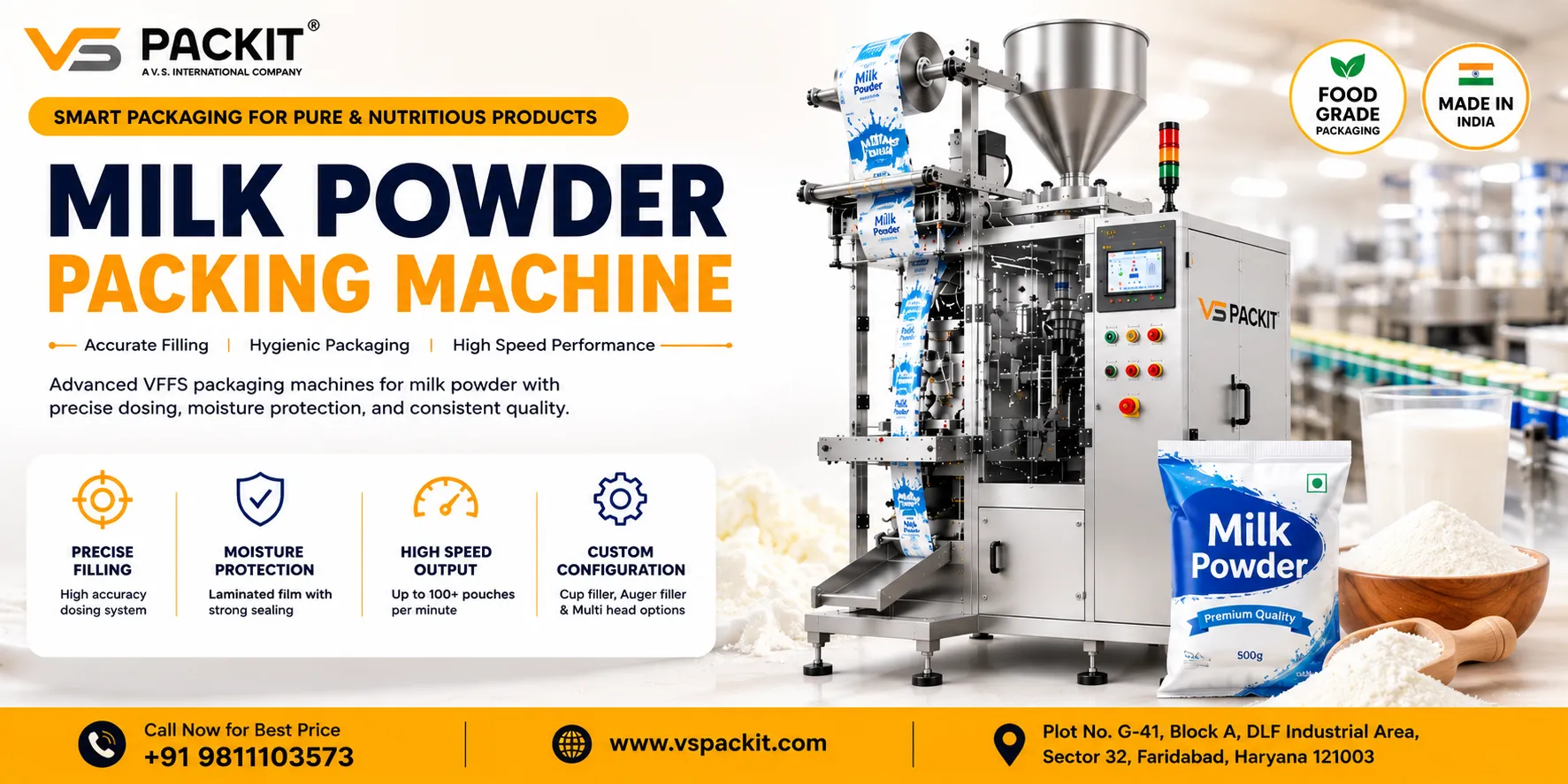
Most milk powder packing lines use a Vertical Form Fill Seal (VFFS) process, built around a filling mechanism suited to powder rather than liquid.
- Film forming: Packaging film is drawn through a forming collar and shaped into a vertical tube.
- Dosing: An auger filler or volumetric cup filler measures the exact quantity of milk powder. Auger fillers are generally preferred for milk powder since the rotating screw handles compaction and reduces dusting far better than a basic cup system.
- Filling: The measured powder is released into the formed pouch through a filling chute.
- Sealing: Vertical and horizontal sealing jaws close the pouch using controlled heat and pressure, forming an airtight seam that protects the powder from moisture.
- Cutting and discharge: The finished pouch is cut free and moves onto a conveyor or directly into secondary packaging like cartons.
Because milk powder is moisture sensitive, many machines also include desiccant or nitrogen flushing options to extend shelf life, particularly for export grade or long shelf life products.
Types of Milk Powder Packing Machines
Choosing the right type depends heavily on your product's flow characteristics and your daily production volume.
Manual and semi-automatic machines: Suitable for smaller units or lower daily volume, where an operator still manages part of the loading and adjustment process.
Cup filler machines: Use a volumetric cup to dose powder by volume. Cost effective and fast, well suited to milk powder that flows relatively freely and does not clump easily.
Auger filler machines: Use a rotating screw to dose powder by controlled rotation, which handles density variation, reduces dusting, and improves accuracy for milk powder that tends to compact or clump under humidity. This is the more common choice for serious dairy and export packaging operations.
Servo auger filler machines: A more advanced version of the auger system, using servo motors for tighter control over dosing accuracy and repeatability, especially useful when packing multiple pack sizes on the same line.
Multi-lane and high speed systems: Built for large scale operations packing thousands of pouches a day, often running dual or multi lane configurations to multiply output without doubling floor space.
Key Features to Look For
A specification sheet only tells part of the story. Here is what genuinely matters once the machine is running daily production.
Auger filler suited to your powder type: If your milk powder tends to clump or vary in density, an auger filler will consistently outperform a basic cup system on accuracy.
Dosing accuracy: Since milk powder is sold by weight, even small deviations across thousands of pouches add up to real losses. Look for machines that hold accuracy within a few grams.
Moisture and dust control: Enclosed hoppers, dust extraction, and optional nitrogen flushing all help protect milk powder's shelf life and reduce workplace dust.
Stainless steel construction: All product contact parts should be food grade stainless steel, both for hygiene compliance and long term durability against a mildly abrasive powder.
PLC control with digital display: Enables quick changeovers between pack sizes and gives operators real time visibility into speed, weight accuracy, and fault alerts.
Servo driven dosing: For operations packing multiple SKUs or pack sizes, servo control offers tighter repeatability than standard mechanical dosing.
Film compatibility: Confirm the machine handles the film type and thickness you plan to use for moisture barrier protection, since milk powder needs stronger moisture resistance than many other dry products.
Milk Powder Packing Machine Price in India
Pricing varies based on filling mechanism, automation level, and output speed. Here is a practical breakdown to help you budget.
| Machine Type | Price Range (INR) | Typical Speed | Best For |
|---|---|---|---|
| Manual/semi-automatic cup filler | 1.4 lakh to 2.5 lakh | 20 to 40 pouches/min | Small units, lower daily volume |
| Automatic cup filler machine | 1.8 lakh to 5 lakh | 30 to 60 pouches/min | Mid size dairy or food units |
| Automatic auger filler machine | 2.5 lakh to 8.75 lakh | 20 to 60 pouches/min | Milk powder with clumping tendency, export grade packing |
| High speed servo auger/multi-lane system | 8.75 lakh and above | 60 to 100+ pouches/min | Large scale dairy plants, bulk export operations |
These figures are indicative and shift based on pouch size range, additional features like nitrogen flushing, and the manufacturer you work with. For most mid sized dairy operations, an automatic auger filler machine offers the best balance between accuracy, running cost, and investment.
Why Getting Milk Powder Packing Right Matters
Milk powder is a nutrition sensitive, relatively high value product, and packaging mistakes here carry more weight than with many other dry goods. Inconsistent fill weight either shortchanges the consumer, which creates regulatory and trust issues, or over-fills, which quietly reduces your margin on every pouch. Poor sealing lets moisture in, which shortens shelf life and can affect the powder's texture and solubility, both of which matter a great deal to consumers checking quality.
For export focused manufacturers, this becomes even more important, since international buyers often have strict standards around moisture content, pack integrity, and batch consistency. A well chosen packing machine, paired with proper moisture control, directly protects your ability to meet those standards consistently, shipment after shipment.
Machines Worth Considering for Milk Powder Packing
If you are shortlisting equipment for a milk powder packing line, these configurations are worth a closer look.
The Komet Sprint is built for units that need fast, dependable pouch packing with minimal stoppages, making it a strong fit for dairy manufacturers running consistent daily batches of milk powder.
For milk powder that tends to clump or vary in density, Servo Auger Fillers offer precise, servo controlled dosing that manages these challenges far better than a standard cup filler, which matters a lot for export grade consistency.
If your line handles multiple pack sizes or product variants, Duplex Packaging Systems provide a dual lane setup that increases output without requiring a second full machine setup.
And for manufacturers packing more than one powdered product on the same line, Various Filler Systems offer the flexibility to switch between products with minimal changeover downtime.
If your production also extends into spice powders, it is worth exploring options like a Turmeric Powder Packing Machine or a Chilli Powder Packing Machine, since many manufacturers running milk powder lines also handle other fine powder categories using similar dosing principles.
Choosing the Right Partner for Your Packing Line
A milk powder packing machine is a long term investment, so it is worth spending time comparing suppliers rather than settling for the first quote. Ask specifically about dosing accuracy under real production conditions, moisture control options, after sales support, and spare parts availability. A transparent quotation should clearly state the model, filling range, output speed, and warranty terms, giving you a solid basis to compare across manufacturers.
Final Thoughts
Milk powder packing sits at the intersection of accuracy, hygiene, and shelf life protection, which makes it one of the more demanding categories in dry powder packaging. Choosing a machine that matches your powder's specific flow characteristics, whether that calls for a cup filler or an auger system, along with solid moisture control, will save you far more in reduced wastage and consistent quality than chasing the lowest upfront price. Take the time to match the machine to your actual production needs, and milk powder packing becomes one less thing to worry about on your production floor.