
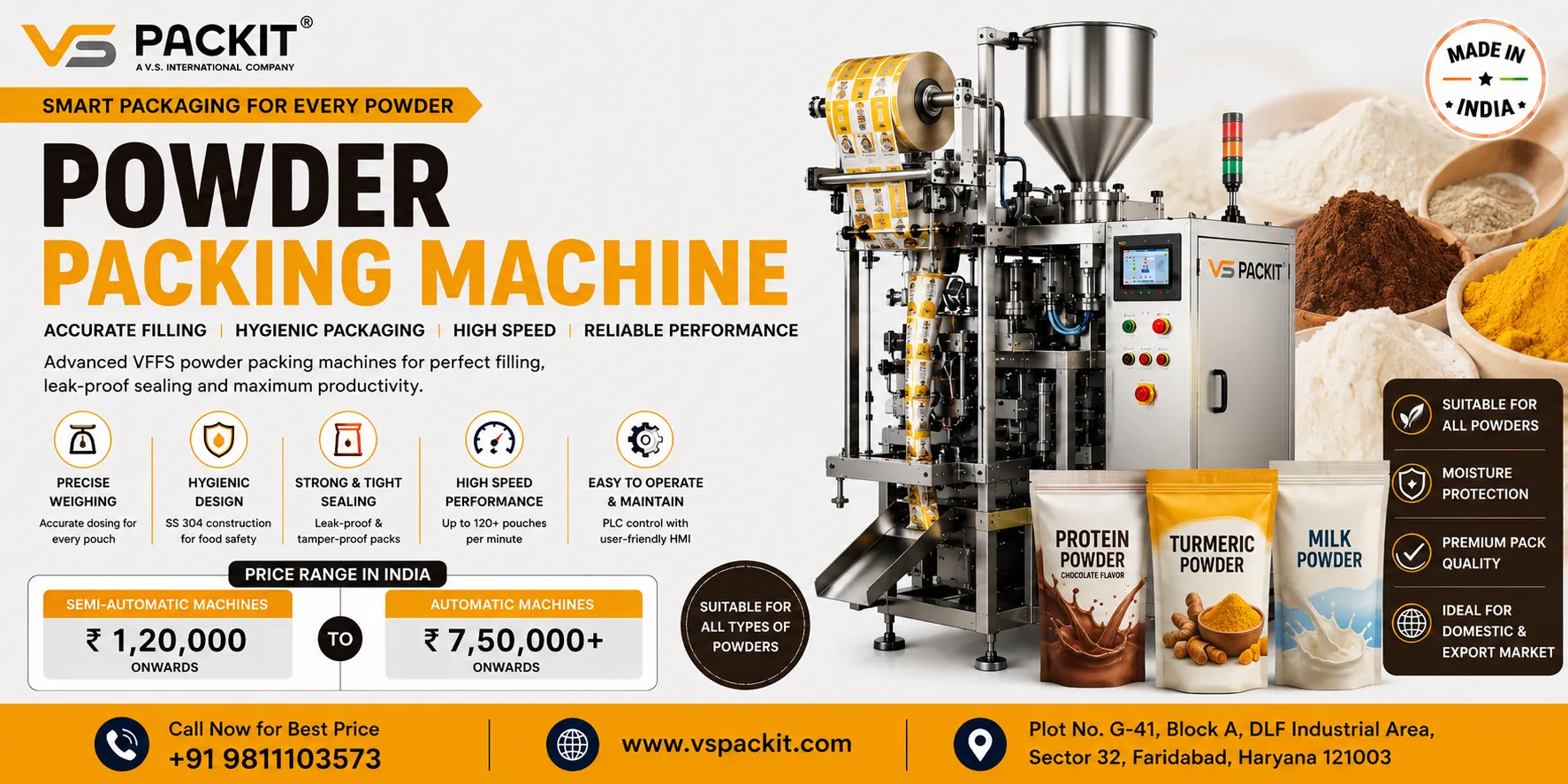
Powder is one of the trickiest product categories to pack well. Whether it is a food powder, a chemical compound, a nutraceutical blend, or a detergent formulation, the same core problems keep showing up on the shop floor: dusting, inconsistent fill weights, static cling, and product settling that throws off calibration halfway through a shift. Anyone who has spent real time on a packing line knows that a powder packing machine is not a one-size-fits-all purchase. The right setup depends heavily on the specific powder's flow characteristics, your daily output target, and how much automation actually makes sense for your operation right now.
Having worked around packing lines across food, pharma, agro, and industrial powder segments, one pattern comes up again and again. Businesses that take the time to match the filling technology to their actual product, rather than buying whatever machine looks most impressive in a demo video, end up with far fewer line stoppages and far better long term ROI.
This guide covers how a powder packing machine actually works, the difference between a powder packaging machine and a small powder filling machine, what filling technologies exist, and how to choose the right configuration for your production scale.
Not sure which filling system suits your powder? Talk to our team and get a recommendation based on your product, pouch size, and daily volume.
Why Powder Packing Is Harder Than It Looks
Powders behave very differently depending on particle size, moisture content, and bulk density, and this directly affects how a machine should be built:
- Flowability issues: Fine powders tend to clump or bridge inside hoppers, causing inconsistent flow into the filling mechanism. Coarser powders flow more freely but can segregate by particle size during transport.
- Static and dusting: Very fine powders generate static charge that makes them cling to machine parts, film surfaces, and pouch necks, which leads to weak seals and messy pouches.
- Weight accuracy under variation: Powder density can shift slightly from batch to batch. A machine that cannot compensate for this will drift out of calibration over a production run, leading to underfilled or overfilled packs.
- Contamination and hygiene: For food and pharma powders especially, the filling system needs to be easy to clean and free of dead zones where residue can build up between batches.
This is exactly why generic packing equipment often underperforms on powder. A machine purpose built as a powder packing machine accounts for these variables from the design stage, rather than trying to retrofit a solution meant for liquids or granules.
How a Powder Packing Machine Works
Most powder packing lines, regardless of scale, follow a similar sequence:
- Product feeding: Powder moves from a hopper or storage silo into the filling mechanism, often assisted by a vibratory feeder or agitator to prevent bridging.
- Dosing and filling: This is the core of the machine. Depending on the powder type and required accuracy, dosing happens through an auger screw, a volumetric cup, or a net weigh system.
- Pouch or container forming: For pouch packing, film unwinds and forms around a collar before the powder drops in. For pre-made containers or bottles, the container is indexed under the filling head instead.
- Sealing or capping: Heat sealing for pouches, or capping and induction sealing for bottles and jars.
- Discharge and secondary packing: Finished packs move to a conveyor for cartoning, labeling, or case packing.
The choice of dosing method has the biggest impact on both accuracy and cost, which is why it is worth understanding the main filling technologies before deciding on a machine.
Filling Technologies Used in Powder Packing Machines
Different powders call for different filling systems, and getting this match right is often the single biggest factor in how well a line performs.
Auger Fillers: A rotating screw doses powder based on a calibrated number of rotations. This works extremely well for fine to medium powders like spices, flour, protein powders, and pharma actives, where tight weight tolerance matters. Servo controlled auger fillers offer even finer control and faster changeovers between products.
Multi-Head Weighers: Multiple weighing heads combine small portions to hit a target weight with high accuracy at high speed. More common for granular or coarser powders, and generally used at larger production scales due to higher machine cost.
Volumetric Cup Fillers: A fixed volume cup doses product by volume rather than weight. Economical and fast, well suited for free flowing powders where slight weight variation is acceptable.
Duplex and Multi-Lane Systems: For businesses running high volume production, duplex configurations run two filling and sealing lines simultaneously off a single machine frame, effectively doubling output without doubling floor space or operator headcount.
Powder Packaging Machine vs Small Powder Filling Machine
These two terms often get used interchangeably, but there is a practical difference worth understanding before you shop.
A powder packaging machine typically refers to a more complete production line setup, often including pouch forming, filling, sealing, coding, and sometimes even cartoning integrated together. These are built for continuous, higher volume operations.
A small powder filling machine, on the other hand, is usually a compact, often semi-automatic unit meant for lower volume production, contract packing, or businesses just starting to automate away from hand filling. These machines are easier to operate, need less floor space, and come at a lower upfront cost, making them a practical entry point for small and mid-sized manufacturers before scaling up to a full production line.
Choosing between the two really comes down to current order volume and how much room you have to grow into a larger setup later. Buying more automation than your daily output currently needs often means paying for idle capacity, while undersizing your equipment early can mean a costly upgrade sooner than expected.
Choosing the Right Powder Packing Machine for Your Business
A few practical questions help narrow down the right configuration:
- What is your powder's flow behaviour? Fine, cohesive powders need auger or combination systems. Free flowing powders can often work well with simpler volumetric fillers.
- What weight accuracy do you actually need? Pharma and nutraceutical powders often need tighter tolerances than industrial or agro powders, which affects both machine choice and cost.
- What is your daily or monthly volume? This determines whether a small powder filling machine is sufficient or whether a duplex, high speed system makes more financial sense.
- How many SKUs or pack sizes do you run? Frequent changeovers benefit from servo controlled systems that can be reprogrammed quickly rather than mechanically adjusted each time.
- What is your hygiene and compliance requirement? Food and pharma applications need contact parts in food grade stainless steel with easy strip down cleaning.
VS Packit Filling Systems for Powder Packing
Different powders and production scales call for different filling technology, and having the right options available matters when you are trying to match equipment to your actual product rather than settling for a generic setup.
| Product | Best Suited For |
|---|---|
| Servo Auger Fillers | Fine to medium powders needing precise, programmable dosing with fast changeovers between products |
| Various Filler Systems | Businesses handling multiple product types across powders, granules, and free flowing materials |
| TPI 912 Duplex Auger | High output operations needing twin lane filling for doubled throughput without extra floor space |
| Duplex Packaging Systems | Manufacturers scaling up production who need consistent accuracy across simultaneous packing lines |
Common Mistakes to Avoid
A few recurring issues show up across powder packing installations:
- Ignoring powder characteristics during machine selection: A machine that works perfectly for one powder can underperform badly on another with different flow properties. Always test with your actual product before committing.
- Underestimating cleaning and changeover time: Frequent product changes without a machine designed for quick strip down cleaning can eat into daily output more than the filling speed itself.
- Overbuying automation too early: Jumping straight to a high speed duplex line before daily volumes justify it often means paying for capacity that sits idle.
- Overlooking dust control: Fine powders that generate dust need proper containment and extraction built into the machine design, both for product loss reasons and for operator safety.
- Not planning for future SKUs: A machine locked into one pouch size or one powder type can become a bottleneck the moment the product line expands.
Conclusion
A powder packing machine is one of the few equipment decisions that directly affects daily output, product consistency, and how much manual labour your operation depends on. The right filling technology, whether auger, volumetric, or multi-head weigher, needs to match your specific powder's behaviour rather than being chosen off a spec sheet alone.
Whether you are just moving up from a small powder filling machine or planning a full powder packaging machine line with duplex output, taking the time to test with your actual product and size the machine to your real production volume will save considerable cost and downtime down the road.
Have questions about which filling system fits your powder and production scale? Get in touch with our team and we can walk you through the right configuration.