

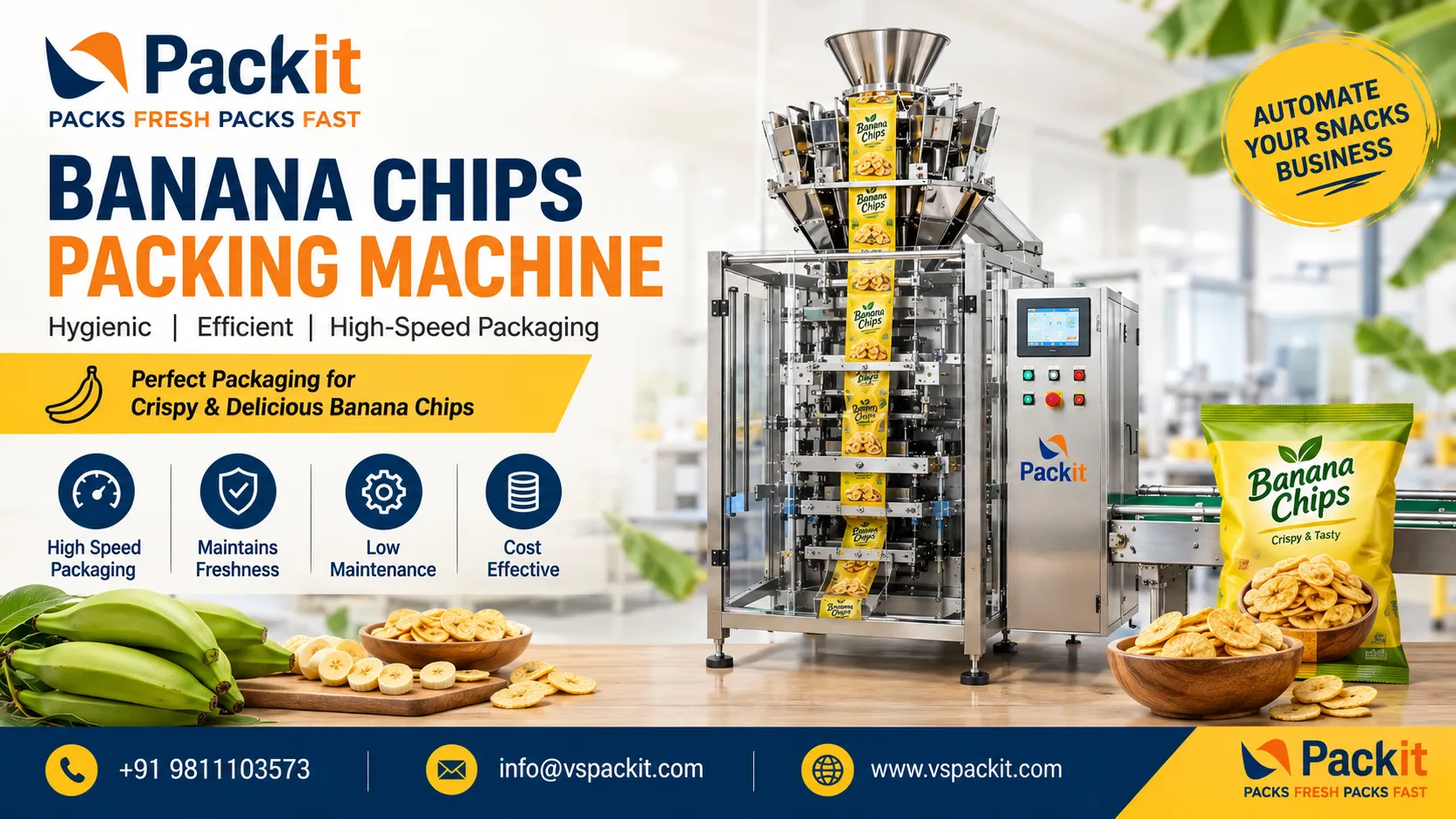
This article is a complete guide to help you purchase a banana chips packing machine in India. From the working mechanism to features that will set apart a good machine and a bad one, you'll find everything you need to know here.
What Is a Banana Chips Packing Machine
A banana chips packing machine is a machine, which forms, fills, and seals the package of a desired amount of banana chips in one operation. Most often, the packing machine for banana chips, being a complex mechanism, is equipped with a Vertical Form Fill Seal, or VFFS, and a volumetric or multihead filler, which allows achieve an exact fill with fragile, irregular products such as banana chips.
The machine is designed to solve a specific packaging issue, since banana chips are quite a fragile and irregular product, which requires special attention during the filling process.
Reasons Why Banana Chips Are Hard to Pack
I have worked for years in packing lines for various fried snack producers, and banana chips are among the most challenging products to pack correctly. Several factors associated with the properties of this product could interfere with the correct packing process. First of all, banana chips are irregular in size and shape, and although modern volumetric fillers could solve this issue in most cases, an incorrectly set machine may cause overfilled or underfilled bags. Second, banana chips are quite fragile, meaning that rough handling during the filling process will lead to broken pieces, which will create unsatisfactory visual appearance on the bag bottom. Therefore, such bags would not be welcomed by the consumer, despite the product quality.
Furthermore, banana chips, just like any other fried snack, have oil on their surface after the frying process. This oil could appear on the film during the packing process and damage the seal, leading to the most frequent defects in the finished pack – leakages. A machine designed to fill and seal bags with chips would address this issue during the design phase, while a machine used for powder or granules would not.
How a Banana Chips Packing Machine Works Essay
In short, the machine takes a film, forms it into a tube, inserts a predetermined amount of product, makes vertical and horizontal seals, and cuts the formed pouch, all with one compact movement.
- Film unwinding and forming – At the beginning of the process, a film is unwound from a film roll and, with the help of a former, formed into a vertical tube.
- Vertical sealing – The overlapping edges of the film tube are welded vertically to form a pouch.
- Product filling – The desired amount of product is inserted into the formed pouch using a weighing or volumetric method.
- Horizontal sealing – The horizontal seal of the welded pouch is made by heated jaws, in which the bottom of the current pouch and the top of the next one are simultaneously welded.
- Cutting, discharge – The pouch is cut off and discharged onto a take-away conveyor.
- Nitrogen flushing – In some cases, nitrogen is flushed into the pouch to displace oxygen. This process is necessary to prevent the oxidation of oils in the product, which is why many products, especially those.
- subjected to high-temperature processing (e.g., frying), are packed in nitrogen instead of ordinary air.
Machine Components That Are Critical for Chips Packaging
Not all VFFS machines are created equal, and if your product is a delicate oily snack like banana chips, you will benefit from knowing which components are more important than the specs indicate.
- Gentle product delivery system that reduces the risk of breakage by decreasing the falling height and impact force.
- Servo-driven vertical and horizontal sealers that provide accurate and repeatable sealing pressure irrespective of the machine’s speed.
- Anti-static and dust removal functions that prevent the accumulation of the fine chip dust and static electricity.
- Nitrogen flushing valve that replaces oxygen in the pouch to prevent oxidation.
- Photo eye and encoder that ensure correct print registration of the film.
- Touchscreen PLC with recipe functions that store the set pressure, temperature, and speed values to quickly change the settings depending on the chip variety.
- Food grade stainless steel parts in contact with the product that resist the adhesion of oil and facilitate cleaning.
Applications and Industries Fit for a Banana Chips Packing Machine
A banana chips packing machine can be used for more than just bananas! In fact, most of these companies use the same core system (and slight modifications of the filling head) for a variety of different dried and fried snack products, including:
- Banana chips and banana wafers
- Potato chips and wafers
- Namkeen and mix snacks
- Roasted and salted nuts
- Extruded and puffed snacks
- Dry mix fruit
- Popcorn and other corn snacks
This is important to note if you are looking to use one production line for multiple similar products, as you can often modify the same machine to fit your needs.
Benefits of Automating Your Chips Packing Line
Having worked with numerous packaging lines across the snacks industry, the benefits of having switched from semi-automatic or manual methods to a proper chips packing machine always seem to boil down to several key points.
- Consistency is one such prime example, as a servo-driven line will produce each pouch with exactly the same amount of fill and the same quality of seal, something that could not be said about manual packing.
- Speed is another major benefit, as an automated line will produce far more bags with far fewer workers than any number of manually operated tables could manage.
- Fewer losses due to mishandling, overfilling, or seal defects also contribute to the overall value of automated packing.
- The ability to provide a longer shelf life for oil-fried products by means of nitrogen-flushing and proper sealing allows for fewer issues with distributor returns.
- Finally, while the initial investment may be steep, replacing multiple workers with a single automated line has a much lower long-term cost.
GT-5S and Komet Sprint: High-Speed and Compacted VFFS Machines for Chips Packaging
When it comes to VS PacKit’s offer, some of the most frequently asked questions regard the two machines that can be found in the most discussions with chips manufacturers.
The first is a high-speed continuous motion VFFS machine called GT-5S. It is ideal for brands that want to boost the production rates due to its ability to work in continuous motion. GT-5S is compatible with most of the multi-head weighers and cup fillers available on the market, making it a great choice for banana chips manufacturers who want to ensure high-speed sealing without reducing the quality of filling. Thanks to the machine’s servo-driven jaw actuation and vacuum pull belts, the operators can achieve perfect seal quality even at higher speeds that are usually challenging for such products. That is why GT-5S is a smart choice for brands that want to elevate their production rates while keeping the fill weights accurate and ensuring the product’s integrity.
Meanwhile, Komet Sprint is a more compact solution designed for small and medium chips manufacturers or those looking to scale their production from manual packaging. This machine set is perfect for brands that want to enjoy the benefits of VFFS packaging, including superb precision and touchscreen interface, without having to invest heavily into high-speed equipment. With Komet Sprint, the manufacturers gain a reliable filler with excellent speed that is still sufficient for most medium-paced production lines.
Ultimately, there is no doubt that both solutions can be a great addition to the manufacturing process of a chips packaging company, but which one is worth choosing depends on the production volumes, desired pouch formats, and the available floor space.
GT-5S vs Komet Sprint: Quick Comparison
| Factor | GT-5S | Komet Sprint |
|---|---|---|
| Best suited for | High-volume chips brands | Smaller and mid-sized producers |
| Motion type | Continuous motion | Compact intermittent/continuous motion |
| Ideal for | Large-scale, multi-shift operations | Scaling brands, leaner floor space |
| Filler integration | Multihead weigher, cup filler, auger filler | Compatible filling attachments |
| Floor space required | Larger | Smaller footprint |
What Determines the Cost of a Chips Packing Machine
Many banana chips manufacturers start their research on the banana chips packing machine price, which is fair, but the number you find doesn’t provide much information on what you’re actually buying. The real specification that makes the difference of value is the engineering of the product filler.
The most important factor in a chips packing machine is the filler, as delicate as the product is. The costlier option will have a more elaborated design to reduce breakage, thus, saving you money on rejections, whereas a simpler gravity filler will produce more rejects. The quality of the servo system, the grade of the steel of the filler’s jaws, the type of sealing system, and the level of service provided will also determine the price.
When it comes to determining the chips packing machine price, it’s better to ask for details, such as the type of filler, sealing method, nitrogen, and service policy, for each quotation you receive. Don’t get fixated on the number but focus on the differences in the configuration. If you want to get more information on the factors that influence the price of a chips packing machine, you can check the VS PacKit’s Chips Packing Machine Price Guide and Potato Chips Packing Machine Price in India Guide.
Buying Guide: Questions to Ask Before Buying
- Ask to try it on a live trial with your own chips. Density, moisture levels, and chunk sizes all play a role in the process and may vary in different banana chip production batches. Asking to test it on a trial basis is the only way to be certain about the results.
- Asking about the breakage percentage during the trial run is critical. In most cases, it is the only way to understand if the machine was built to handle delicate products.
- Asking if the machine can flush nitrogen into the bag is necessary if you are planning on having a long shelf life for your product.
- Asking about the materials used in the machine and ensuring they are food-grade certified is vital. It is essential to get all the necessary paperwork and ensure that nothing is hidden about the construction materials.
- Asking about the options for fillers is important. While some may suggest using a simple volumetric cup filler, it is best to ask about multi-head weighers that are usually more relevant to your needs. They may be more expensive than volumetric fillers.
- Asking about the possibility of using different formats is necessary. You may want to keep multiple options available instead of having one pouch size as the only option. The switching time between different pouches should also be taken into consideration.
- Asking about spare parts and the response time of the manufacturer is important. Sealing jaws, Teflon coatings, and sensors need to be replaced occasionally, and there must be spares in stock.
Common Mistakes Made by Manufacturers Essay
One common mistake that many factory owners make is purchasing a machine that is barely sufficient for the current level of production. In most cases, it is more cost-effective to buy an option with higher specifications and improve the production rate rather than upgrade the equipment several times within the next two to three years.
Another error that manufacturers tend to make is underestimated the impact of oily residues on the sealing performance. Often, demo machines that worked fine during the 5-minute sample may reveal issues after four hours of a continuous workflow due to the formation of an oily film. It may be helpful to specifically ask about this detail during the trial period.
Finally, I have noticed that some manufacturers try to save money by skipping the trial run of the machine. As a result, they may find out too late that the fill weight is insufficient or that there are issues with the product’s breakage rate. In my opinion, it is better to invest extra money and spend an additional week to organize a trial rather than restructure the entire production process due to a single mistake.
Maintenance and Safety
Proper maintenance ensures that a chips packing line operates at its rated capacity and protects the capital invested in the equipment. The following activities are part of the routine maintenance:
- Cleaning the product delivery system and the hopper after every shift to avoid oil and crumb accumulation.
- Periodic checks and replacement of Teflon coating on the jaws in case of damage.
- Checking the temperature of the seal bar against the calibrated temperature.
- Regular lubrication of the driven parts according to the manufacturer’s guidelines.
- Periodical checks of the nitrogen flushing valve operation.
In terms of safety, machines must be equipped with standard safety guards at all moving parts, heated elements, and electrical equipment in accordance with the general safety requirements applicable in India for industrial machines and equipment and specific food contact surfaces.
Latest Technology and Future Trends
The latest technological trends in chips packaging are witnessing a shift towards advanced automation. This implies that besides the standard PLC-based recipe-storage, machine performance-monitoring systems are becoming a must, and precision is achieved through sophisticated servo drives. The future trends include more synchronized filling and sealing systems that are capable of delivering consistent performance when handling delicate items and using environmentally friendly films that help reduce wastage in the FMCG industry.
ROI: What to Expect
The return on investment in a banana chips packing machine is manifested through three primary sources of value: waste reduction due to a more accurate fill and gentle product handling, decrease in cost-per-unit accounted for by a reduced labor input, and diminished returns due to faulty seal and shelf life issues. Thus, the initial expenditure on an appropriately specified automatic line is projected to be offset by the combined effect of these three mechanisms within a reasonable timeframe, which may be estimated depending on the current productivity parameters and waste generation rates of the manufacturer considering the transition.
Why Manufacturers Choose VS PacKit
VS PacKit, the brand name of V.S. International’s packaging machinery, has been manufacturing VFFS and pouch packing solutions for over two decades from its Faridabad manufacturing unit. What differentiates the brand for applications such as chips and other snacks is not just one or two features but the combination of a servo-driven engineering precision, a customization for even the most challenging applications such as banana chips, and third, a post-sales support that manufacturers can trust for keeping their production lines running during a breakdown.
With two granted design patents and a constant innovation in filling and sealing technology, VS PacKit offers not a portfolio of duplicated design patents but actual engineering know-how that can be relied on for a machine that will run 24/7, 365 days a year. For anyone searching online for a Snacks Packing Machine, or comparing the Banana Chips Packing Machine Price in India against other manufacturers, a related resource of What Makes a Chips Packing Machine Worth the Investment should be consulted alongside to this guide, and the Potato Chips Packing Machine page for manufacturers that work with a variety of products.
Ready to upgrade your chips packing line?
If loss of product due to breakage, uneven fill weights and seal failures is eroding your brand and distributor relationships, give us a call. We can provide a manufacturer that designs equipment specific to delicate snack foods, not a machine that has been modified to fit a certain need. Call VS PacKit to discuss your production needs and to trial run your banana chips.