
Walk into any dairy plant today and you will notice one thing fast. The milk pouch on your breakfast table did not seal itself. Somewhere behind the scenes, a machine measured that milk down to the millilitre, sealed it airtight, and pushed it out at a speed no human hand could match. That machine is the quiet backbone of the entire dairy supply chain, and it goes by a simple name: the milk packing machine.
If you are running a dairy, planning to start one, or simply trying to understand what separates a good packing line from a bad one, this guide covers everything in plain language. No jargon overload, no sales pitch dressed up as advice. Just the real picture of how milk packing machines work, what they cost, and how to choose one that will not let you down at 4 AM when the first batch of the day needs to go out.
What Is a Milk Packing Machine?
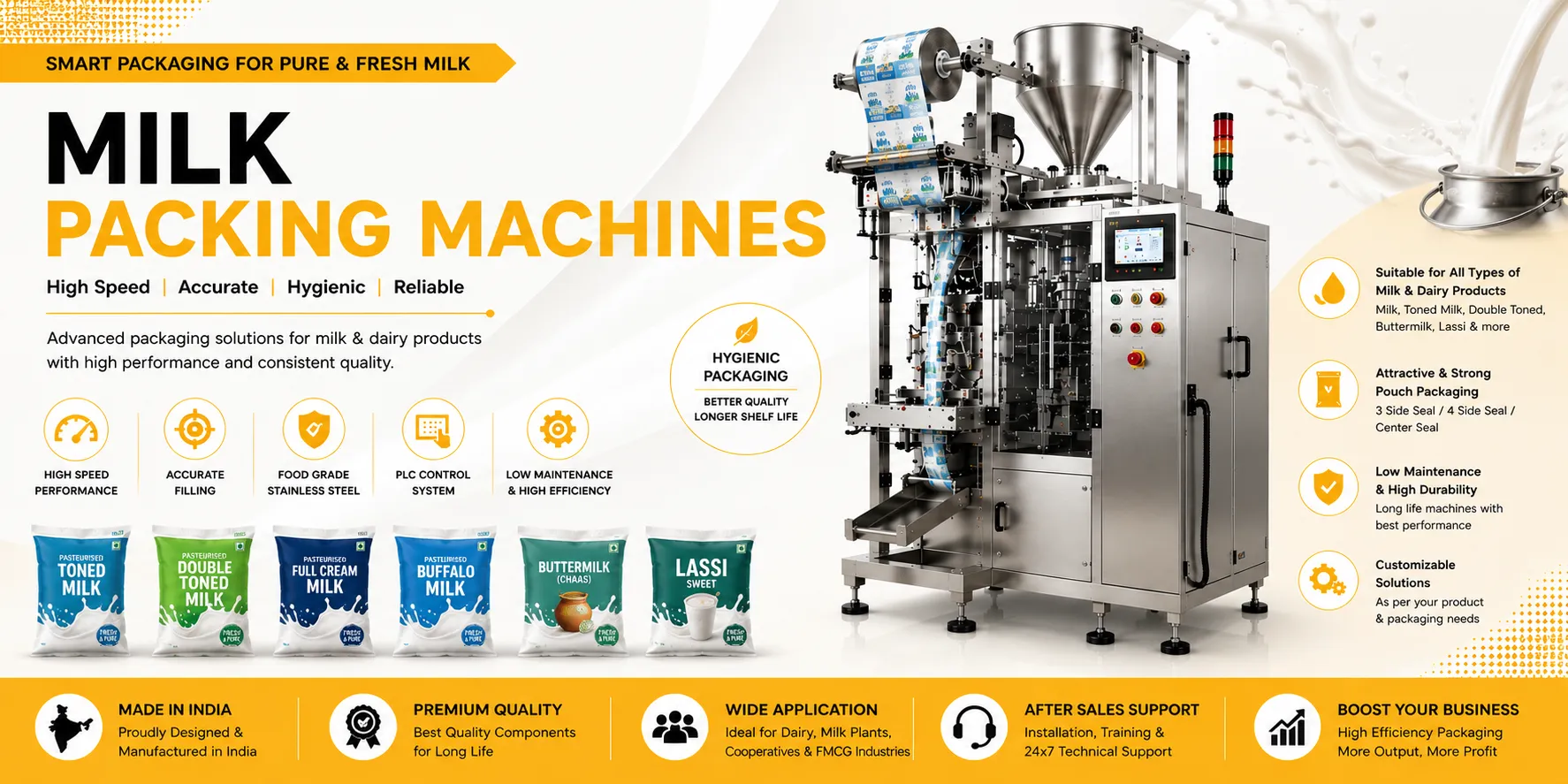
A milk packing machine is equipment that fills liquid milk (or similar dairy products like curd, buttermilk, and flavoured milk) into pouches, sachets, cartons, or bottles, then seals them for distribution. It handles three jobs in sequence: forming the pouch or container, dosing the exact quantity of milk, and sealing it so the product stays fresh and contamination free until it reaches the consumer.
You will also hear these machines called milk pouch packing machines, milk packaging machines, or milk bag packaging machines. They all describe the same core function with slight variations depending on the packaging format used.
Dairy cooperatives, private dairies, mini processing units, and even large FMCG milk brands rely on these machines daily. Without one, a dairy is stuck hand filling pouches, which is slow, inconsistent, and simply not viable once volume crosses a few hundred litres a day.
How Does a Milk Packing Machine Work?
Most modern milk packing machines follow a Form Fill Seal (FFS) process. Here is what actually happens inside the machine, step by step.
- Film feeding: A roll of food grade polyethylene film (usually LDPE) is pulled through the machine and shaped into a tube or pouch form.
- Sterilisation: Many machines pass the film through a UV sterilisation chamber to kill bacteria before the milk touches it.
- Filling: A calibrated pump or filler doses the exact quantity of milk, whether that is 200 ml, 500 ml, or a full litre, with tight accuracy, often within plus or minus 2 ml.
- Sealing: Heated sealing bars close the top and bottom of the pouch using controlled heat and pressure, forming an airtight seam.
- Cooling and cutting: A cooling bar sets the seal, and the pouch is cut free and dropped onto a conveyor or crate.
The entire cycle for a single pouch can take a fraction of a second on high speed machines, which is how a plant manages thousands of pouches an hour without breaking a sweat.
Types of Milk Packing Machines
Not every dairy needs the same setup. Broadly, milk packing machines fall into these categories.
Manual milk packing machines: Simple, low cost machines suited for small dairies or startups packing a few hundred to a couple thousand pouches a day. Operators load the film and product manually, and the machine handles filling and sealing.
Semi-automatic machines: A step up, these reduce manual intervention in dosing and sealing while still needing an operator for certain tasks. Good middle ground for growing dairies.
Fully automatic milk packing machines: Built for volume. These run continuously, handle multiple heads (single, double, or four lane configurations), and can churn out anywhere from 2,000 to over 12,000 pouches per hour depending on the model. Large dairies and cooperatives lean on these to keep up with daily demand.
Carton and bottle filling systems: Beyond pouches, some dairies package milk in cartons or bottles, which need a different type of filler entirely, built around volumetric or weight based dosing for rigid or semi-rigid containers.
If you want to explore models built for different scales, VS Packit's milk pouch packing machine range covers everything from entry level to high output configurations, and the milk pouch filling machine line is engineered specifically for dosing accuracy on liquid dairy products.
Key Features That Actually Matter
When you are comparing machines, specification sheets can get overwhelming fast. Here is what genuinely affects day to day performance on the plant floor.
Filling accuracy: Even a small deviation, say 5 ml per pouch, adds up to real product loss across thousands of pouches a day. Look for machines rated at plus or minus 1 to 2 ml accuracy.
Stainless steel build: All product contact parts should be food grade stainless steel. This is non negotiable for hygiene compliance and machine longevity in a wet, high cleaning environment.
PLC and HMI control: A programmable logic controller with a touchscreen interface lets operators switch recipes, adjust pouch sizes, and monitor faults without needing an engineer on standby.
Sealing consistency: Weak or inconsistent seals lead to leakage, which is one of the biggest sources of complaints and returns in pouch milk distribution. Digital heat control on the sealing bars helps keep this steady.
Speed versus your actual demand: Buying a 12,000 pouch per hour machine when your plant processes 2,000 litres a day is overkill and a waste of capital. Match machine capacity to your realistic daily volume, with some room for growth.
Servo driven film pulling: Servomotors give smoother, more accurate film movement compared to older mechanical systems, reducing film wastage and jerky pouch formation.
After sales support: A packing line down for two days because a spare part is unavailable is a real cost. Choose a manufacturer with a track record of service response, not just a good brochure.
What Does a Milk Packing Machine Cost?
Pricing varies quite a bit based on automation level, capacity, and build quality. In India, entry level manual or semi-automatic milk packing machines can start around 70,000 to 1.25 lakh rupees, while mid range automatic machines with PLC control typically fall between 3 lakh and 8.5 lakh rupees. Higher capacity, multi lane systems built for large scale dairy plants can go well beyond that depending on customisation, filling range, and the number of heads.
Rather than chasing the lowest price tag, it helps to look at the full cost picture: film wastage rates, energy consumption, maintenance frequency, and downtime. A slightly costlier machine that runs reliably for years often works out cheaper than a budget option that needs constant repair.
Here is a rough price band by machine type, so you know where your budget fits before you start comparing quotes.
| Machine Type | Typical Price Range (INR) | Typical Output | Good For |
|---|---|---|---|
| Manual pouch packing machine | 70,000 to 1.25 lakh | 200 to 5,000 pouches/hour | Small dairies, startups, low daily volume |
| Semi-automatic machine | 1.5 lakh to 3 lakh | 1,000 to 3,000 pouches/hour | Growing dairies moving past manual filling |
| Fully automatic, single lane | 3 lakh to 6 lakh | 3,000 to 8,000 pouches/hour | Established dairies with steady daily demand |
| Fully automatic, multi lane | 6 lakh to 8.5 lakh and above | 8,000 to 12,000+ pouches/hour | Large dairies, cooperatives, high volume plants |
If you want a clear, itemised breakdown for your specific volume and product type, VS Packit's milk packing machine price page is a good starting point to compare configurations.
Why the Right Machine Matters for a Dairy Business
Milk is a perishable, high volume, low margin product. That combination leaves almost no room for error on the packaging line. A machine that under-fills pouches invites customer complaints and regulatory trouble. One that over-fills quietly eats into your margins pouch after pouch. A machine with weak seals means leakage during transport, which translates into returns, wasted stock, and damaged trust with retailers.
On the other side, a well chosen packing machine becomes a genuine growth enabler. It lets a dairy scale from a few hundred litres a day to several thousand without adding proportional labour cost. It standardises pouch weight and appearance, which matters when you are trying to build a recognisable brand on store shelves. And it reduces the manual handling of milk, which lowers contamination risk substantially compared to hand filling.
This is also why serious dairy equipment buyers do not shop on price alone. They look at machines engineered specifically for dairy hygiene standards, with easy clean-in-place designs, corrosion resistant components, and consistent sealing performance across long production runs.
Popular Machine Configurations Worth Knowing About
For dairies exploring their options, a few configurations come up often in the industry. Here is a quick side by side view to help you shortlist based on your plant size and product range.
| Machine | Best Suited For | Key Strength | Learn More |
|---|---|---|---|
| Komet 81 | Dairies needing steady, continuous pouch packing | Reliable performance with minimal changeover time between batches | Komet 81 |
| Indus 5000 | Mid to large dairies scaling up daily volume | Built for higher output and consistent throughput | Indus 5000 |
| Duplex Packaging Systems | Dairies running multiple SKUs or product lines | Dual lane setup that boosts output without extra floor space | Duplex Packaging Systems |
| GT-5S | Small to growing dairies with limited floor space | Compact footprint with a lower entry investment | GT-5S |
| Various Filler Systems | Dairies packing multiple liquids, not just milk | Flexible filling for curd, lassi, flavoured milk, and more | Various Filler Systems |
Maintenance Tips to Keep Your Machine Running
A packing machine is a workhorse, but it needs basic care to stay reliable.
Run a warm up period of about 20 to 30 minutes before engaging the heat seal bar every morning. Cold sealing bars are one of the most common causes of weak seals early in a shift. Check that heater temperature stays within the specified range, since temperature drift is often the real cause behind pouch leakage complaints. Keep the product and bag loading areas free of obstruction, and clean film guides regularly to prevent jerky pulling that throws off pouch dimensions. Finally, stick to a scheduled maintenance calendar rather than waiting for a breakdown. Preventive checks on seals, pumps, and sensors cost far less than emergency repairs during peak production hours.
Choosing the Right Partner, Not Just a Machine
At the end of the day, a milk packing machine is a long term investment in your dairy's daily operations. It is worth spending time on a manufacturer that understands dairy specific hygiene needs, offers genuine after sales support, and can customise filling ranges and pouch sizes to match your product line. Whether you are setting up your first small unit or upgrading an existing plant to handle higher volumes, the right machine should feel less like a piece of equipment and more like a dependable part of your team.
Milk Packing Machines by VS Packit
VS Pack designs and manufactures milk packing machines built for real dairy floor conditions, not just spec sheets. From compact semi-automatic units for smaller dairies to high speed, multi lane systems for large scale plants, every machine is built around accurate dosing, consistent sealing, and food grade stainless steel construction.
Whether you need a straightforward milk pouch packing machine for a growing dairy or a high output milk pouch filling machine for an established plant, VS Pack's range is engineered to reduce wastage, cut downtime, and keep your packing line running the way it should. Get in touch for a configuration tailored to your daily volume, product type, and pouch size requirements, along with transparent pricing so there are no surprises later.
| Explore | What You'll Find |
|---|---|
| Milk Packing Machine Price | Transparent pricing across manual, semi-automatic, and fully automatic models |
| Milk Pouch Packing Machine | Full range of pouch packing machines for small to large dairy setups |
| Milk Pouch Filling Machine | Precision filling systems built for consistent dosing accuracy |