
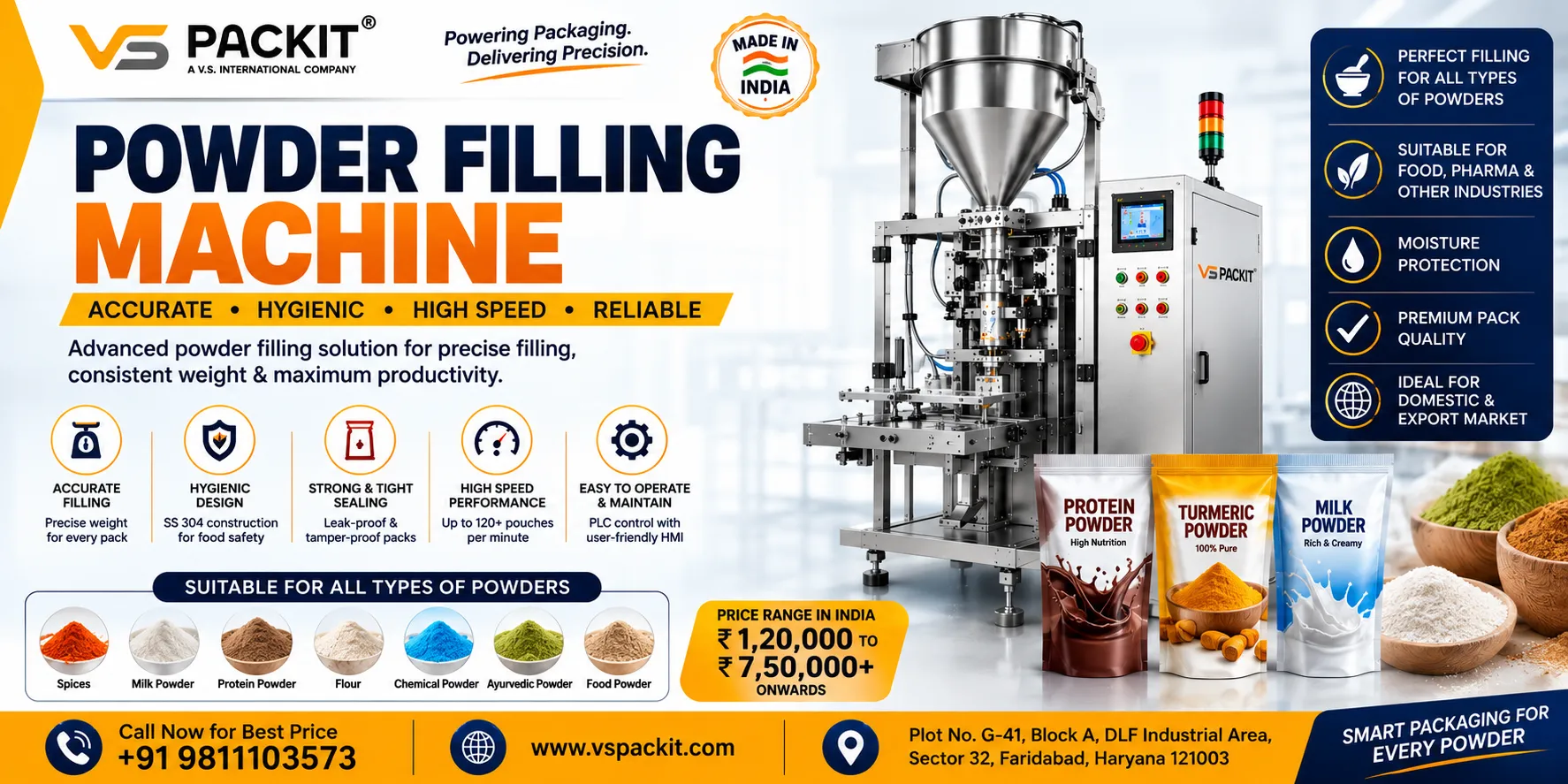
Every packing floor that handles powder eventually runs into the same set of headaches. A pouch that reads slightly underweight on the checkweigher, a bottle neck caked with static-clung powder, a batch that flows fine on Monday and jams the hopper by Thursday because the humidity shifted overnight. None of this is a machine failure in the usual sense. It is almost always a mismatch between the powder's actual behaviour and the powder filling machine chosen to handle it.
Years spent around packing lines in spice units, pharma contract manufacturing, and chemical powder plants have made this pattern obvious. The operations that run smoothly are rarely the ones with the most expensive equipment. They are the ones where someone took the time to understand exactly how their specific powder flows, settles, and doses, and picked a machine built around that reality instead of a generic spec sheet.
This article looks at how a powder filling machine works, what separates a dependable automatic powder filling machine from one that constantly needs babysitting, the main filling technologies in use today, and a practical framework for narrowing down your options.
Trying to figure out the right machine for your powder? Speak with our team and we will walk you through options based on your product, container, and volume.
The Core Challenge: Powder Does Not Behave Like Liquid or Granules
Liquid fillers rely on flow rate and viscosity. Granule fillers rely on particle count and volume. Powder sits in an awkward middle ground, and that is exactly why it causes so many production headaches:
Inconsistent flowability: Fine powders bridge and clump inside hoppers, especially in humid conditions, while coarser powders flow more freely but can segregate by particle size during vibration and transport.
Density that shifts with the weather: The same product from the same supplier can weigh differently pouch to pouch depending on ambient humidity, storage time, and how finely it was processed in a given batch.
Static and dust: Very fine, light powders pick up static charge easily, which causes clinging at the fill point and weakens seals, along with generating airborne dust that affects both product loss and housekeeping.
Regulatory and brand expectations on weight: Whatever the label says, the pack needs to actually contain that amount, batch after batch, which puts real pressure on the dosing accuracy of the machine.
Recognising which of these challenges apply most to your specific powder is the first real step in choosing equipment, well before comparing brochures or price lists.
How a Powder Filling Machine Works
The mechanics are broadly consistent across most machines on the market, regardless of scale or price point:
- Hopper and feed system: Powder sits in a hopper, typically fitted with an agitator or vibratory assist to keep material moving into the dosing mechanism without bridging.
- Dosing mechanism: This is where the real differentiation happens. Auger screws, volumetric cups, or weigh-based systems measure out the correct amount for each cycle.
- Delivery point: The dosed powder drops into a pouch formed in line, or into a positioned bottle or jar depending on the packaging format.
- Sealing or capping: Pouches get heat sealed; rigid containers get capped or induction sealed.
- Cycle advance: The machine indexes to the next container or pouch and the cycle repeats.
Nearly every meaningful difference in accuracy, speed, and cost between machines comes down to the dosing mechanism, which is worth understanding in more depth before making a decision.
Filling Technologies Compared
Auger Fillers: A calibrated rotating screw meters powder through controlled rotations. This is the go-to choice for fine, cohesive powders like ground spices, milk powder, and many pharmaceutical actives, where flow is inconsistent on its own. Servo driven versions add faster, more repeatable changeovers between products.
Volumetric Cup Fillers: These measure a fixed volume per cycle rather than weighing product directly, giving high speed at a lower machine cost. Best suited to free-flowing powders where minor weight variation between fills is acceptable.
Weigh Cell Based Systems: These weigh each dose directly using load cells, delivering tighter accuracy for products where weight compliance matters most, though at a higher equipment cost than volumetric alternatives.
Duplex and Multi-Lane Configurations: For higher daily output requirements, duplex machines run two filling and sealing stations off one frame, roughly doubling throughput without a proportional jump in floor space or operator headcount.
What Separates a Good Automatic Powder Filling Machine From an Average One
Labeling something "automatic" does not guarantee it performs consistently. A few things genuinely separate a solid automatic powder filling machine from one that will frustrate an operator daily:
- Adaptive dosing: A well engineered machine compensates for small density shifts rather than needing constant manual recalibration through the day.
- Fast changeover capability: For lines running multiple SKUs, servo controlled systems that reprogram digitally save far more time than mechanically adjusted equipment.
- Built-in dust management: Enclosed filling heads and proper extraction reduce both product loss and operator exposure, particularly for fine powders.
- Genuinely easy cleaning: Food grade stainless steel construction with quick strip down access matters a lot when switching between products or running frequent hygiene checks.
- Dependable local service: A powder line running daily cannot afford extended downtime waiting on parts or a technician, so service response time should weigh into the buying decision just as much as the specs.
A Practical Framework for Choosing Your Machine
Rather than starting with a machine list, start with these questions about your own operation:
- How does my powder actually flow, and does that change with the seasons or humidity?
- What accuracy tolerance does my product actually require, based on regulation or brand promise?
- How many different products or pack sizes run through this line, and how often do they change?
- What packaging format am I using, and does the machine's filling head genuinely suit it?
- What is my realistic daily volume over the next one to two years, not just right now?
Answering these honestly narrows the field far more effectively than comparing feature lists side by side.
VS Packit Filling Systems for Powder Applications
Matching the right filling technology to your product matters more than picking the most advanced looking machine on the shelf. Here is a quick reference across the range:
| Product | Best Suited For |
|---|---|
| Powder Filling Machine Price | Comparing pricing across automation levels and capacities before finalizing a budget |
| Servo Auger Fillers | Fine to medium powders needing precise, programmable dosing with quick changeovers |
| Various Filler Systems | Operations handling a mix of powders, granules, and other free-flowing materials on one line |
| TPI 912 Duplex Auger | High volume production needing twin lane filling for doubled throughput |
| Duplex Packaging Systems | Manufacturers scaling production who need consistent accuracy across simultaneous lines |
| Indus 5000 | Mid to large scale operations looking for a robust, higher capacity filling setup |
| Komet 81 | Businesses needing a compact yet reliable filling solution for steady daily output |
| Komet Sprint | Fast changeover environments where speed and flexibility matter as much as accuracy |
Common Mistakes Worth Avoiding
A handful of patterns repeat across powder filling installations no matter the industry:
- Skipping a live trial with your own product. Every powder behaves differently based on grind, moisture, and blend, so a demo run with a different sample can be misleading.
- Underestimating cleaning and changeover time. Frequent product switches on a machine not designed for quick strip down often cost more production time than the raw filling speed gains back.
- Buying more automation than current volume actually needs. High speed duplex systems make sense once daily output justifies them, not as a starting point.
- Overlooking dust containment. Poor containment on fine powders leads to product waste and creates ongoing housekeeping and safety issues.
- Not planning for future SKUs or pack sizes. A machine locked to a single configuration can become a bottleneck sooner than expected as the product range grows.
Final Thoughts
Choosing the right powder filling machine really comes down to understanding your product's behaviour before comparing equipment. Whether you need a straightforward automatic powder filling machine for a single steady product line, or a higher throughput duplex setup to support growth, grounding the decision in a real trial run with your own powder will save far more time and cost than relying on specifications alone.
Not sure which configuration fits your production line? Get in touch with our team and we will help you work through the right setup for your product and volume.