

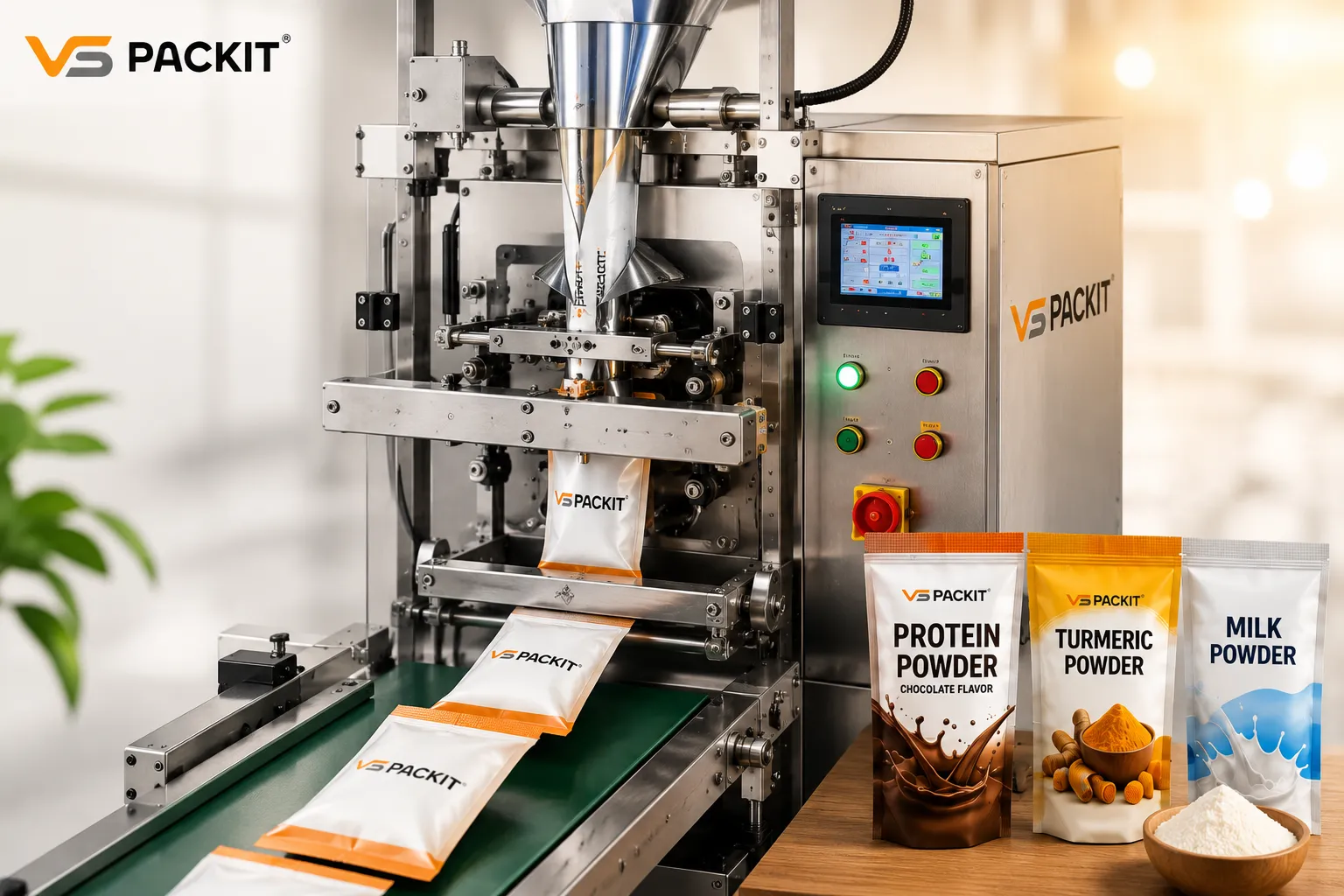
A weak seal is one of those problems that looks small on the production floor and turns into a big one on the retail shelf. A pouch that leaks even slightly lets in air and moisture, and depending on the product, that can mean stale spices, clumped powder, spoiled food, or a customer complaint that eventually finds its way back to your brand. The pouch sealing machine sitting at the end of your packing line is doing more work than most people give it credit for, and getting this piece of equipment right has a bigger impact on product quality than most buyers initially expect.
Having spent years around packing operations across food, spice, pharma, and chemical segments, the pattern is consistent. Businesses that treat sealing as an afterthought, something to figure out after the filling machine is chosen, end up with recurring seal failures no matter how good their filling accuracy is. Sealing deserves the same level of attention as filling, if not more, because a perfectly dosed pouch with a bad seal is still a bad pack.
This guide walks through how a pouch sealing machine works, the different sealing technologies available, what to look for when comparing machines, and practical guidance for manufacturers searching for the right equipment and reliable support close to home.
Looking for a pouch sealing machine that fits your product and volume? Contact our team and we will help you find the right configuration and connect you with support near you.
Why Sealing Quality Matters More Than It Gets Credit For
A pouch sealing machine has one core job: create a consistent, airtight closure on every single pack, regardless of the product inside. This sounds simple, but a few factors make it genuinely difficult to get right at scale:
Film compatibility: Different laminated films respond differently to heat and pressure. A sealing setting that works perfectly on one film type can produce a weak or burnt seal on another.
Product interference at the seal line: Powder, small particles, or oily residue that ends up right at the seal area can prevent the film layers from bonding properly, leading to leaks that only show up after the pack has been on a shelf or in transit for a while.
Speed versus dwell time trade-off: Faster production speeds mean less time for the sealing jaws to hold heat and pressure on the film. Machines need to balance throughput against giving the seal enough dwell time to actually bond properly.
Temperature consistency across the seal width: Uneven heat distribution across the sealing bar creates weak spots even when the overall seal looks fine to the eye.
Getting these right is the difference between a pouch that survives a supply chain and one that starts leaking the moment it is handled.
How a Pouch Sealing Machine Works
Most pouch sealing machines, whether standalone units or integrated into a larger form-fill-seal line, rely on one of a few core mechanisms:
- Heat sealing: The most common method for laminated and plastic films. Heated jaws or bars press the film layers together, melting the inner layer to fuse them into an airtight bond.
- Band sealing: A continuous heated band or belt moves the pouch through the sealing zone, allowing for continuous operation rather than a stop-start cycle, which suits higher speed lines.
- Impulse sealing: A brief, intense burst of heat seals the film quickly and then cools rapidly, often used for thinner films where prolonged heat exposure could damage the material.
- Ultrasonic sealing: High frequency vibration generates localized heat at the seal point without a heated element, useful for certain film types and cleaner, more consistent seals in specific applications.
Standalone pouch sealing machines are used when pouches are pre-filled elsewhere and simply need closing, while integrated systems combine filling and sealing into a single continuous operation for higher volume production.
Types of Pouch Sealing Machines by Production Scale
Manual and Semi-Automatic Sealers: Simple, tabletop or standing units where an operator manually feeds each pouch through the sealing jaws or band. Suitable for small businesses, sampling runs, or contract packers with lower daily volumes.
Continuous Band Sealers: These run pouches through a moving conveyor and heated band, allowing steady, higher throughput sealing without a stop-start cycle for every pack.
Vertical Pouch Sealing Machines: Often paired with filling systems on a single frame, sealing pouches vertically as part of a continuous form-fill-seal cycle, common in food and spice packing lines.
Fully Automatic Integrated Systems: Built into larger production lines with filling, sealing, coding, and sometimes cartoning combined, designed for manufacturers running consistent, high daily volumes.
What to Look for When Comparing Machines
A few practical checkpoints make comparing pouch sealing machines much easier:
- Film type compatibility: Confirm the machine is rated for the specific laminated or plastic film you plan to use, since not every sealer performs well across all film types.
- Adjustable temperature and dwell time control: Look for machines that let you fine-tune both heat and hold time, since this flexibility matters when you switch products or film thickness.
- Seal strength consistency across the width: Ask for sample seals from a demo run and check for even bonding across the entire seal line, not just the center.
- Speed matched to your actual production needs: A machine rated for very high speed is not automatically better if your daily volume does not require it, and running below rated speed can sometimes affect seal quality on certain machines.
- Ease of cleaning and maintenance: Sealing jaws and bands need regular cleaning to prevent residue buildup that can weaken seals over time, so check how easily the machine allows this.
- Local support and service availability: A sealing machine that jams or drifts out of calibration needs quick attention, so confirm what service and spare part support is actually available in your region before buying.
Finding a Reliable Pouch Sealing Machine and Support Near You
A common search pattern among buyers is looking for a pouch sealing machine near me, and this usually comes down to one practical concern: getting timely installation help, operator training, and service support without long delays. While sourcing the right machine matters, having a manufacturer or supplier with dependable service reach across regions matters just as much once the machine is running daily on your production floor. Before finalizing a purchase, it is worth confirming installation timelines, spare part availability, and how quickly a technician can respond if something goes wrong, rather than assuming support will simply be there when needed.
VS Packit Machines for Pouch Sealing and Packaging
Different production scales and pouch formats call for different equipment. Here is a quick reference across the range:
| Product | Best Suited For |
|---|---|
| Komet 81 | Businesses needing a compact, dependable machine for steady daily pouch sealing and filling |
| Indus 5000 | Mid to high volume operations needing a robust, higher throughput sealing and packing setup |
| Komet Sprint | Faster cycle times for operations that need speed without moving to a full duplex configuration |
| Duplex Packaging Systems | Manufacturers scaling production who need consistent, simultaneous sealing across twin lines |
| Pouch Sealing Machine Price | Comparing pricing across automation levels and speeds before finalizing a budget |
Common Mistakes to Avoid
A few recurring issues show up across pouch sealing installations regardless of industry:
- Choosing sealing settings by guesswork instead of testing with the actual film and product. Every film and product combination behaves slightly differently at the seal point, so always run a live trial before locking in settings.
- Ignoring dwell time when chasing higher speed. Pushing speed beyond what the seal actually needs to bond properly leads to weak seals that only reveal themselves after the pack leaves the factory.
- Skipping regular cleaning of sealing jaws or bands. Residue buildup on sealing surfaces is one of the most common, and most preventable, causes of inconsistent seals.
- Underestimating the importance of local service support. A sealing issue that could be fixed in an hour with the right support can turn into days of downtime without it.
- Buying based on speed alone without checking seal strength. A fast machine that produces weak seals costs more in returns and complaints than a slightly slower one that seals reliably every time.
Conclusion
A pouch sealing machine deserves the same careful evaluation as any filling equipment on your line, since a strong, consistent seal is what actually protects your product from the moment it leaves the factory to the moment it reaches the customer. Match the sealing technology to your specific film and product, test thoroughly before committing, and make sure reliable support is available wherever your production line is located.
Looking for the right pouch sealing machine and dependable support near you? Get in touch with our team and we will help you find the setup that fits your product and production scale.