

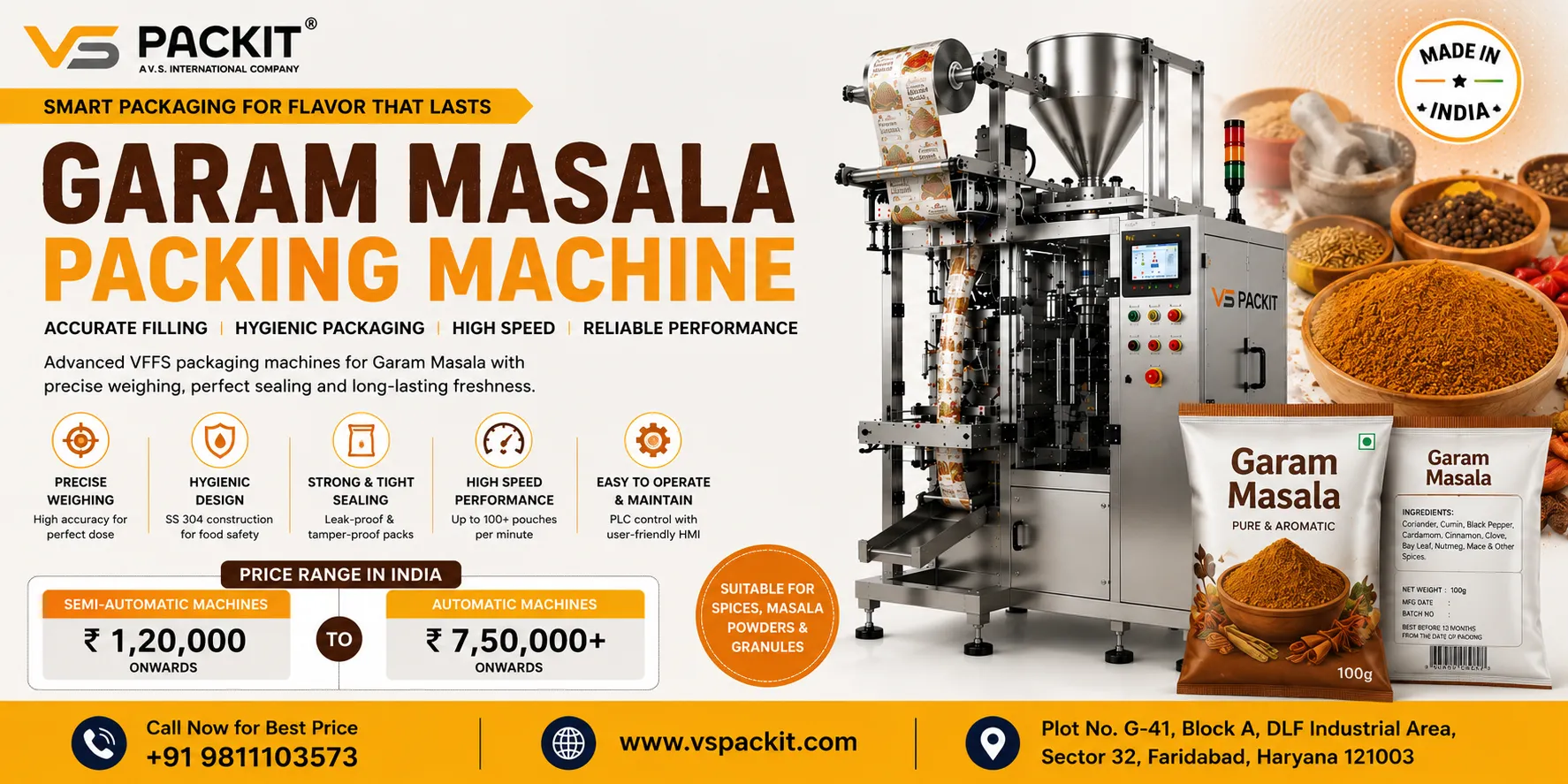
Garam masala is one of those products that never really slows down in demand. Every household kitchen in India uses it, hotels and restaurants buy it in bulk, and export orders keep growing every year. But if you have ever run a spice packing unit manually, you already know the real problem is not making the masala, it is packing it fast, clean, and consistent without losing product to spillage or bad sealing.
This is where a garam masala packing machine changes the entire game for a spice business. Over the years, working closely with small spice units, regional brands, and larger manufacturing setups, one thing has become very clear: the businesses that scale fastest are the ones that automate packing early instead of waiting until labour costs and order volumes force their hand.
In this article, we will look at what a garam masala packing machine actually does, why powder packing is trickier than it looks, what affects garam masala packing machine price, and how to pick the right pouch packing setup for your production scale.
Why Garam Masala Needs Special Packing Equipment
Garam masala is not like grains or granules. It is a fine, aromatic powder blend, and that creates a few specific challenges during packing:
- Fine powder flowability – Since garam masala is ground finely, it tends to clump, stick to machine parts, and create dust during filling. A machine not designed for fine powders will either underfill or overfill packets constantly.
- Aroma retention – Garam masala loses its fragrance and flavour quickly once exposed to air. Packing needs to happen fast and the seal needs to be airtight, or the shelf life and taste both suffer.
- Weight accuracy – Customers and regulators both expect exact weight. A packet marked 100 grams needs to actually contain 100 grams, batch after batch, or you risk complaints and legal weight-and-measures issues.
- Consistent sealing – A weak seal means moisture enters, the masala turns lumpy, and your brand reputation takes a hit on store shelves.
A dedicated garam masala packing machine is built to handle exactly these issues, using auger fillers or multi-head weighers designed for powder, combined with heat sealing systems that lock in freshness.
How a Garam Masala Packing Machine Works
Most modern machines follow a fairly simple production flow, even though the internal engineering is quite advanced:
- Film unwinding: The packing film (usually laminated for aroma barrier) unwinds from a roll.
- Bag forming: The film is formed into a pouch shape using a forming collar.
- Filling: An auger filler (a rotating screw mechanism) doses the exact quantity of garam masala into the pouch. For fine powders, auger fillers are far more accurate than volumetric cup fillers.
- Sealing: Vertical and horizontal sealing jaws heat-seal the pouch on all sides.
- Cutting and discharge: The machine cuts the sealed pouch and drops it onto a conveyor, ready for cartoning or dispatch.
This entire cycle, from empty film to sealed pouch, usually takes just a few seconds per pack on a mid-range machine, which is where the real labour and time savings come from compared to hand filling and manual sealing.
Types of Garam Masala Packing Machines
Not every spice business needs the same machine. The right choice depends on your daily volume, pouch size range, and budget.
1. Auger Filler Pouch Packing Machines
These are the most common choice for garam masala because the auger screw handles fine powder with minimal dusting and very tight weight tolerance. Ideal for pack sizes from 10 grams sachets to 1 kg pouches.
2. Multi-Head Weigher Based Machines
Used by larger manufacturers who need very high speed and slightly larger pack sizes. These machines weigh product using multiple weighing heads before dropping it into the pouch, giving excellent accuracy at high output rates, though the machine cost is naturally higher.
3. Semi-Automatic Machines
Good for small units and startups. The operator places pouches manually, and the machine handles filling and sealing. This is a good entry point if you are just moving away from manual weighing and hand sealing but are not ready for a fully automatic line.
4. Fully Automatic Vertical Form Fill Seal (VFFS) Machines
The standard for mid to large scale operations. Film goes in on one end, sealed and filled pouches come out the other, with almost no manual intervention. These machines integrate well with date coding, batch printing, and even nitrogen flushing for extended shelf life.
If you want to explore the full range of options with pricing details based on capacity and automation level, this breakdown of masala packing machine price is a useful starting point before you finalize a budget.
What Affects Garam Masala Packing Machine Price
This is usually the first question every buyer asks, and rightly so, since it is a significant investment. Based on real deployment experience across different spice units, here are the factors that actually move the price:
- Filling mechanism: Auger fillers cost less than multi-head weighers but are slightly slower at very high volumes.
- Automation level: Semi-automatic machines are the most budget friendly, fully automatic VFFS lines cost more but reduce labour dependency significantly.
- Pouch size range: Machines built for a wide range of pouch sizes (say 10g to 1kg) cost more than fixed single-size machines.
- Speed (pouches per minute): Higher throughput machines with servo-driven systems are priced higher but pay back faster if your order volumes justify it.
- Additional features: Nitrogen flushing, zipper pouch capability, batch coding, and gusseted bag forming all add to the base price.
- Build quality and after sales support: Stainless steel food grade construction and reliable service support matter a lot for spice powder, since maintenance downtime directly hits production.
A realistic entry point for a semi-automatic garam masala packing machine starts on the lower end, while fully automatic multi-head weigher systems with advanced features sit at the higher end of the range. The right approach is to size the machine to your actual daily volume rather than buying more capacity than you currently need, and then plan an upgrade path as your orders grow.
Choosing the Right Garam Masala Pouch Packing Machine
Since garam masala is almost always sold in pouches rather than jars or tins, pouch format matters a lot. When evaluating a garam masala pouch packing machine, keep these points in mind:
- Pouch style: Pillow pouches are the most economical and widely used. Stand-up pouches with zippers add shelf appeal and reusability but cost more per unit and need a slightly different machine configuration.
- Barrier film compatibility: Make sure the machine can handle laminated films with aroma barrier layers, since plain film will not protect the spice properly.
- Weight range flexibility: If you plan to sell both small sachets and family packs, check that the same machine can switch between weight ranges without major mechanical changes.
- Hygiene design: Look for contact parts made of food grade stainless steel, easy to clean without excessive downtime, since powder residue buildup is a real day to day issue in spice packing.
- Local service availability: Spice packing lines run daily, so a machine that is hard to service quickly becomes a production bottleneck. Always check on ground service support before buying.
For a closer look at models built specifically for pouch formats and different capacity ranges, this page on masala pouch packing machine covers the common configurations used across the industry.
Common Mistakes Spice Businesses Make While Buying
Having seen a fair number of installations across small and mid-sized units, a few recurring mistakes stand out:
- Buying based on price alone: The cheapest machine often has weaker sealing consistency, which shows up later as customer complaints and returns.
- Ignoring pouch flexibility: Businesses that only think about their current pack size often end up needing a second machine within a year when they add new SKUs.
- Skipping a trial run with actual product: Garam masala from different brands behaves differently based on grind fineness and oil content. Always test the machine with your actual product batch before finalizing.
- Underestimating operator training: Even automatic machines need trained operators for changeovers and routine maintenance. Factor this into your planning.
Conclusion
A garam masala packing machine is not just an equipment purchase, it is a decision that directly affects your production capacity, product consistency, and how fast you can respond to growing orders. Whether you are a small unit moving from hand packing to semi-automatic, or a growing brand ready for a fully automatic pouch packing line, matching the machine to your actual volume and pouch format is the key decision that determines long term value.
Take time to compare garam masala packing machine price against actual throughput and after sales support rather than just the upfront number, and always insist on a product trial before committing. Spice packing has enough day to day operational challenges already, the right machine should remove friction, not add to it.