

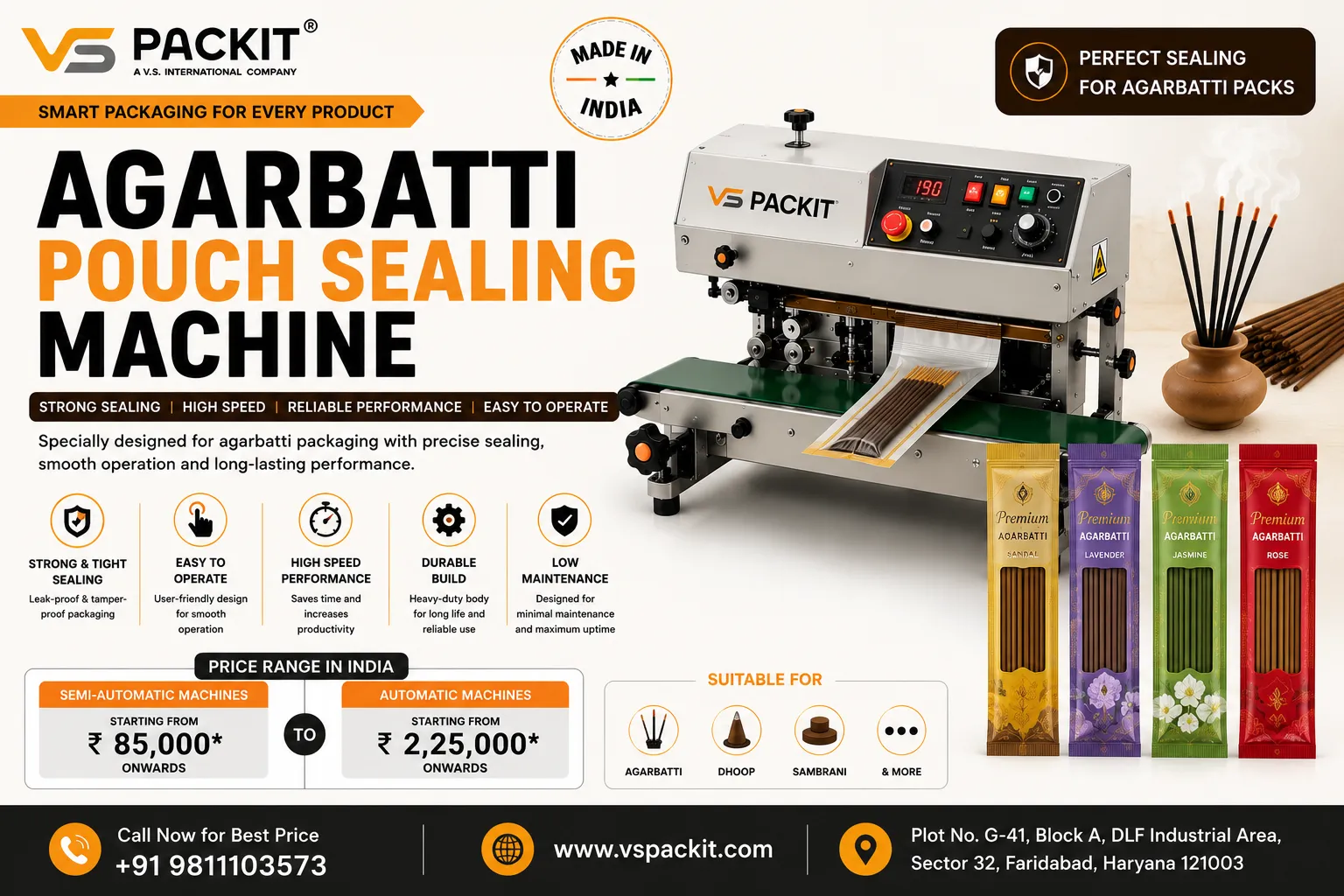
Agarbatti packaging looks simple from the outside. A long pouch, a bundle of sticks, a seal at the top. But anyone who has spent time on an incense packing line knows this category comes with its own set of handling problems that a general purpose sealer is not always built to solve.
Having worked with manufacturers across incense, spice, and food packaging for years, one pattern shows up repeatedly. Businesses that install a standard pouch sealing machine, the kind built for general food or spice pouches, expecting it to handle agarbatti packs without modification end up with crushed sticks, uneven pouch alignment, or seals that fail exactly where the product needs protection most. An agarbatti pouch sealing machine is not just a smaller or narrower version of a regular sealer, it is built around the specific way incense sticks need to be handled and sealed.
This guide covers what makes agarbatti pouch sealing machines different, what to check before buying one, and how pricing typically works across this segment.
Looking for the right agarbatti pouch sealing machine for your production line?
Contact our team and we will help you find a configuration and share a price suited to your volume.
Quick Snapshot
| Semi-Automatic | Fully Automatic | |
|---|---|---|
| Best for | Lower volume, smaller units | Consistent daily batch production |
| Operator involvement | Manual pouch feeding | Pouch detection, programmable controls |
| Typical add-on | Manual counting | Integrated filling and counting |
| Where cost goes up | — | Stainless steel build, food-safe contact parts, tailored pouch guides |
Exact pricing depends on your pouch length, daily volume, and stick count per pack, share these details and we'll quote accordingly.
What Makes Agarbatti Packaging Different
Incense sticks are light, brittle, and unevenly shaped compared to powders or granular products. This creates a few handling challenges that directly affect sealing.
Delicate Product Handling
Rough feeding or aggressive jaw pressure during sealing can snap or crush sticks before the pack even reaches a shelf. The sealing mechanism needs to apply pressure at the seal line without disturbing the sticks bundled inside.
Pouch Shape and Length
Agarbatti pouches are typically longer and narrower than standard food or spice pouches, which means the machine needs pouch guides and feeding mechanisms designed for that specific format rather than a general purpose width range.
Film Thickness
The film used for agarbatti packaging is frequently thinner than standard food grade laminate, which changes how much heat and dwell time the seal actually needs. A setting calibrated for thicker film can scorch or weaken a thinner one.
Stick Alignment at The Seal Point
Sticks poking too close to the seal line can prevent the film from bonding cleanly, leading to leaks or an uneven seal that looks fine on the outside but fails during transit or storage.
This is why an agarbatti pouch sealing machine is built with adjustments most standard sealers do not carry as default.
Core Features to Look For
A few checkpoints separate a machine genuinely suited to agarbatti packaging from one adapted after the fact.
- Gentle pouch handling mechanism — feeding and jaw movement calibrated to avoid crushing or displacing sticks during the sealing cycle
- Adjustable temperature and dwell time — fine control that accounts for thinner film without compromising seal strength
- Pouch guides suited to longer, narrower formats — alignment components built around agarbatti pouch dimensions rather than a generic range
- Consistent seal width across the pack — since agarbatti pouches are longer, uneven heat distribution across the seal bar becomes more noticeable and more likely to cause a weak spot somewhere along the length
- Options across automation levels — semi-automatic sealers for lower volume operations, fully automatic integrated systems for manufacturers running consistent daily batches
An agarbatti packet pouch sealing machine suited to your specific batch size and pouch length makes a measurable difference in reject rates once it is running daily, not just on a demo trial.
Agarbatti Pouch Sealing Machine Price: What Affects the Number
Pricing on an agarbatti pouch sealing machine depends on the same core factors that affect any sealing equipment, with a few segment specific additions.
Automation level plays the biggest role, with manual and semi-automatic sealers priced lower than fully automatic systems that include pouch detection and programmable controls. Build quality matters too, since stainless steel components and food safe contact parts add to the cost but hold up better over daily use. The modifications specific to agarbatti handling, including tailored pouch guides and gentler feeding mechanisms, also factor into the final quote compared to a general purpose sealer.
Buyers should avoid assuming a lower priced general sealer will work fine for agarbatti packs without adjustment. The savings on the machine often gets offset by higher reject rates and product damage once the line is running at full volume. A lot of listings you'll come across quote a machine price alone without accounting for these adjustments, which is usually where the real cost difference shows up later.
Common Mistakes in Agarbatti Sealing Setups
A few recurring issues show up across agarbatti packing lines regardless of the manufacturer.
- Using a sealer built for powders or granular products without adjusting for stick handling, which leads to breakage during the feeding and sealing cycle
- Running film settings copied from a different product line instead of testing dwell time and temperature specifically for the thinner agarbatti film
- Ignoring pouch length variation between different stick counts, which causes alignment issues if the machine is not set up to handle the actual range you pack
- Overlooking local service support, since a sealing issue on a running line can stall an entire day of packing without quick access to a technician
Getting the setup right from the start, with a machine actually built for agarbatti handling rather than adapted for it, saves far more in reduced rejects and smoother daily runs than chasing the lowest price alone.
Related Sealing Options
If agarbatti isn't your only product, or you're comparing this against a general purpose setup, these might be worth a look too: our pouch sealing machine price page covers pricing across the broader sealing range, and the plastic pouch sealing machine page is a good comparison point if you're deciding between a dedicated agarbatti setup and a more general purpose sealer.