
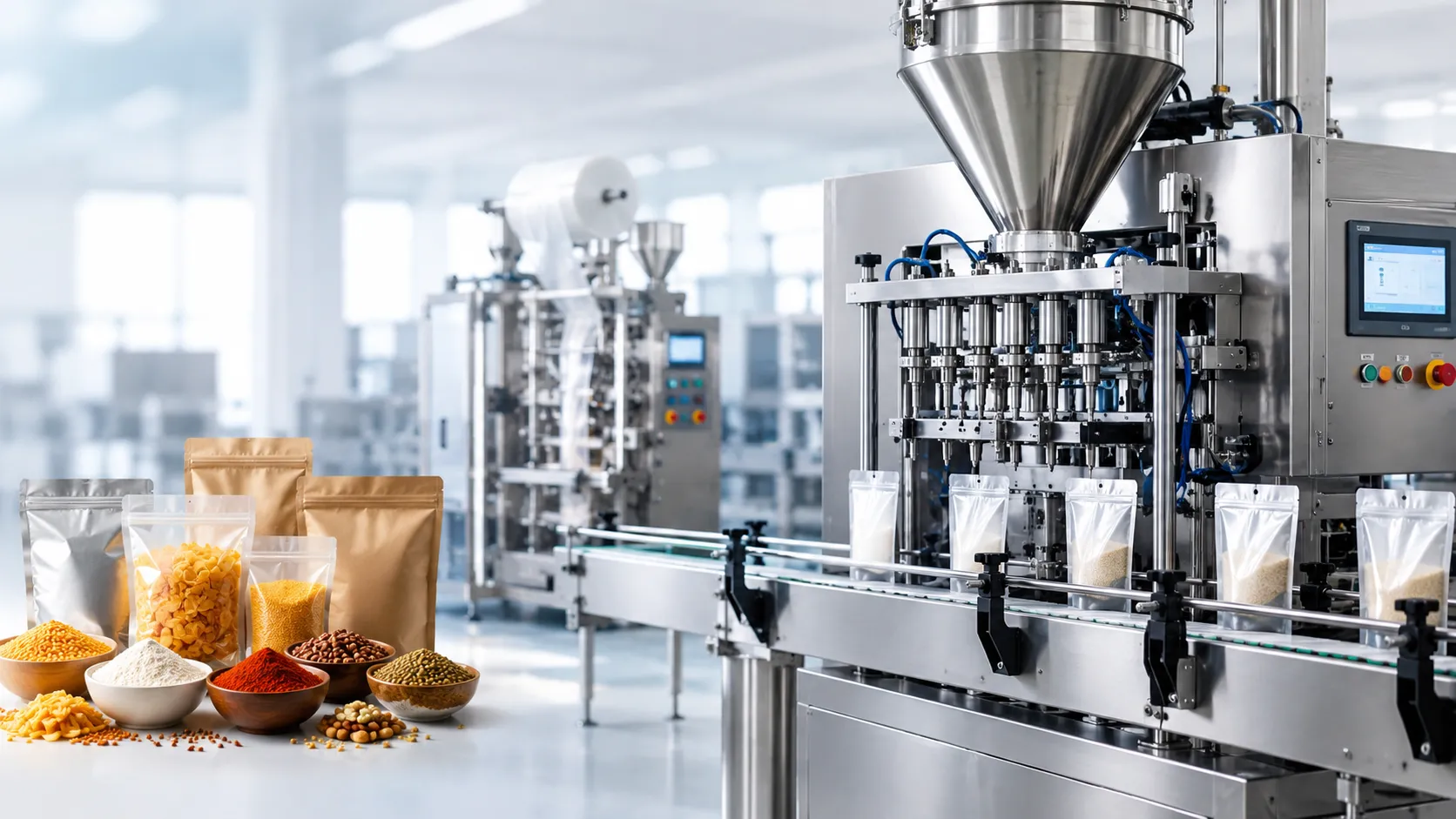
Choosing a filling machine manufacturer is harder than choosing a filling machine. Most suppliers show similar photos and similar claims, yet the filler they fit to your line decides how much product you give away in overfill, how often the line stops, and whether your pouch weights pass a legal metrology check. This guide covers what a filling machine manufacturer actually builds, how the main filler types differ, what drives accuracy, and which questions to put to a supplier before you pay an advance.
VS Packit, a brand of V. S. International, is a filling machine manufacturer based in Faridabad, Haryana. Our fillers are built to run on pouch, sachet and stick-pack lines, either as a module on a packing machine or as a configured dosing system.
What a Filling Machine Manufacturer Actually Builds
A filler is the part of a packing line that measures product and delivers it into a pack. It is a dosing device: it does not form the pouch or seal it. A manufacturer can therefore supply a filler in two ways. The first is a standalone unit that doses into pre-made containers. The second is a filler integrated with a form fill seal frame, so one machine measures, forms, fills and seals.
For pouch products, the integrated route is common because it removes a hand-off between two machines. If that is the format you need, see our vertical form fill seal machine page for how the frame and filler work together. This page stays focused on the filler itself and on the manufacturer behind it.
Types of Filling Machines and Where Each Fits
No single filler suits every product. A manufacturer who offers only one type will often recommend it for everything, so it helps to know the four main designs before you speak to anyone.
| Filler type | How it doses | Best suited to |
|---|---|---|
| Servo auger filler | A rotating screw delivers a set volume per turn | Fine, dusty or sticky dry products |
| Volumetric cup filler | Adjustable cups fill by volume and discharge together | Free-flowing granules, grains, seeds, salt, sugar |
| Multihead weigher | Load cells weigh several portions and combine the closest to target | Snacks, namkeen, dry fruits, irregular pieces |
| Piston or pump filler | A piston or pump moves a measured volume of liquid | Oils, milk, sauces, pastes, water |
A servo auger filler counts screw rotations with a servo motor, which keeps the dose steady even when the product is light and prone to dusting. A volumetric cup filler is simpler and faster, but it measures volume, so a change in bulk density changes the weight. A multihead weigher measures weight directly, which is why it is the usual choice for products that vary in shape. Compare all four on our filler systems page.
Automatic vs Semi-Automatic Filling Machines
An automatic filling machine runs its full cycle without an operator touching the product: it triggers from a sensor or a timer, doses, and releases. A semi-automatic machine needs the operator to place the pack and press a pedal or button for each fill.
Semi-automatic fillers cost less and suit trials, small batches or products that change often. They become expensive in labor once volume grows, and weight consistency depends on the operator. Most manufacturers who sell to FMCG and food processors recommend an automatic filling machine once daily output moves past a single shift of hand-fed work. If you are still deciding, run the numbers on labor per shift against the machine cost before you commit.
What Decides Filling Accuracy
Buyers often ask a manufacturer for an accuracy figure, such as plus or minus a gram. That number means little without the conditions behind it. The same filler gives very different results depending on these factors:
- Bulk density and how much it varies between batches
- Flow behavior: free-flowing, cohesive, oily, or prone to bridging in the hopper
- Dust and static, which affect both the dose and the seal area
- Fill weight relative to the filler size, since small doses from a large auger lose precision
- Machine speed, because faster cycles leave less time for product to settle
- Calibration routine and the quality of load cells or servo drives
Ask any manufacturer to state accuracy for your product, at your pouch weight and at your target speed. A figure quoted on sand or rice tells you nothing about turmeric or detergent.
How to Evaluate a Filling Machine Manufacturer
The machine you receive reflects how the manufacturer works. Use the points below to separate a real manufacturer from a trader who assembles bought-in parts.
Fabrication and in-house capability
Ask where the frame, hopper and contact parts are fabricated. A manufacturer with its own fabrication can modify a hopper, change a screw profile or adjust a forming tube without waiting for an outside vendor. Visit the plant if you can, or ask for a video walkthrough.
Trial on your product
A reliable manufacturer wants to see your product before quoting. Send a sample, and ask for filled packs with measured weights. A supplier who quotes without asking what you pack is guessing.
Materials and documentation
For food and pharma work, ask for stainless steel contact parts and a clear list of materials. Request a wiring diagram, spare parts list and operating manual with the machine, since these decide how quickly your own team can fix small faults.
Spares, service and response time
Find out where spares are stocked, which parts wear first, and how fast a technician can reach you. A machine that waits a week for a heater or a sensor costs more than the price gap between two quotes.
References and scalability
Ask for customers running a similar product, and check whether the machine can be upgraded later with a second lane, a coder or a nitrogen unit. Our guides on choosing a packaging machinery supplier and on how top manufacturers set industry standards expand on this checklist.
What Affects the Cost of a Filling Machine
Price depends on a handful of variables rather than a fixed rate card. The filler type matters most, since a multihead weigher costs far more than a cup filler. After that come the number of lanes or heads, the level of automation, the material of contact parts, the control system, and any options such as nitrogen flushing, coding or dust extraction. Output target and pouch size range also change the frame size and drive specification.
For this reason, a single online price is rarely accurate. A quotation built from your product, pack size and daily output will be far closer to the final figure.
Delivery, Installation and After-Sales Support
Ask for a written delivery schedule and what is included at handover: installation, operator training, a trial run on your product, and a warranty period with clear terms. Confirm what the warranty excludes, since wear parts such as seal bars and belts are often treated separately.
If you export, check packing standards for sea freight, and whether the supplier can provide the documents your customs agent needs.
Why Buyers Work With VS Packit
V. S. International has been building packaging machinery since 1999, and our plant sits in the Delhi NCR industrial belt in Faridabad, close to fabrication suppliers and to many of our customers. We configure the filler around your product and pack size, then match it to a frame or a standalone dosing unit. Examples include twin-lane auger machines and twin-lane cup machines for higher output on a small footprint.
If your product is a specific powder, our dedicated powder filling page goes deeper. For single-serve formats, look at the SP-914 stick pack machine. For a wider view of our range, visit the packaging machinery directory or read about VS Packit.
Talk to a Filling Machine Manufacturer, Not a Catalog
Tell us what you fill, how much of it, and in what pack. Our engineers will recommend a filler type and send a quotation built around your product.
VS Packit (V. S. International)
Plot No. G-41, Block A, DLF Industrial Area, Sector 32, Faridabad, Haryana 121003
Phone: +91 98111 03573
Email: info@vspackit.com
Hours: 9:00 am to 5:00 pm