

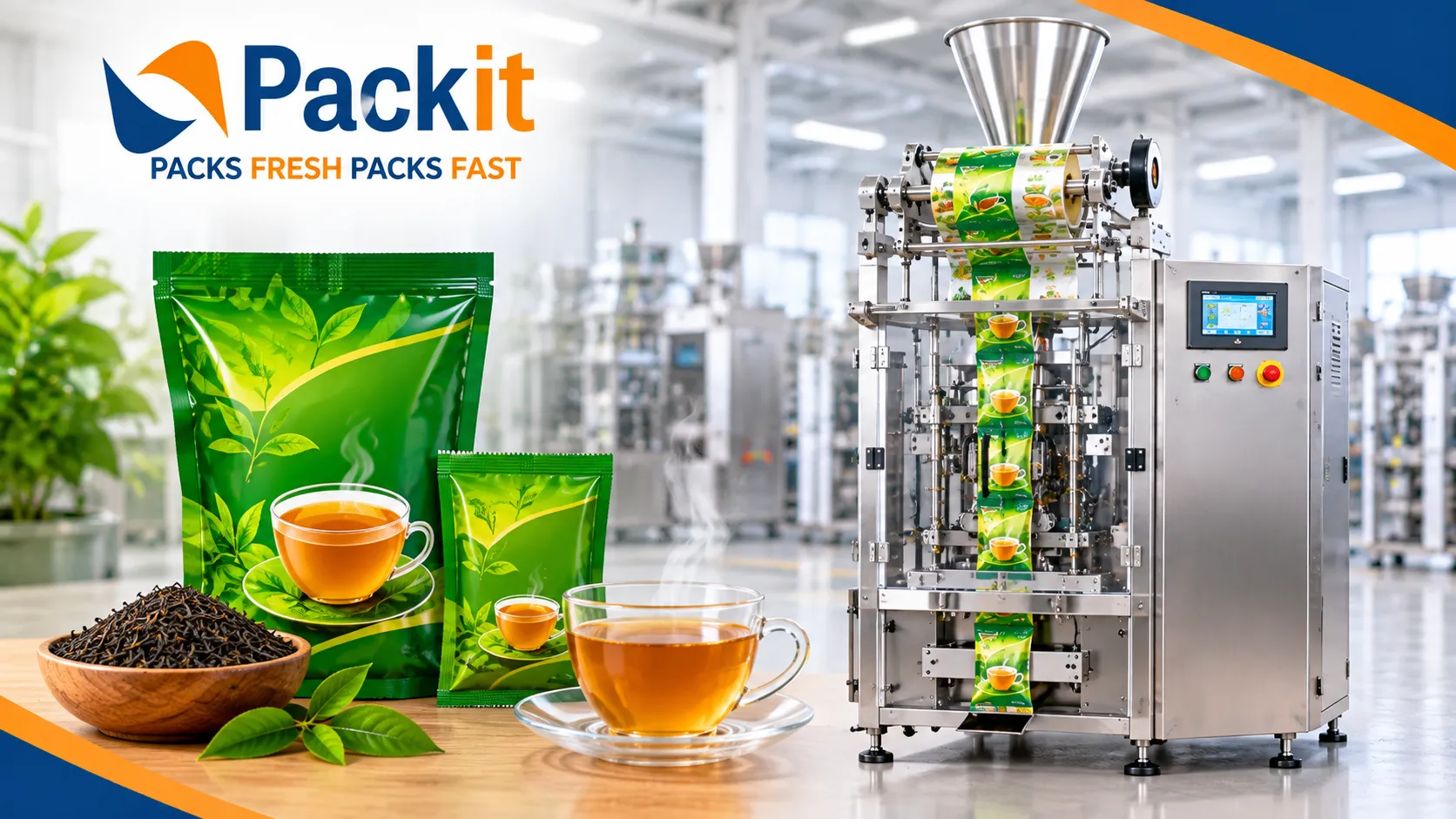
VS Packit builds automatic tea packing machines that weigh, fill and seal loose tea into pouches at a steady speed. The machine is built on our vertical form fill seal platform, so tea is packed straight from the hopper into film formed on the machine. It suits tea packers, blenders and brands that sell CTC, dust, leaf and flavoured tea in retail pouches and bulk packs.
Why Tea Needs a Machine Built for It
Tea loses aroma and strength quickly when it meets moisture, light and oxygen. It is also a light, bulky product whose density changes between CTC granules, fine dust and broken leaf. A general-purpose machine often gives uneven pack weights on tea, or leaves dust in the seal area. A tea packing machine is set up around those behaviours: the right filler for the grade, clean seals and a film path that protects the aroma.
Key Features of the VS Packit Tea Packing Machine
- Servo-driven sealing and PLC control for consistent seals and repeatable pack weights.
- Filler matched to the tea grade, including volumetric cup, servo auger and multi head weigher options.
- Sealing jaws and dust handling designed to keep tea particles out of the seal area.
- Compatibility with barrier laminates that protect tea from moisture, light and oxygen.
- Optional nitrogen flushing for premium and delicate teas where a longer shelf life matters.
- Date and batch coding option for traceability.
- Food-grade stainless steel contact parts, easy to clean between blends.
Choosing the Filler for Your Tea Grade
| Tea type | Recommended filler | Why it suits |
|---|---|---|
| CTC tea | Volumetric cup filler | Granules flow freely and keep a steady density |
| Tea dust and fine grades | Servo auger filler | Fine particles bridge and need controlled dosing |
| Leaf, green and flavoured tea | Multi head weigher | Gentle weighing protects fragile leaf and cuts giveaway |
If you are unsure which suits your blend, our guide to a multihead weigher vs auger filler vs cup filler explains the trade-offs, and our team can confirm the choice with a trial on your own tea.
How Tea Is Packed: From Hopper to Sealed Pouch
The machine follows the same sequence for every grade, and knowing it helps you judge a quotation. Flat film is held on a roll at the unwind, and dancer rolls or brakes keep its tension steady, because uneven tension is one of the most common causes of poor seals and drifting print. The film then runs over a forming collar and filling tube, which wrap it around the tube. Heated jaws bond the inner sealing layer along the back of the bag to make the vertical seam, either as a fin seal or a lap seal. Servo-driven belts pull the film down, and the machine sets bag length either by counting motor revolutions or by reading a registration mark on printed film.
Below the tube, a pair of cross-seal jaws closes on the film. One set seals the top of the filled pouch while the other seals the bottom of the next one, and a knife between the jaws cuts the pouch free. Tea is dropped down the tube in the pause between seals, so the dosing and the sealing must be timed to each other. This is why a tea line is tuned on your own tea, not only on test material.
Pouch Styles and Pack Sizes
The machine makes pillow and gusseted pouches from roll film, with pack sizes set to your range, from small retail packs to larger family and trade packs. Each size needs its own forming set, so list the sizes you plan to run when you request a quotation. For help choosing between styles, read about VFFS pouch types.
Film and Barrier Requirements
Tea packs usually use a laminate with a barrier layer, such as a metallised or foil structure with a polyethylene sealing layer. Plain polyethylene gives little protection against aroma loss and moisture. Our team will advise on film width, thickness and structure so the seal quality and the shelf life both meet your needs.
Why Barrier Film Matters More for Tea Than for Most Foods
Tea is sensitive to moisture, oxygen and light, and together these dull the flavour, fade the aroma and shorten shelf life. That is why most tea packs use a laminate with a barrier layer instead of plain polyethylene. A metallised film, usually metallised polyester or BOPP laminated to a polyethylene sealing layer, gives a high moisture barrier and shields the leaf from oxygen and light. In a typical sandwich laminate the metallised film is the barrier core, with an outer printed layer for appearance and an inner sealing web that keeps the pouch closed until the customer opens it.
For the machine, the barrier film matters in three ways. First, the sealing layer must bond reliably at the jaw temperature set on the machine, even when a few tea particles reach the seal. Second, the film must be stiff enough to run smoothly over the forming collar. Third, heat-seal strength should stay consistent from the first pouch to the last on the roll. We advise on film structure, width and thickness at quotation stage, and we run your film on the machine during the trial so that any problem shows before dispatch, not after installation.
Packing Dust, CTC, Orthodox and Green Tea
Indian tea is not one product. CTC tea, which dominates the large domestic market, is a hard, uniform granule that flows well and suits a volumetric cup filler. Dust and fannings are finer and tend to bridge in a hopper and rise as airborne dust, so a servo auger filler with a controlled hopper agitator gives steadier doses and a cleaner seal area. Orthodox, whole-leaf, green and flavoured teas are fragile and bulky, and breakage lowers their value. For these, a multi head weigher with soft drop and gentle handling protects the leaf and keeps giveaway low.
- CTC and dust blends: cup or auger dosing, high speed, strong seals and printed pillow pouches in retail sizes.
- Premium orthodox and green tea: multi head weigher, gusseted or flat-bottom pouch for shelf appeal, and optional nitrogen flushing.
- Flavoured and blended tea: weigher with anti-stick surfaces, since oils and added flavour can make leaf cling to contact parts.
- Institutional and bulk packs: larger pouch formats with heavier film and a strong, wide seal.
Nitrogen Flushing: When It Is Worth the Cost
Nitrogen displaces oxygen inside the pouch, which slows oxidation and protects aroma, and it also cushions delicate leaf from crushing in transit. For a fast-moving CTC pack that is sold within weeks, the barrier film alone is often enough. For premium, long-shelf-life or export packs, flushing is a sensible add-on. The trade-off is a slightly slower cycle and a small recurring gas cost, so we suggest deciding by shelf-life target and price point, not by default.
What to Check Before You Buy a Tea Packing Machine
A good purchase is decided by the factory acceptance test, so plan it in advance. A sound test plan states the pack weights, speed, number of pouches to be run and the pass criteria before the machine is built. It uses your real tea and your real film, not substitute material, and it runs long enough to show whether the machine holds weight and seal quality, not only whether it starts. Safety checks, such as guarding, emergency stops and pinch points, should be part of the test, and the supplier should repeat any failed test at no charge.
- Pack-weight accuracy across a full run, measured on a calibrated scale.
- Seal strength and appearance, including seals that pass through tea dust.
- Actual speed at your pack size, not the catalogue maximum.
- Time taken to change from one pack size to another.
- Manuals, wiring and pneumatic drawings, and a recommended spare parts list.
- Operator training for the people who will run the line every day.
Our team shares this checklist with every buyer and invites you or your technician to watch the trial. If you are still comparing options, read our guide on how to choose a pouch packing machine before you short-list suppliers.
Running Costs and Wastage to Plan For
The machine price is only part of the cost of owning a tea line. Film is usually the largest running cost, so a pouch that is a few millimetres too long adds up over millions of packs. Giveaway is the next item: if every pack carries two extra grams, the loss over a year is large compared with the cost of a more accurate filler. Finally, plan for spare jaws, heater cartridges and Teflon tape, which are wear parts, and keep a small stock of them. Good dosing, correct pouch length and regular cleaning of the seal area are the three habits that keep the cost per pack low.
Industries and Buyers We Serve
- Tea estates and bulk packers supplying wholesale markets.
- Blenders and branded tea companies with regional distribution.
- Private label and institutional tea suppliers.
- Start-up tea brands moving from manual packing to automation.
Why Buy From VS Packit
VS International has built packaging machinery for more than two decades at its facility in Faridabad, Haryana, and supplies machines to well-known Indian food and FMCG brands. Installation, operator training, spare parts and technical support are available across India. If you are in the National Capital Region, read about our local supply in tea packing machine manufacturer in Faridabad. For other fine products on the same platform, see our powder packing machine and the main vertical form fill seal machine page.
Get a Quotation for Your Tea Packing Line
Send us the tea grade, pack weights, pouch style and the speed you need per hour. We will recommend a configuration and quote it line by line, and we can arrange a trial with your own tea. Request a quote or call +91 9811103573.