

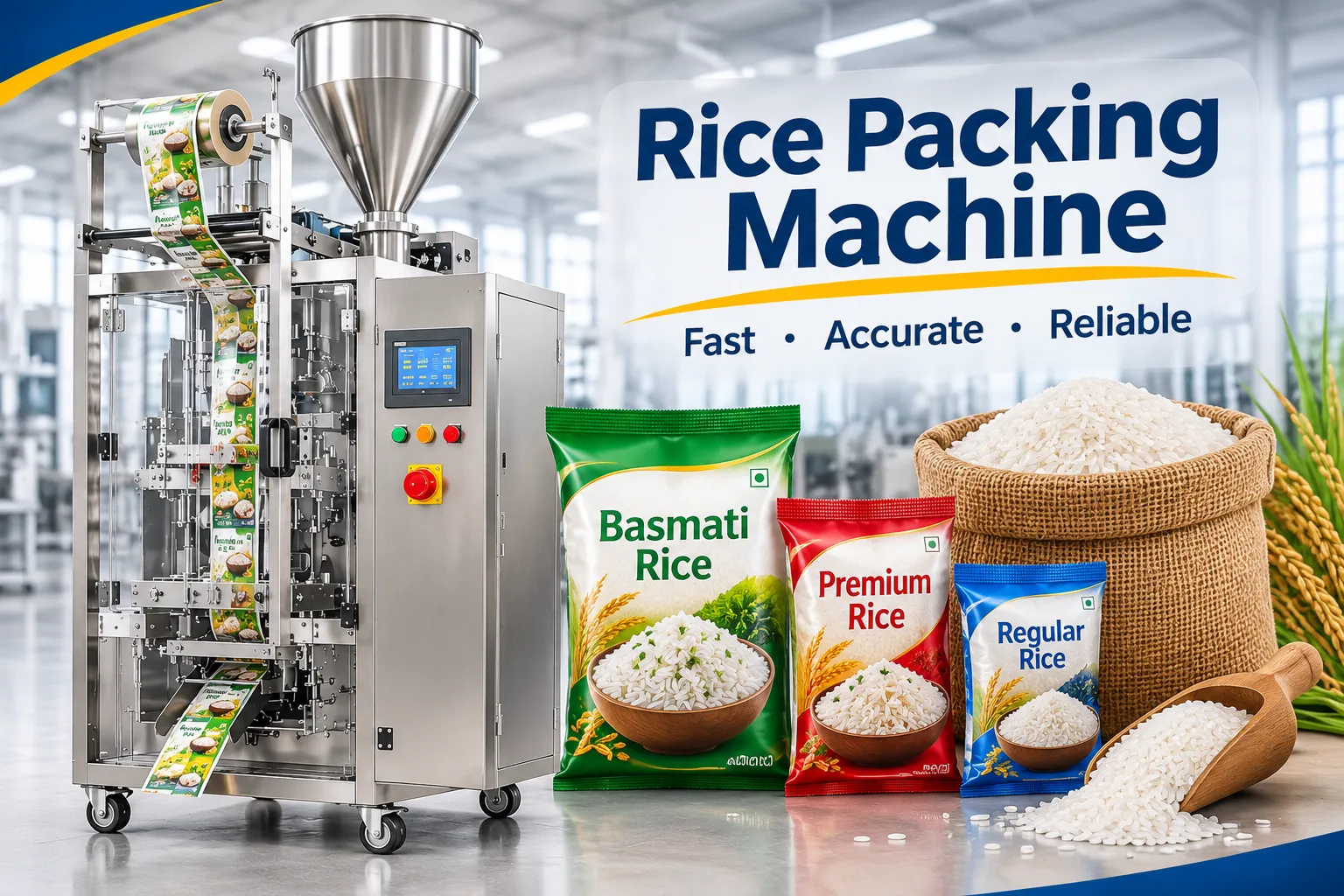
VS Packit builds automatic rice packing machines that weigh, form, fill and seal rice into bags in one continuous cycle. The machine runs on our vertical form fill seal platform with servo-driven sealing and PLC control, so pack weights stay steady across a full shift. It suits rice mills, basmati brands, exporters and grain packers who sell in retail packs and larger family bags.
What a Rice Packing Machine Must Get Right
Rice looks easy to pack, yet it creates problems for a weak machine. Long basmati grains can jam in narrow openings. Fine rice dust settles on the seal and weakens it. Overfilling by even a few grams on every bag adds up to tonnes of lost product over a year. A good rice packing machine controls the dose, keeps the seal area clean and protects the grain from breakage.
Key Features
- Servo-driven sealing and PLC control for repeatable seals and pack weights.
- Choice of volumetric cup filler for regular rice or multi head weigher for premium basmati and tighter weight control.
- Sealing jaws set for strong, even seals on bags that carry weight.
- Pillow and gusseted bag formats from roll film, so there is no stock of ready-made bags to manage.
- Food-grade stainless steel contact parts with easy access for cleaning.
- Date and batch coding option for traceability.
- Quick format changes between pack sizes with the right forming sets.
Filler Options for Rice
| Application | Recommended filler | Reason |
|---|---|---|
| Regular and parboiled rice, high volume | Volumetric cup filler | Free flowing grain, simple, economical and easy to clean |
| Premium basmati and export packs | Multi head weigher | Weighs each portion, keeps giveaway low and handles long grain gently |
| Mixed grain and pulse packs | Multi head weigher | Different sizes and densities are weighed rather than measured by volume |
Our guide to a multihead weigher vs auger filler vs cup filler explains how to decide, and our team can test your rice on both options before you buy.
How an Automatic Rice Packing Cycle Works
Rice is fed from a hopper or bucket elevator into the filler. The film unwinds from a roll and is wrapped around a forming tube, and heated jaws seal the back seam to turn the flat film into a tube. Servo belts pull the film down, and the cross-seal jaws close below the tube to seal the bottom of one bag and the top of the previous one. A knife cuts the bag free. Rice drops through the tube in the pause between seals, so the filler and the sealing jaws must be timed to each other. Bag length is set by the servo motor, or by a registration mark if the film is pre-printed.
The same cycle repeats thousands of times an hour. The things that decide the quality of the output are the steadiness of the film tension, the accuracy of the dose and the cleanliness of the seal area. These are the three points we test with your own rice before the machine leaves our Faridabad works.
Bag Styles and Pack Sizes
Small retail packs usually go in pillow bags, while heavier family packs sit better in gusseted bags that lie flat and stack neatly in cartons or on shelves. The machine is configured to the pack sizes you sell, such as 500 g, 1 kg, 2 kg and 5 kg, and each size needs its own forming set. Read more about VFFS pouch types to choose the right style for your brand.
Film and Seal Quality
Rice bags need a film that is strong enough to carry weight, resists puncture from sharp grain edges and seals cleanly. Laminated films with a polyethylene sealing layer are common. We recommend the film structure and width with the machine so that seals hold during transport and storage.
Why Moisture and Bag Condition Decide Claims
Rice is very sensitive to water damage, and the trade treats about 14 percent moisture as the safe-storage limit in tropical conditions. Many export specifications cap moisture at 14 percent or lower. Rice packed close to that limit can heat or form condensation during carriage, and long dwell times at humid ports can lead to moisture pickup, mould, off-smell or infestation. A good laboratory certificate at origin does not protect against damage in transit, so the pack itself matters.
This is where packing machine choices show up as money. Torn bags, weak seals and contamination are frequent causes of claims, and a packaging failure can let moisture or insects in even when the milling was excellent. A machine that makes a full-width, even seal, with the correct sealing temperature for your film, lowers that risk. So do bag liners or laminated film where the buyer demands them, and metal detection and batch coding where the market requires traceability.
Retail and Bulk Formats We Support
Two formats dominate the trade: retail packs in the 1 kg to 5 kg range, and bulk bags for wholesalers and exporters. Our automatic VFFS rice packing machine is aimed at the retail and small-bulk packs, where roll film, quick pack-size changes and steady weights save the most money. Very large sacks are normally filled on a separate weigh-and-bag system, and we will tell you plainly if your requirement falls into that group.
- 500 g and 1 kg pillow bags: the fastest and lowest-cost format for everyday retail.
- 2 kg and 5 kg gusseted bags: flat base, better stacking, and more space for branding.
- Export retail packs: tighter weight tolerance, clean seal appearance and batch coding.
- Private label packs: several sizes on one machine with fast changeover.
Basmati, Sella and Regular Rice: Handling Differences
Basmati has a long, slender grain that breaks more easily than short-grain rice, and broken grain lowers the price. Gentle handling at the hopper, a smooth drop path and a cup or weigher setting that does not crush grain protect the breakage percentage you milled so carefully. Steam-treated or parboiled sella rice is harder and heavier, and flows differently, so the cup volume or the weigher settings are tuned to its density. Regular and sortex-cleaned rice usually flows freely and suits a cup filler. Fine rice dust is the common enemy of the seal in every case, so we fit dust control and advise a short cleaning routine for the sealing area.
Giveaway: The Hidden Cost on Every Bag
Overfilling a 1 kg pack by only 5 grams means 5 kg of rice given away for every 1,000 bags. For a mill packing 20,000 bags a day, that is 100 kg a day or about 30 tonnes over a year of 300 working days. A multi head weigher can cut this loss sharply by combining the heads that give a weight closest to the target. A cup filler is cheaper but depends on steady grain density, so it needs a little extra margin. We help you work out which is better for your price per kilogram and your volume, which is a more reliable way to choose than comparing machine prices alone.
Buying Checklist for a Rice Packing Machine
- List every rice variety, pack size and bag style you plan to run in the next three years.
- Decide the target speed per minute and the shift pattern, then ask for the speed demonstrated on your own rice.
- Ask for the weight accuracy in grams, measured over a full run on a calibrated scale.
- Check the seal strength by hand and by a drop test of a filled bag.
- Confirm the cost and time for each additional forming set.
- Ask for spares, training, installation and a named service contact.
Our guide on how to choose a pouch packing machine covers the wider decision in more detail, and you can compare running cost against purchase price in our article on pouch packing machine price in India.
Who Uses This Machine
- Rice mills and basmati processors packing under their own brand.
- Exporters who need consistent weights for international buyers.
- Grain and pulse packers who also run dal, sugar and cereal lines.
- Regional brands moving from manual packing to automatic lines.
Built and Supported in India
VS International has built packaging machinery for more than two decades at its facility in Faridabad, Haryana. We provide installation, operator training, spare parts and service support across India. If you pack other grains, read our guide on choosing the right dal packing machine, or see how we serve nearby mills in rice packing machine manufacturer in Faridabad. The base platform is described on our vertical form fill seal machine page.
Request a Quotation
Tell us the rice variety, pack sizes, target output per hour and bag style. We will recommend a configuration and quote it line by line, and we can arrange a trial with your own rice. Contact VS Packit or call +91 9811103573.