
If you have started asking around for a milk packing machine, you have probably noticed something frustrating already. Every supplier quotes a different number, and the range you are seeing can stretch from under a lakh to well over eight lakh rupees. That is not a pricing trick. It genuinely reflects how different these machines can be depending on automation level, output speed, build quality, and the brand behind them.
This guide breaks down the real cost of a milk packing machine in India, what actually drives that price up or down, and how to avoid overpaying or underbuying for your dairy's needs.
What Is the Average Milk Packing Machine Price in India?
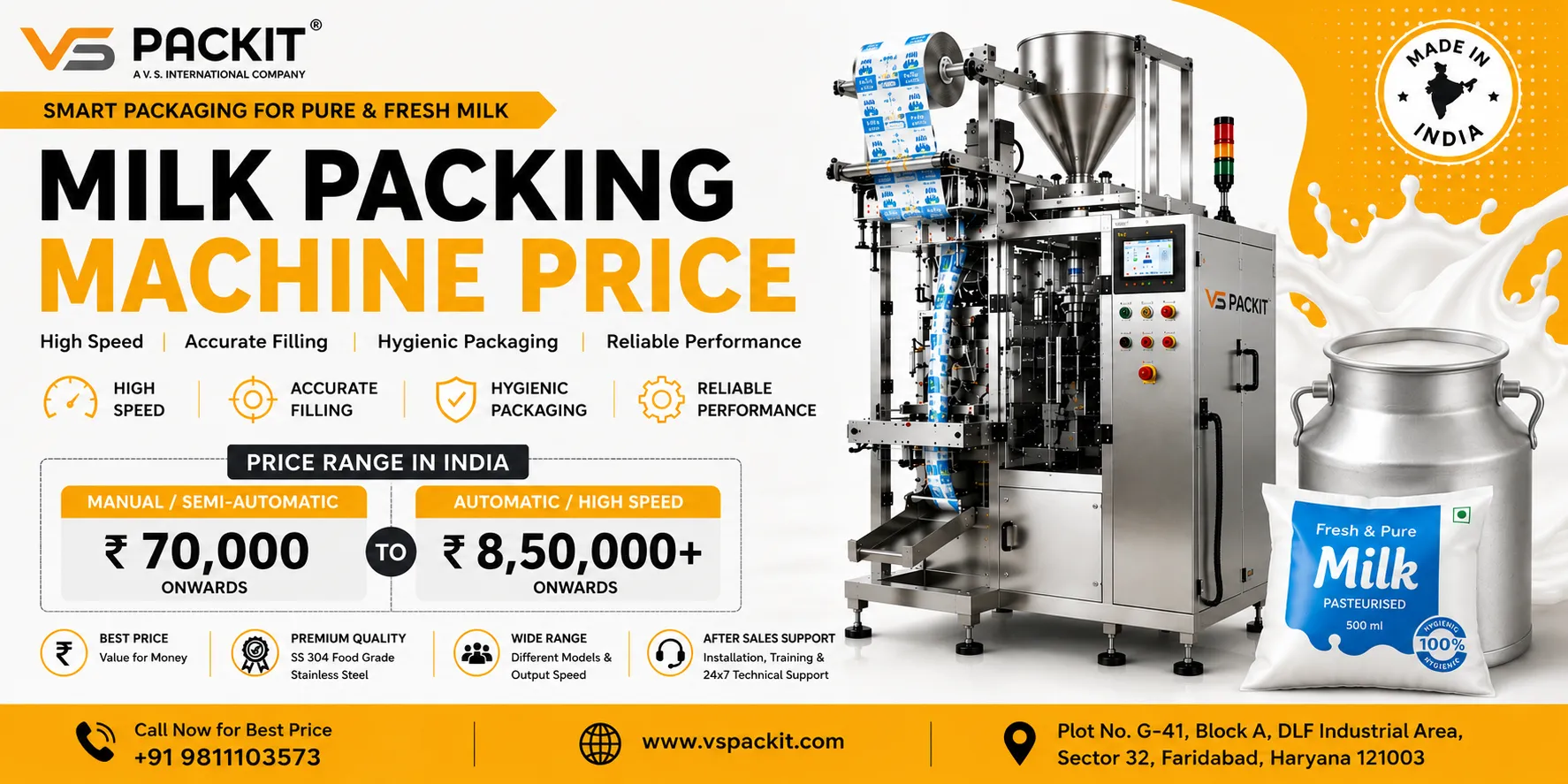
As a broad benchmark, the milk packing machine price in India typically falls between 70,000 rupees and 8.5 lakh rupees. Basic manual machines sit at the lower end, while high speed, PLC controlled automatic systems with multiple filling heads sit at the higher end.
That is a wide bracket, so here is a more practical breakdown by machine type.
| Machine Type | Price Range (INR) | Typical Speed | Best For |
|---|---|---|---|
| Manual pouch packing machine | 70,000 to 1.85 lakh | 200 to 1,200 pouches/hour | Small dairies, home based dairies, startups |
| Semi-automatic machine | 1.85 lakh to 2.65 lakh | 1,000 to 1,600 pouches/hour | Dairies scaling beyond manual filling |
| Automatic single head machine | 2.2 lakh to 4.4 lakh | 1,600 to 2,500 pouches/hour | Mid size dairies with steady daily demand |
| Automatic dual head machine | 4.5 lakh to 6.5 lakh | 3,000 to 6,000 pouches/hour | Established dairies running multiple lines |
| High capacity multi lane systems | 6.5 lakh to 8.5 lakh and above | 6,000 to 12,000+ pouches/hour | Large dairies, cooperatives, bulk production |
These numbers are indicative and will shift based on the manufacturer, customisation, and the exact filling range your product needs.
What Actually Decides the Cost of a Milk Packing Machine?
The cost of a milk packing machine is not just about the machine's size. Several factors quietly add or cut cost, and knowing them helps you understand a quotation instead of just reacting to the final number.
Automation level: This is the single biggest driver. A manual machine needs an operator for loading and adjustment at every stage, which keeps the build simpler and cheaper. A fully automatic machine with PLC control, servo driven film pulling, and sensor based fault detection costs more upfront but reduces labour dependency over time.
Filling accuracy and technology: Machines with tighter dosing accuracy, often within plus or minus 1 to 2 ml, use better calibrated pumps and sensors, which adds to the price but reduces product giveaway and wastage over months of use.
Number of filling heads: Single head machines are cheaper but slower. Dual or multi lane machines cost more but multiply your output without needing a second full setup.
Build material and finish: Full stainless steel construction on all product contact parts costs more than machines that use stainless steel only on select components. For dairy hygiene compliance, this is not an area to compromise on just to save money.
Output speed: Higher pouches per hour generally means a higher price tag, since it requires faster mechanical cycles, sturdier components, and often a more powerful motor and control system.
Brand and after sales support: Established manufacturers with a service network and readily available spare parts typically price their machines slightly higher than lesser known suppliers, but this often pays off in reduced downtime later.
Customisation: Non standard pouch sizes, multiple filling ranges on one machine, or specific integration with your existing conveyor and crating setup can add to the base cost.
Milk Packing Machine Cost vs Long Term Value
It is easy to fixate on the sticker price, but the real cost of a milk packing machine plays out over its working life, not just on day one. A cheaper machine with poor sealing consistency can lead to leaking pouches, product returns, and unhappy retailers, all of which cost more than the money saved at purchase. Similarly, a machine with high film wastage due to inaccurate cutting or pulling eats into your margins pouch after pouch, even if that is not obvious on a monthly statement.
When you are comparing quotes, it helps to look beyond the base price and ask about these three things specifically: expected film wastage percentage, average maintenance cost per year, and typical downtime history for that model. A machine priced 15 to 20 percent higher but with better numbers on these three fronts is usually the smarter buy for a dairy running daily production.
Manual vs Automatic Milk Packing Machine Price Comparison
Since this comparison comes up constantly, here is a direct side by side to make the decision easier.
| Factor | Manual Machine | Automatic Machine |
|---|---|---|
| Price | 70,000 to 1.85 lakh | 2.2 lakh to 8.5 lakh |
| Labour requirement | High, needs operator at each step | Low, mostly monitoring |
| Output | 200 to 1,200 pouches/hour | 1,600 to 12,000+ pouches/hour |
| Best suited for | Daily volume under 500 to 1,000 litres | Daily volume above 1,000 litres |
| Long term running cost | Higher labour cost over time | Higher upfront cost, lower ongoing labour cost |
If your dairy is processing under a few hundred litres a day, a manual or semi-automatic machine often makes more financial sense than jumping straight to full automation. If you are already crossing a thousand litres daily or planning to scale soon, the higher upfront cost of an automatic machine tends to pay for itself within a reasonable timeframe through labour savings and output consistency.
Machines Worth Comparing Before You Decide
Rather than comparing on price alone, it helps to look at specific machine configurations and what they are built for. Here are a few worth putting on your shortlist.
The Komet 81 is a solid option for dairies that want dependable, continuous pouch packing without frequent changeovers, making it a good fit when you are trying to balance cost with steady daily reliability.
The Indus 5000 suits dairies planning for higher daily volume, where the slightly higher investment is offset by consistent throughput and reduced per pouch cost at scale.
For dairies running more than one product line or SKU, Duplex Packaging Systems offer a dual lane setup that increases output without requiring a second machine, which works out more cost effective per unit produced.
And for smaller or growing dairies watching their budget closely, the GT-5S offers a compact, lower investment option that still delivers reliable performance without the price tag of a full scale industrial line.
You can explore the complete lineup of milk packing machines to compare specifications, capacities, and pricing side by side before making a decision.
Getting the Right Quote
One thing worth keeping in mind while collecting quotes: the lowest number on paper is not always the best deal. It helps to work with established packaging machine suppliers who can walk you through the full cost picture, including installation, operator training, spare parts availability, and warranty coverage. A transparent supplier will break down exactly what is included in the quoted price rather than leaving you to discover hidden costs after the machine arrives at your plant.
Before finalising, it is worth asking for a written quotation that specifies the exact model, filling range, output speed, warranty period, and what after sales support looks like. This small step saves a lot of back and forth later and gives you a clear basis to compare quotes from different suppliers.
Final Thoughts on Budgeting for a Milk Packing Machine
The cost of a milk packing machine should be evaluated against your actual daily volume, growth plans, and product range, not just against the cheapest quote in your inbox. A machine that is slightly more expensive but matches your real production needs will almost always work out better financially over its lifespan than one bought purely to save money upfront. Take the time to compare a few models, ask detailed questions about accuracy and build quality, and choose a supplier who will stand behind the machine after the sale, not just at the point of purchase.