

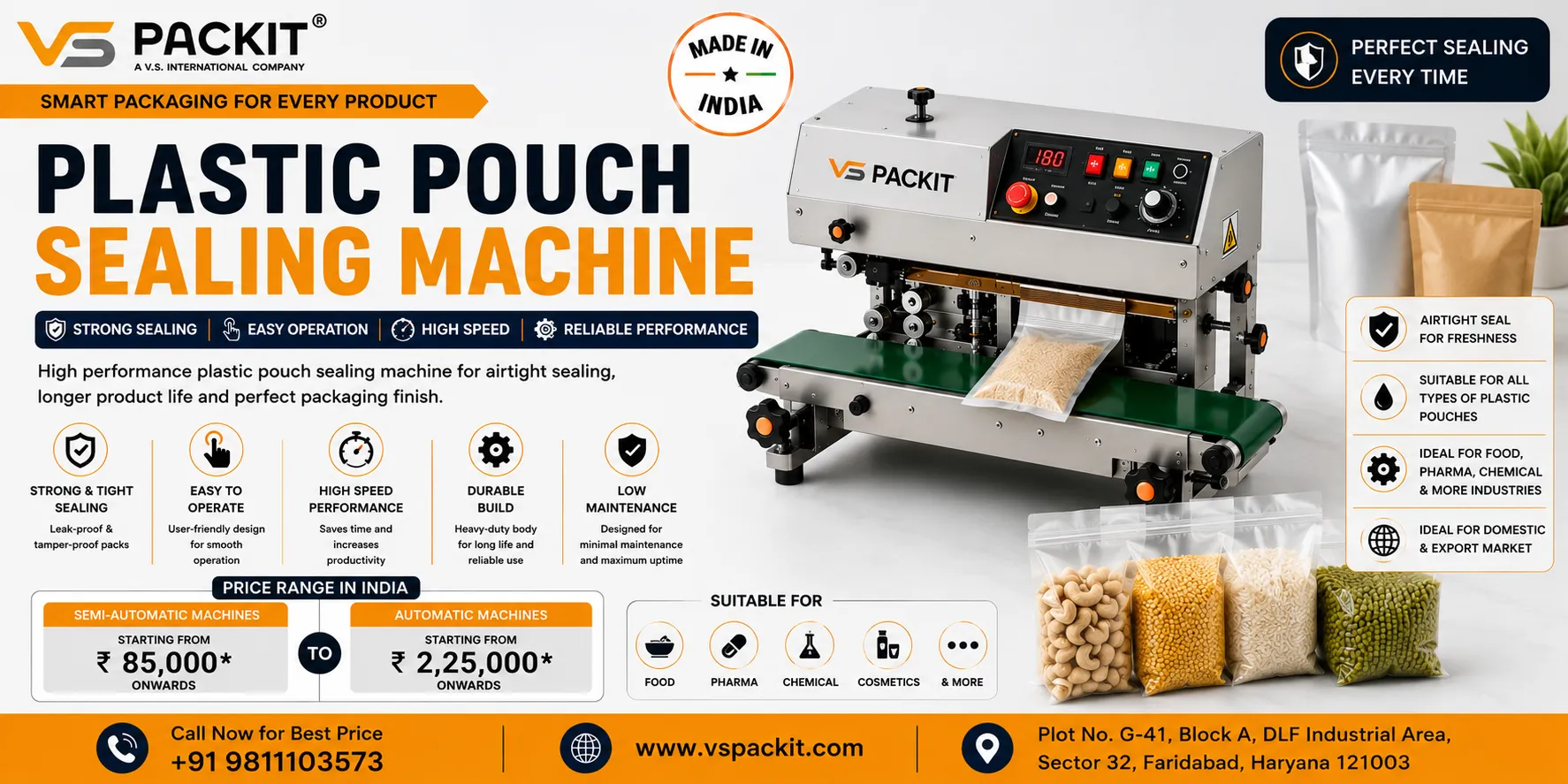
Plastic pouches have become the default packaging format across food, spice, pharma, and chemical industries, and for good reason. They are lightweight, cost efficient, and adapt well to different product types. But a plastic pouch is only as good as its seal, and a plastic pouch sealing machine sitting at the end of your line carries more responsibility for product quality than most buyers realize until something goes wrong.
Having spent years around packing operations across multiple industries, one thing becomes obvious quickly. Plastic film behaves differently depending on its composition, thickness, and layering, and a sealing machine that is not properly matched to your specific film often produces seals that look fine on the day of packing but fail somewhere between the factory and the shelf.
This guide walks through how plastic pouch sealing machines work, what separates a good match from a poor one, and where to look when comparing equipment for your production line.
Need a plastic pouch sealing machine matched to your film and volume? Contact our team and we will help you find the right setup for your production line.
Why Plastic Film Behavior Matters at the Seal Point
Not all plastic film reacts the same way to heat and pressure, and this is where most sealing problems actually start.
Film composition and layering: Laminated plastic films used in food, spice, and pharma packaging are built with multiple layers, and only the inner layer is meant to melt and bond during sealing. A machine running the wrong temperature can either fail to melt that layer properly or scorch through it entirely.
Thickness variation: Thicker films need more dwell time to bond fully, while thinner films can weaken or burn if held under heat too long. A plastic pouch sealing machine needs adjustable controls to handle this range rather than a single fixed setting.
Product residue at the seal line: Oily products, powders, or small particles that land at the seal area during filling can prevent the plastic layers from bonding cleanly, which is one of the most common and preventable causes of leaks.
Static and cling behavior: Some plastic films cling or generate static during high speed feeding, which can cause misalignment at the sealing jaws if the machine is not built to handle it consistently.
Getting these factors right consistently, pack after pack, is the core job of a properly matched sealing machine.
Types of Plastic Pouch Sealing Machines
Plastic pouch sealing machines generally fall into a few categories depending on production scale and how the line is set up.
Manual and semi-automatic sealers: Suited to lower volume operations, sampling runs, or contract packers where an operator manually feeds pouches through the sealing jaws.
Continuous band sealers: Move pouches through a heated band on a conveyor, allowing steady sealing without a stop-start cycle, suited to mid range throughput needs.
Vertical form fill seal systems: Combine filling and sealing into a single continuous cycle, common across food and spice packing lines running consistent daily volumes.
Fully automatic integrated systems: Built for high volume manufacturers, combining filling, sealing, and often coding into one line with minimal manual intervention.
What to Check Before Buying
A few practical checkpoints make comparing plastic pouch sealing machines far easier.
Confirm the machine is rated for your specific film type and thickness range, since not every sealer performs consistently across all plastic compositions. Ask for adjustable temperature and dwell time control, since flexibility matters the moment you switch film thickness or product type. Request sample seals from a live trial using your actual film rather than the supplier's standard demo material, and check for even bonding across the full seal width, not just the center. Match machine speed to your actual daily volume rather than defaulting to the highest rated option, since running well below rated speed can sometimes affect seal consistency on certain machines. And confirm local service support and spare part availability before finalizing, since a jammed or miscalibrated sealer needs quick attention to avoid production downtime.
VS Packit Machines for Plastic Pouch Sealing
Different production scales and pouch formats call for different equipment. Here is a quick reference across the range.
| Product | Best Suited For |
|---|---|
| Komet 81 | Businesses needing a compact, dependable machine for steady daily pouch sealing and filling |
| Indus 5000 | Mid to high volume operations needing a robust, higher throughput sealing and packing setup |
| Komet Sprint | Faster cycle times for operations that need speed without moving to a full duplex configuration |
| Duplex Packaging Systems | Manufacturers scaling production who need consistent, simultaneous sealing across twin lines |
Common Mistakes to Avoid
A few recurring issues show up across plastic pouch sealing installations regardless of industry.
Choosing sealing settings by guesswork instead of testing with the actual film and product, since every film composition behaves slightly differently at the seal point. Ignoring dwell time while chasing higher speed, which leads to weak seals that only reveal themselves after the pack has already left the factory. Skipping regular cleaning of sealing jaws or bands, since residue buildup is one of the most common and most preventable causes of inconsistent seals. And underestimating the value of local service support, since a sealing issue that could be resolved in an hour with the right support can turn into days of downtime without it.
Matching the machine properly to your plastic film and production volume, rather than buying based on speed or price alone, is what actually keeps seal quality consistent on the factory floor day after day.