

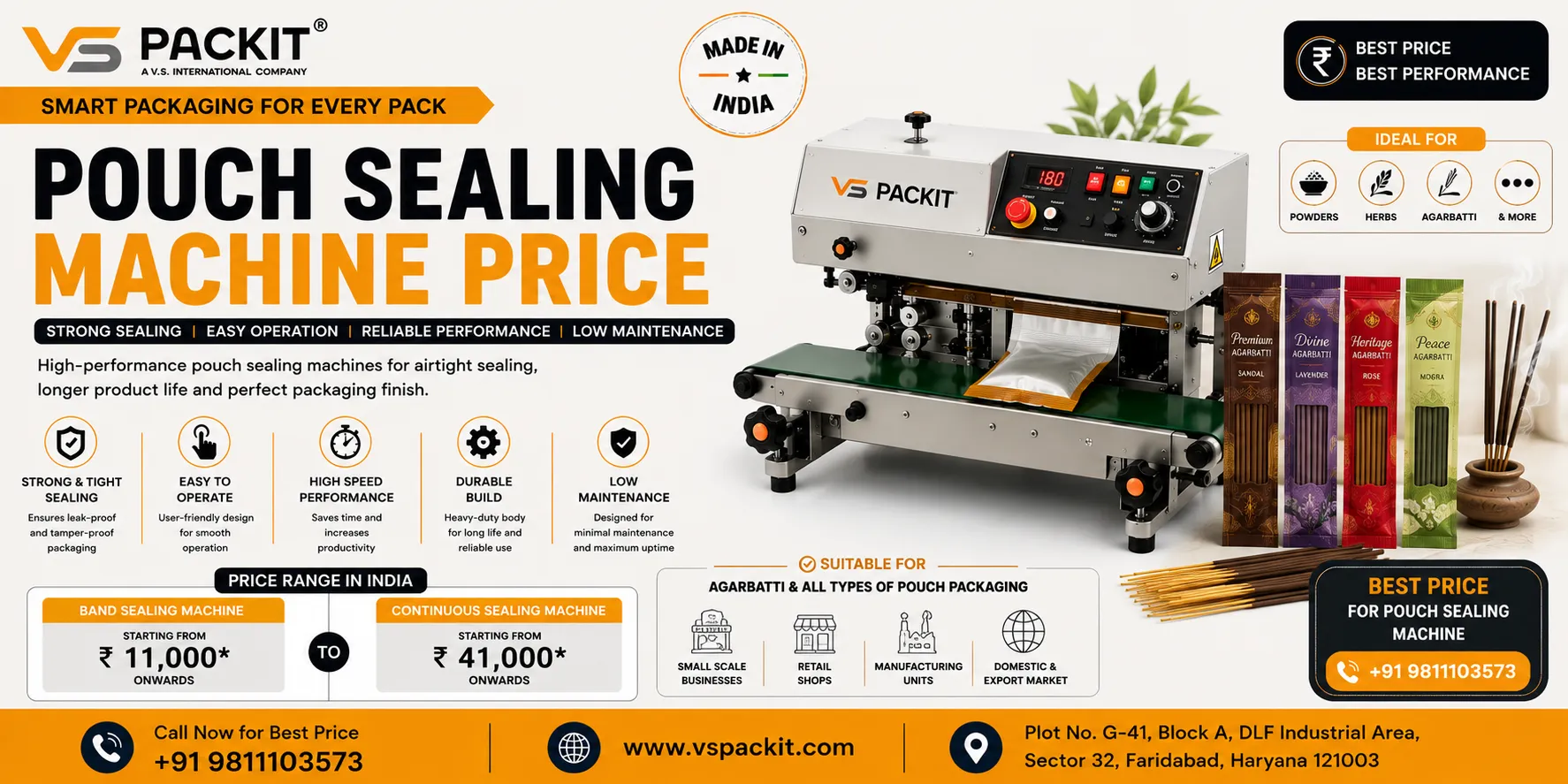
Ask five different suppliers for a pouch sealing machine price and you will likely get five different numbers, sometimes with a gap wide enough to make you question whether they are even talking about the same category of machine. This is one of the most common frustrations buyers run into, and it usually happens because pricing on this equipment depends on far more than the sticker figure suggests.
Having worked closely with manufacturers across food, spice, pharma, and chemical packaging over the years, one thing becomes clear early on. The lowest quote is rarely the cheapest machine once you factor in downtime, rework, and service delays down the line. Understanding what actually drives pouch sealing machine price helps buyers compare quotes properly instead of chasing the smallest number on paper.
This guide breaks down what goes into pricing, what ranges to expect across different machine types, and how to avoid the common trap of comparing machines that are not actually comparable.
Looking for the exact pouch sealing machine price for your product and volume? Contact our team and we will share a configuration and quote suited to your requirement.
Why Pouch Sealing Machine Price Varies So Much
A sealing machine is not a single, standardized product. It is built around your film type, your pouch size, your daily output target, and how much of the process you want automated. Each of these pulls the price in a different direction.
Level of automation
A manual or semi-automatic sealer where an operator feeds pouches by hand costs a fraction of a fully automatic system with sensors, PLC controls, and integrated filling. The jump in price reflects the jump in labor saved and consistency gained.
Sealing technology
Heat sealing setups tend to be more affordable and widely available. Ultrasonic sealing, which suits specific film types and cleaner seal requirements, generally sits at a higher price point due to the components involved.
Build quality and frame material
Machines built with stainless steel frames and food grade contact parts, which matter a great deal in spice, food, and pharma packing, cost more than machines with mixed steel construction. This difference is not cosmetic, it affects hygiene compliance and long term durability.
Speed and throughput rating
A machine rated for higher packs per minute needs stronger motors, better temperature control across the seal width, and more robust mechanical parts to hold that speed without seal quality dropping. All of that adds to the price.
After sales support and spare parts network
This one gets overlooked constantly. A supplier with strong regional service reach and readily available spare parts may price the machine slightly higher, but the real cost of ownership often works out lower because you are not losing production days waiting for a technician.
Automatic Pouch Sealing Machine Price: What Drives the Higher End
An automatic pouch sealing machine price sits noticeably above manual or semi-automatic units, and buyers sometimes need convincing on why the gap is justified. The honest answer from years of watching production floors is that automation pays for itself in consistency, not just speed.
Automatic systems typically include programmable temperature and dwell time settings, automatic pouch detection, and integration with filling and coding units. This reduces operator dependent variation, which is one of the biggest causes of inconsistent seals on manually run lines. For businesses running multiple shifts or scaling volume steadily, the higher upfront number usually balances out within a reasonable operating period once you account for reduced rejects and lower labor requirements per shift.
Buyers evaluating automatic pouch sealing machine price should ask suppliers for a breakdown of what is included, since automation packages vary. Some quotes include only the sealing unit, while others bundle filling, sealing, and basic coding into one system.
Agarbatti Pouch Sealing Machine Price: A Segment With Its Own Requirements
Agarbatti and incense stick packaging has specific handling needs that general purpose sealing machines are not always built for. The pouches are often longer and narrower, and the product inside is delicate enough that rough handling during sealing can damage sticks before the pack even reaches a shelf.
Agarbatti pouch sealing machine price tends to reflect these adjustments, including modified pouch guides, gentler handling mechanisms, and sealing settings tuned for the specific film used in incense packaging, which is frequently thinner than standard food grade film. Buyers in this segment should avoid assuming a general purpose sealer will work without modification, since mismatched equipment here leads to crushed sticks, uneven pouch alignment, and seals that fail exactly where the product needs protection most.
Pouch Sealing Machine Price in India: Regional Factors Worth Knowing
For manufacturers researching pouch sealing machine price in India, a few regional factors shape what you will see in quotes compared to imported alternatives.
Domestically manufactured machines generally come with a shorter lead time and easier access to spare parts, since the supply chain for components does not depend on international shipping. This matters more than it seems on paper, because a delayed spare part on an imported machine can mean weeks of downtime versus days.
Import duties and currency fluctuations also affect pricing on machines sourced from outside the country, which can make budgeting less predictable over a multi year equipment lifecycle. Buyers comparing domestic and imported options should factor in not just the purchase price but also installation support, training availability in the local language, and how close the nearest service technician actually is.
Regional demand also plays a role. Areas with dense clusters of food, spice, or pharma manufacturing tend to have more competitive pricing and faster service response simply because suppliers maintain a stronger local presence there.
A Rough Reference Range
Exact numbers shift based on configuration, but as a general orientation point based on what buyers typically encounter across segments:
| Machine Type | Typical Positioning |
|---|---|
| Manual or Semi-Automatic Sealer | Entry level, suited to low volume or sampling runs |
| Continuous Band Sealer | Mid range, suited to steady throughput without full automation |
| Vertical Form Fill Seal Machine | Mid to higher range, combines filling and sealing in one cycle |
| Fully Automatic Integrated System | Higher range, built for consistent high daily volume with minimal manual intervention |
These bands are directional rather than fixed, since film type, pouch size, and customization requests all shift the final quote. The only reliable way to get an accurate figure is a direct conversation with a supplier who understands your product and volume specifics.
What Experienced Buyers Check Before Comparing Quotes
After seeing enough installations go smoothly and enough go sideways, a pattern shows up consistently among buyers who end up satisfied with their purchase.
They ask for a live trial with their actual product and film, not a demo run on the supplier's standard sample film. They confirm what is included in the quoted price versus what counts as an add on, since installation, training, and initial spare parts are sometimes billed separately. They check the warranty terms closely, particularly around sealing jaws and heating elements, which are the components most likely to need replacement first. And they ask directly about service response time in their specific region rather than assuming national coverage means fast local support.
Common Pricing Mistakes to Avoid
A few mistakes show up again and again across pouch sealing machine purchases, regardless of industry.
Comparing quotes without matching specifications, where one quote is for a manual sealer and another is for a semi-automatic system, leads to confusion about why prices differ so much. Choosing the lowest price without checking film compatibility, which sometimes means paying more later for a machine that cannot handle your actual packaging material. Skipping questions about spare part costs and availability, only to discover replacement parts are hard to source once the machine is already running daily production. And underestimating the value of local support, since a lower priced machine from a supplier with weak regional presence can end up costing more in downtime than a slightly higher priced machine backed by dependable service.
Getting the price right is not just about finding the smallest number on a quote. It is about matching the machine to your actual product, volume, and long term operating needs, so the number you pay upfront reflects the value you actually get on your production floor every single day.