
If you have ever tried packing a fine powder on equipment that was not really built for it, you already know the frustration. Product clumps in the hopper, weights drift from packet to packet, static makes the powder cling to the film, and by the end of a shift the operator is spending more time troubleshooting than actually packing. Finding the right packing machine for powder is not just about picking any automatic machine off a catalogue, it is about matching the equipment to how your specific powder behaves.
Having spent considerable time around packing lines in food, pharma, chemical, and agro processing units, the same lesson keeps repeating itself. The manufacturers who get the best results are the ones who understand their powder's flow properties first, and then choose a machine around that, rather than picking a machine based on price or looks and hoping the powder cooperates.
This article walks through what actually matters when selecting a packing machine for powder, how a powder packaging machine differs from a compact small powder filling machine, the filling technologies available, and practical guidance for narrowing down the right choice for your production line.
Need help picking the right machine for your powder? Reach out to our team and we will help you match the filling system to your product and volume.
Understanding Powder Behaviour Before Choosing a Machine
No two powders pack the same way, and this is where most buying mistakes start. Before looking at any machine specification, it helps to understand a few basic properties of your product:
Particle size and cohesion: Very fine powders like turmeric, custard powder, or certain pharma actives tend to clump together and resist free flow. Coarser powders like sugar or coarsely ground spices flow much more easily but can separate by particle size during transport and vibration.
Bulk density consistency: Some powders have fairly stable density batch to batch, while others shift depending on humidity, grinding consistency, or storage conditions. A machine that cannot adapt its dosing to these shifts will drift out of target weight over a production run.
Dust generation: Fine, light powders generate airborne dust that clings to machine surfaces and pouch seal areas, weakening seals and creating housekeeping issues on the floor.
Moisture sensitivity: Hygroscopic powders absorb moisture quickly once exposed to air, which affects both how fast they need to be packed and how airtight the final seal needs to be.
Once you understand where your product falls across these factors, choosing between the different filling technologies becomes a lot more straightforward.
How a Packing Machine for Powder Actually Works
Regardless of brand or automation level, most powder packing setups follow a broadly similar sequence:
- Feeding: Powder is fed from a hopper into the dosing mechanism, often with a vibratory tray or agitator to keep material moving and prevent bridging inside the hopper.
- Dosing: This is the step that determines accuracy. Auger screws, volumetric cups, or multi-head weigh systems measure out the correct quantity for each pack.
- Pouch formation or container indexing: For pouch based packing, film forms around a collar before the dose drops in. For bottles, tins, or pre-made pouches, the container is positioned under the filling head instead.
- Sealing: Heat sealing for flexible pouches, or capping and induction sealing for rigid containers.
- Discharge: Finished packs move onward to secondary operations like labeling, coding, or cartoning.
The dosing method is really the heart of the machine and the biggest factor separating a good fit for your powder from a poor one.
Filling Technologies to Consider
Auger Fillers
A rotating screw pushes powder through a tube in controlled increments, offering strong accuracy for fine to medium powders that do not flow freely on their own. Spices, flour, milk powder, and many pharma powders are commonly packed this way. Servo driven auger systems allow faster changeovers when running multiple products on the same line.
Volumetric Cup Fillers
These measure powder by volume rather than weight using a fixed cup mechanism, delivering high speed at a lower machine cost. Best suited to free-flowing powders where minor weight variation between packs is acceptable.
Multi-Head Weighers
Several small weighing heads combine portions to reach a precise target weight, typically used for granular or coarser products at higher production volumes, given the higher equipment investment involved.
Duplex and Multi-Lane Configurations
For manufacturers with higher daily output needs, duplex machines run two filling and sealing operations off a single frame, effectively doubling throughput without needing double the floor space or a second full operator team.
Powder Packaging Machine vs Small Powder Filling Machine
These two terms are often used loosely, but the distinction matters when planning a purchase.
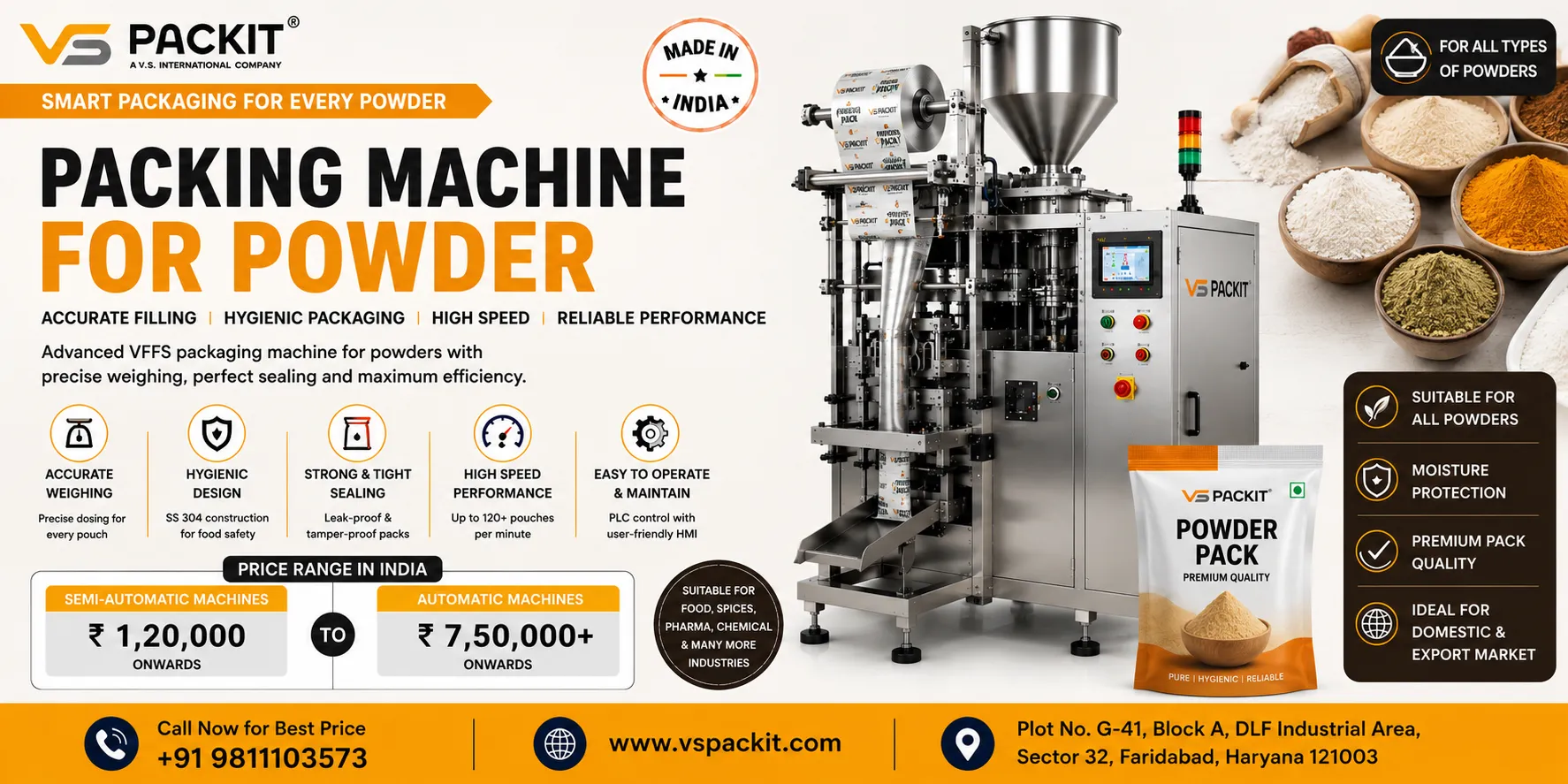
A powder packaging machine generally refers to a more complete, higher output production setup, often integrating pouch forming, filling, sealing, and coding together into one continuous line, built for businesses running consistent daily volumes.
A small powder filling machine is a more compact, often semi-automatic solution designed for lower output, contract packers, or manufacturers just starting to move away from manual filling. These machines are simpler to operate, take up less floor space, and require a smaller upfront investment, which makes them a sensible entry point before scaling into a larger automated line.
The right choice depends less on what looks impressive and more on your actual current daily volume, along with how quickly you expect that volume to grow.
What to Look for When Comparing Machines
A few practical checkpoints help narrow the field quickly:
- Match the filling mechanism to your powder's flow behaviour. Cohesive powders need auger or combination systems, free-flowing powders can often work fine with simpler cup fillers.
- Check weight accuracy tolerance against your actual requirement. Pharma and nutraceutical applications typically need tighter tolerances than industrial or agricultural powders.
- Consider changeover time if you run multiple SKUs. Servo controlled systems reprogram quickly between products, while mechanical systems often need manual adjustment for each changeover.
- Verify hygiene and cleaning design for food and pharma use. Look for food grade stainless steel contact parts and a design that allows quick strip down cleaning between batches.
- Confirm dust containment if your powder is fine or light. Poor dust control leads to product loss and creates housekeeping and safety issues on the floor.
VS Packit Filler Systems for Powder Packing
Matching filling technology to your specific product and volume matters more than picking the most feature-loaded machine on paper. Here is a quick reference to help narrow down the right fit:
| Product | Best Suited For |
|---|---|
| Servo Auger Fillers | Fine to medium powders needing precise, programmable dosing with quick changeovers across multiple products |
| Various Filler Systems | Operations handling a mix of powders, granules, and other free-flowing materials on the same line |
| TPI 912 Duplex Auger | High volume production needing twin lane filling to double throughput without added floor space |
| Duplex Packaging Systems | Manufacturers scaling production who need consistent, repeatable accuracy across simultaneous lines |
Mistakes Worth Avoiding
A few recurring issues come up across powder packing installations, regardless of industry:
- Choosing a machine before understanding the powder. Testing with your actual product before purchase avoids costly surprises after installation.
- Underestimating cleaning and changeover downtime. Frequent product switches on a machine not designed for quick strip down often eat into output more than raw filling speed does.
- Overinvesting in automation ahead of actual demand. A high-speed duplex line makes sense once volumes justify it, not before.
- Ignoring dust control needs. Fine, light powders need proper containment built into the machine design from the start.
- Not planning for future product or pack size changes. A machine locked to one configuration can quickly become a bottleneck as the product range grows.
Conclusion
Choosing the right packing machine for powder comes down to understanding your product first and matching filling technology second. Whether your operation needs a compact small powder filling machine to get started or a full powder packaging machine line with duplex output for scale, the decision should be grounded in your powder's actual flow behaviour, your current volume, and realistic room to grow.
Not sure which configuration fits your product best? Get in touch with our team and we can help you work through the right setup for your line.