
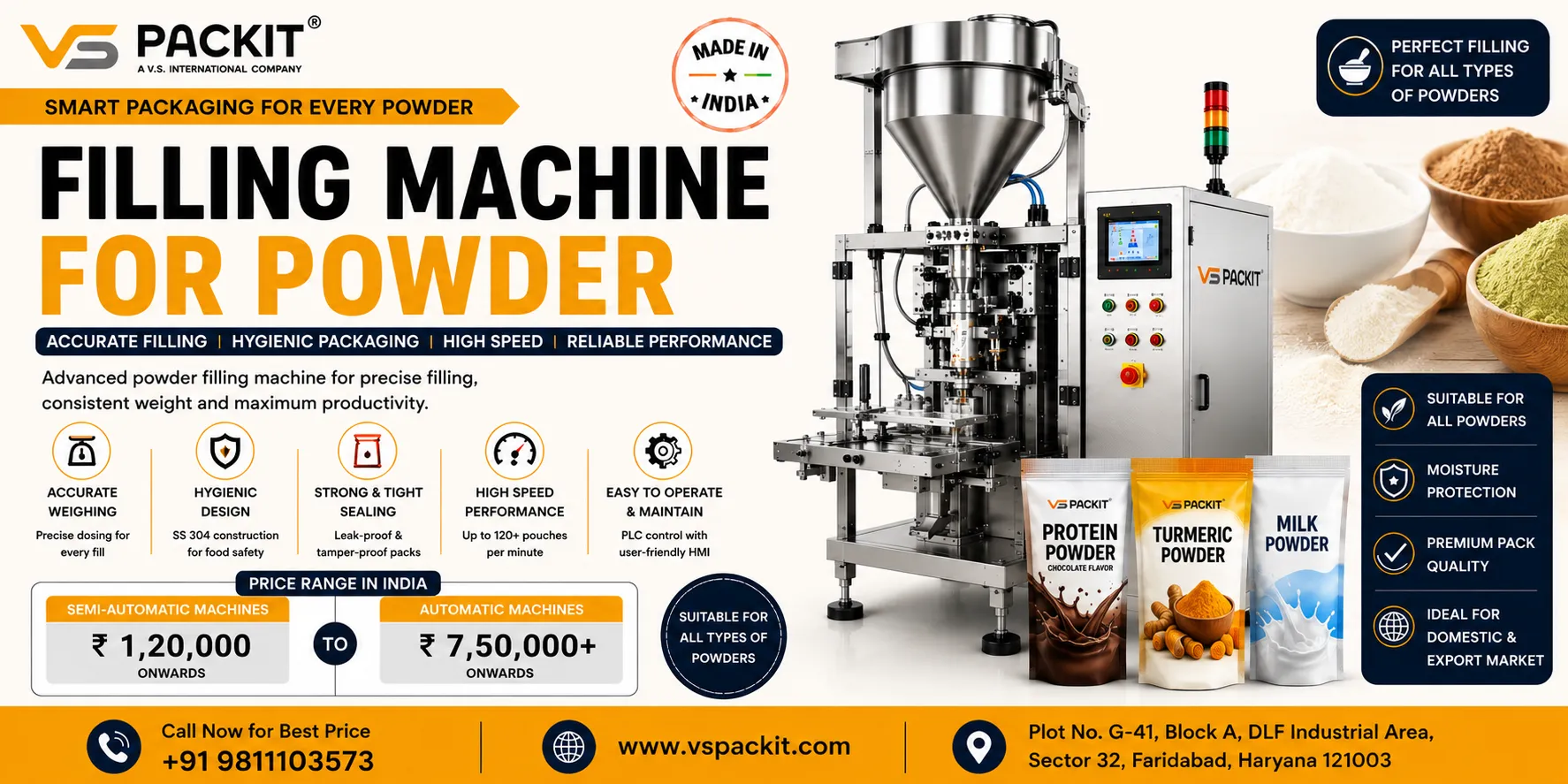
Getting powder into a pouch or bottle sounds simple on paper, but anyone who has actually run a powder line knows how many small things can go wrong. Underfilled packs, product bridging in the hopper, static causing powder to cling to the neck of a bottle, and inconsistent dosing between the first pouch of the shift and the last one. A filling machine for powder needs to solve all of these problems consistently, batch after batch, without needing an operator to babysit it constantly.
Having spent years around packing floors across food, pharma, agro, and chemical powder segments, one thing stands out clearly. The manufacturers who get the best long term results are the ones who invest time upfront in understanding their powder's flow characteristics and required accuracy, rather than simply picking whichever automatic powder filling machine looks the most advanced in a brochure.
This guide covers how filling machines for powder actually work, what separates a good automatic powder filling machine from a mediocre one, the filling technologies available at different budgets, and how to think through the decision practically.
Not sure which filling technology suits your powder? Talk to our team and get a recommendation based on your product, accuracy needs, and daily volume.
Why Powder Filling Is Its Own Discipline
Liquid and granule filling both have their own quirks, but powder brings a specific set of challenges that shape how a filling machine needs to be engineered:
Cohesion and bridging: Fine powders often stick together and form bridges inside hoppers, blocking consistent flow into the dosing mechanism. Machines need agitators or vibratory assistance to keep material moving.
Density fluctuation: The same powder can weigh differently pouch to pouch depending on how it settles, how humid the environment is, and how finely it was ground in that particular batch. A filling machine with rigid, non-adaptive dosing will drift out of target weight as these conditions shift.
Static buildup: Very fine, light powders generate static charge that makes them cling to container necks and film surfaces, which causes both product loss and weak seals.
Precision requirements vary by industry: A pharma powder often needs accuracy within a fraction of a gram, while an industrial or agricultural powder might tolerate a wider margin. This directly affects which filling technology makes sense.
How a Filling Machine for Powder Works
Most powder filling systems, whether filling pouches, bottles, or jars, follow a broadly consistent sequence:
- Hopper feeding: Powder sits in a hopper, often fitted with an agitator or vibratory tray to prevent clumping and keep flow consistent into the dosing stage.
- Dosing: The core of the machine. An auger screw, a volumetric cup, or a weigh cell system measures the correct quantity for each fill cycle.
- Container or pouch positioning: For bottle and jar filling, containers move along a conveyor and index under the filling head. For pouch based systems, film forms around a collar before the dose drops in.
- Sealing or capping: Pouches are heat sealed, while bottles and jars are capped or induction sealed depending on the product.
- Discharge: Filled and sealed units move onward for labeling, coding, or secondary packaging.
The dosing mechanism is really what separates one filling machine from another in terms of both accuracy and cost, so it is worth understanding the main options before deciding.
Filling Technologies for Powder
Auger Fillers: A rotating screw doses powder in controlled increments based on calibrated rotations, offering strong accuracy for fine, cohesive powders that do not flow freely on their own. This is the standard choice for spices, pharma powders, milk powder, and similar products. Servo controlled auger systems allow fast, repeatable changeovers when a line runs multiple products.
Volumetric Cup Fillers: These dose by volume using a fixed cup mechanism, offering higher speed at a lower machine cost, well suited to free flowing powders where slight weight variation between fills is acceptable.
Weigh Cell and Net Weight Systems: These weigh each dose directly for tighter accuracy, commonly used where regulatory weight compliance or premium product positioning demands it, at a higher equipment cost than volumetric systems.
Duplex and Multi-Lane Setups: For manufacturers needing higher daily throughput, duplex configurations run two filling and sealing operations off a single machine frame, effectively doubling output without doubling floor space or headcount.
What Makes a Good Automatic Powder Filling Machine
Not every machine labeled automatic delivers the same reliability. A few things separate a solid automatic powder filling machine from one that constantly needs adjustment:
- Consistent dosing under changing conditions: A good machine compensates for minor density shifts without needing constant manual recalibration.
- Fast, repeatable changeovers: If you run multiple SKUs or pack sizes, servo controlled systems that can be reprogrammed quickly save considerable production time compared to manually adjusted mechanical systems.
- Proper dust containment: Fine powders need enclosed filling heads and dust extraction built into the design, both to reduce product loss and to protect operator health.
- Hygienic, easy to clean construction: Food grade stainless steel contact parts and a design that allows quick strip down cleaning matter a lot for food and pharma applications with frequent product changes.
- Reliable after sales support: A powder line running daily cannot afford long downtime waiting for spare parts or service visits, so local support availability should factor into the buying decision.
VS Packit Machines and Filling Systems for Powder
Different powders, accuracy requirements, and production volumes call for different equipment. Here is a quick reference across the range:
| Product | Best Suited For |
|---|---|
| powder filling machine price | Comparing pricing across automation levels and capacity before finalizing a budget |
| servo auger fillers | Fine to medium powders needing precise, programmable dosing with quick changeovers |
| various filler systems | Operations handling a mix of powders, granules, and other free-flowing materials |
| tpi 912 duplex auger | High volume production needing twin lane filling for doubled throughput |
| duplex packaging systems | Manufacturers scaling production who need consistent accuracy across simultaneous lines |
| indus 5000 | Mid to large scale operations looking for a robust, higher capacity filling setup |
| komet 81 | Businesses needing a compact yet reliable filling solution for steady daily output |
| komet sprint | Fast changeover environments where speed and flexibility matter as much as accuracy |
Mistakes to Avoid When Choosing a Filling Machine
A handful of recurring issues show up across powder filling installations regardless of industry:
- Skipping a trial run with the actual product. Powders behave differently based on grind fineness, moisture content, and blend composition. Always test before finalizing a machine.
- Underestimating changeover and cleaning time. Frequent product switches on equipment not designed for quick strip down often cost more time than the raw filling speed saves.
- Buying more automation than current volume justifies. High-speed duplex or multi-lane systems make sense once daily output actually needs that capacity, not before.
- Ignoring dust control for fine powders. Poor containment leads to both product waste and housekeeping headaches on the floor.
- Overlooking future flexibility. A machine locked to a single pack size or product type can quickly become a bottleneck as the product range expands.
Conclusion
Choosing the right filling machine for powder comes down to understanding your specific product's behaviour first, then matching the dosing technology and automation level to your actual accuracy needs and production volume. Whether you need a straightforward automatic powder filling machine for a single product line or a higher throughput duplex setup for scaling operations, the decision works best when grounded in a real trial run rather than specs alone.
Have a specific powder or production target in mind? Get in touch with our team and we will help you find the right filling configuration for your line.