

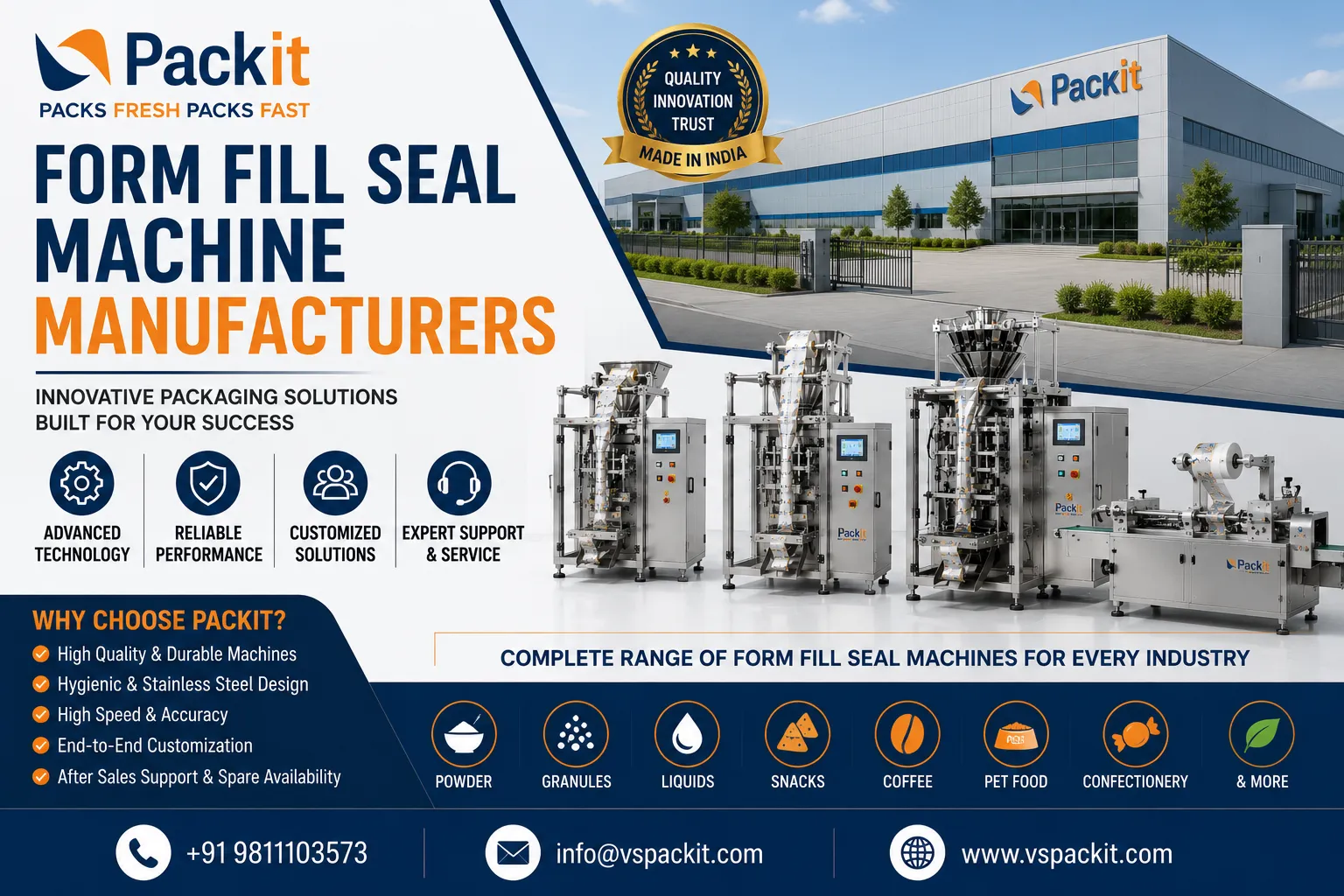
A well-designed Form Fill Seal (FFS) machine does much more than create and seal pouches. It helps reduce material waste, improves production efficiency, maintains packaging consistency, and supports automation across the packaging line. Today, businesses are also looking for manufacturers that provide customized engineering, reliable after-sales support, and machines capable of adapting to changing production requirements.
In my experience, companies often focus only on machine specifications while overlooking the manufacturer's engineering expertise and service capabilities. The right manufacturing partner can significantly reduce downtime and improve long-term operational performance.
This guide explains everything you need to know before selecting form fill seal machine manufacturers, including machine technology, industry applications, buying considerations, automation features, and the qualities that distinguish reliable manufacturers from ordinary suppliers.
What Are Form Fill Seal Machine Manufacturers?
Form fill seal machine manufacturers are companies that design, engineer, manufacture, and support automated packaging machines that form pouches from roll stock, fill them with products, and seal them in a continuous process. They also provide customization, installation, technical support, spare parts, and production optimization for different industries.
Unlike distributors, manufacturers have complete control over machine design, quality standards, engineering improvements, and customization options. This allows businesses to obtain packaging solutions tailored to their production capacity, product characteristics, and packaging material requirements.
Leading vertical form fill seal machine manufacturers also integrate advanced technologies such as servo-driven systems, PLC-based controls, touch-screen HMIs, intelligent sensors, and automated weighing or filling systems to improve productivity and packaging accuracy.
Why Modern Industries Prefer Vertical Form Fill Seal Machine Manufacturers
Vertical Form Fill Seal (VFFS) technology has become the preferred packaging solution for many industries because it combines high production speed, accurate filling, reduced material wastage, and flexible pouch formats in a compact footprint.
Manufacturers across India are increasingly investing in automated packaging systems to remain competitive while maintaining product quality and operational efficiency. Industries such as food processing, dairy, spices, snacks, agriculture, pharmaceuticals, pet food, and chemicals benefit from VFFS technology due to its versatility and reliability.
Some of the key advantages include:
- High-speed automated packaging
- Consistent sealing quality
- Reduced manual labor
- Improved hygiene standards
- Lower packaging material wastage
- Easy integration with filling systems
- Flexible pouch designs
- Better production consistency
- Scalable manufacturing operations
I've noticed that factories upgrading from semi-automatic packaging to fully automated VFFS systems often experience smoother production planning because the machines maintain consistent output even during extended production shifts.
Key Qualities to Look for in Form Fill Seal Machine Manufacturers
The best form fill seal machine manufacturers offer strong engineering capabilities, machine customization, quality manufacturing, automation expertise, reliable after-sales service, and compliance with recognized industrial standards. They focus on delivering long-term productivity rather than simply supplying equipment.
When evaluating manufacturers, consider the following factors:
Engineering and Design Expertise
A reliable manufacturer invests in research, development, and continuous innovation. Machine design should focus on durability, operational efficiency, and ease of maintenance.
Customization Capabilities
Every production line has unique requirements. Manufacturers should be able to customize:
- Pouch dimensions
- Filling systems
- Product handling
- Production speeds
- Sealing configurations
- Integration with existing equipment
Manufacturing Quality
Look for manufacturers that follow recognized quality management practices and build machines using precision-engineered components. Compliance with standards such as ISO quality management systems can be a strong indicator of consistent manufacturing processes.
Automation Integration
Modern packaging systems should support:
- Servo motors
- PLC controls
- Human Machine Interface (HMI)
- Sensor-based monitoring
- Automatic fault detection
- Production data monitoring
Service and Technical Support
One thing many factory owners overlook is the importance of after-sales support. Even the most advanced machine requires preventive maintenance, operator training, spare parts availability, and technical assistance throughout its operational life.
Manufacturers with strong support networks help minimize downtime and maximize production continuity.
How Top Packaging Machine Manufacturers Set Industry Standards
Leading packaging machine manufacturers differentiate themselves by focusing on innovation, engineering precision, quality control, customer support, and continuous product improvement rather than simply increasing machine output.
As manufacturing expectations evolve, businesses seek partners that deliver complete packaging solutions instead of standalone equipment. This includes consultation, machine customization, installation assistance, operator training, maintenance support, and future scalability.
Several characteristics distinguish industry-leading manufacturers:
- Continuous investment in engineering innovation
- Reliable machine performance across production shifts
- Advanced automation capabilities
- Efficient integration with intelligent filling systems
- Compliance with industrial quality standards
- Strong technical documentation and training
- Long-term spare parts availability
- Responsive customer support
Companies such as VS PacKit have built their reputation by focusing on engineering reliability, application-specific customization, and packaging automation tailored to diverse manufacturing sectors. Their product portfolio includes advanced packaging solutions like the Komet Sprint and GT-5S, which are designed to support businesses seeking higher productivity, consistent sealing performance, and flexible packaging capabilities across multiple industries.
For businesses evaluating different suppliers, understanding how manufacturers approach engineering, automation, and long-term service is often more valuable than comparing production speed alone.
How Does a Form Fill Seal Machine Work?
A Form Fill Seal (FFS) machine automates the packaging process by forming a pouch from a roll of packaging film, filling it with the product, and sealing it in one continuous operation. This reduces manual handling, improves packaging consistency, and increases production efficiency across various industries.
Modern FFS machines are designed to perform multiple packaging functions in a synchronized sequence. While the exact process may vary depending on the product and filling system, the core workflow remains the same.
Step-by-Step Working Principle
Step 1: Film Feeding
The machine unwinds a roll of flexible packaging film and guides it through precision rollers. Servo-controlled systems ensure the film remains aligned throughout the process.
Step 2: Pouch Formation
The film passes over a forming collar, which shapes it into a tubular structure. A vertical sealing mechanism then creates the longitudinal seal that forms the body of the pouch.
Step 3: Product Filling
Once the pouch is formed, the product is dispensed into it using the appropriate filling system. Depending on the product characteristics, this may include:
- Volumetric Cup Fillers
- Servo Auger Fillers
- Multi Head Weighers
- Liquid Filling Systems
- Custom dosing systems
Each filling method is selected to maintain accuracy while minimizing product loss.
Step 4: Sealing
After filling, the machine creates the top seal of the current pouch and the bottom seal of the next pouch simultaneously. Temperature-controlled sealing jaws ensure strong, leak-resistant seals.
Step 5: Cutting and Discharge
The completed pouch is cut to the desired size and discharged for further processing, inspection, or packing into cartons.
In my experience, manufacturers often underestimate how important sealing precision is. A perfectly filled pouch still fails quality standards if the seal integrity is inconsistent. This is why advanced servo-controlled sealing systems have become a key differentiator among modern packaging machines.
Major Components of a Form Fill Seal Machine
Every Form Fill Seal machine combines mechanical, electrical, and automation systems to deliver accurate, reliable packaging. Understanding these components helps buyers evaluate machine quality and long-term performance.
Film Unwinding System
This section controls film tension and ensures smooth feeding without wrinkles or misalignment.
Forming Collar and Forming Tube
These components shape the packaging film into the desired pouch configuration before filling begins.
Servo Film Pulling System
Servo motors accurately control film movement, ensuring consistent pouch length and reducing material waste.
Filling System
The filling unit varies depending on the product being packaged. Common options include:
- Volumetric Cup Fillers for granules
- Servo Auger Fillers for powders
- Multi Head Weighers for snacks and irregular products
- Liquid filling systems
- Piston fillers for viscous products
Sealing Jaws
Temperature-controlled sealing jaws create secure and consistent seals suitable for different packaging materials.
PLC Control System
A Programmable Logic Controller (PLC) manages machine operations, monitors performance, and coordinates automation functions.
Human Machine Interface (HMI)
The touchscreen HMI allows operators to adjust production settings, monitor machine status, and diagnose faults quickly.
Sensors and Safety Systems
Modern machines include sensors that detect film position, product flow, temperature variations, and sealing accuracy while helping prevent operational errors.
Types of Form Fill Seal Machines
Form Fill Seal machines are available in different configurations based on packaging orientation, production capacity, product type, and automation level. Choosing the right type depends on your manufacturing requirements and packaging objectives.
Vertical Form Fill Seal (VFFS) Machines
Vertical Form Fill Seal machines create pouches in a vertical direction while the product is filled from the top.
These machines are ideal for:
- Powders
- Granules
- Snacks
- Pulses
- Sugar
- Rice
- Tea
- Coffee
- Frozen foods
- Dry fruits
- Pet food
Many vertical form fill seal machine manufacturers focus on VFFS technology because it offers high efficiency, compact installation, and compatibility with multiple filling systems.
Businesses looking for a reliable Form Fill Seal Packaging Machine often choose VFFS systems because they provide excellent flexibility for different pouch styles and production capacities.
Continuous Motion Machines
Continuous motion machines operate without stopping between packaging cycles, enabling higher production speeds while maintaining sealing accuracy.
Examples include advanced solutions such as the GT-5S, which is designed for manufacturers requiring increased throughput with consistent packaging quality.
Intermittent Motion Machines
These machines pause briefly during each packaging cycle. They are well suited for moderate production volumes and products requiring precise filling control.
Duplex Packaging Systems
Duplex systems use two packaging lanes simultaneously, significantly increasing output while maintaining compact machine dimensions.
They are commonly selected by businesses with growing production demands.
Comparison of Common Form Fill Seal Machine Types
| Feature | Intermittent Motion | Continuous Motion | Duplex System |
|---|---|---|---|
| Production Speed | Moderate | High | Very High |
| Automation Level | High | Advanced | Advanced |
| Packaging Accuracy | Excellent | Excellent | Excellent |
| Suitable Production Volume | Medium | High | Large Scale |
| Energy Efficiency | Good | Very Good | Excellent |
| Floor Space Requirement | Compact | Compact | Moderate |
| Best For | Growing manufacturers | High-volume production | Large manufacturing facilities |
| Typical Examples | Standard VFFS | GT-5S | Duplex Packaging Systems |
When I visited manufacturing facilities using continuous motion packaging systems, I noticed that production teams valued consistent machine uptime just as much as speed. Stable performance over long production runs often contributes more to profitability than achieving the highest possible output.
Applications of Form Fill Seal Machines
Form Fill Seal machines support a wide variety of products by combining automated pouch formation, accurate filling, and reliable sealing in one integrated system.
Common applications include:
Food Products
- Namkeen
- Potato chips
- Extruded snacks
- Dry fruits
- Biscuits
- Popcorn
- Breakfast cereals
Powder Products
- Wheat flour
- Spice powders
- Coffee
- Milk powder
- Protein supplements
- Cocoa powder
Granular Products
- Rice
- Sugar
- Pulses
- Tea
- Salt
- Seeds
Agricultural Products
- Animal feed
- Fertilizers
- Grain products
- Seeds
Pharmaceutical Products
- Nutritional powders
- Medical supplements
- Healthcare products
Chemical Products
- Detergent powder
- Industrial chemicals
- Cleaning compounds
Manufacturers often integrate specialized filling systems depending on the characteristics of each product to improve filling accuracy and reduce wastage.
Industries That Benefit from Form Fill Seal Machines
Modern packaging automation serves a broad range of manufacturing sectors.
Industries include:
- Food Processing
- FMCG
- Dairy
- Agriculture
- Pharmaceutical Manufacturing
- Chemical Processing
- Nutraceuticals
- Pet Food
- Beverage Mixes
- Frozen Foods
- Export Packaging
- Contract Packaging
Government initiatives promoting manufacturing and food processing continue to encourage investment in automated packaging technologies that support quality, productivity, and traceability.
Businesses exploring Packaging Machine Manufacturers in India increasingly prioritize automation-ready solutions that can adapt to future production expansion without requiring complete line replacement.
Benefits of Choosing Modern Form Fill Seal Machines
Modern Form Fill Seal machines improve packaging efficiency by combining pouch formation, filling, and sealing into one automated process. They help manufacturers increase production, maintain consistent quality, reduce waste, and improve operational reliability.
Key benefits include:
- Higher production efficiency
- Reduced manual intervention
- Consistent pouch dimensions
- Accurate product filling
- Lower packaging material waste
- Improved sealing quality
- Better hygiene standards
- Reduced operational costs
- Easier quality control
- Flexible pouch formats
- Improved production planning
- Easy integration with automated filling systems
I've noticed that businesses upgrading from older packaging methods often achieve better inventory management because automated packaging delivers predictable output with fewer rejected pouches.
Advantages of Partnering with Experienced Form Fill Seal Machine Manufacturers
Selecting the right manufacturer provides benefits that extend beyond purchasing a machine.
Experienced manufacturers offer:
- Engineering consultation
- Product-specific machine recommendations
- Customized machine configurations
- Reliable manufacturing quality
- Automation expertise
- Installation guidance
- Operator training
- Preventive maintenance support
- Spare parts availability
- Long-term technical assistance
Companies such as VS PacKit emphasize engineering precision, customization, and application-specific packaging solutions to support manufacturers across multiple industries. Machines like the Komet Sprint are designed for businesses seeking dependable performance, flexible packaging options, and scalable automation as production demands grow.
For readers who want to explore these solutions further, consider reviewing the Form Fill Seal Packaging Machine product page and the Packaging Machine Manufacturers in India page. To better understand how automation can improve manufacturing efficiency, the blog "Scale Faster with the Right Form Fill Seal Packaging Machine" provides practical insights into selecting packaging systems that align with long-term business growth.
Buying Guide: How to Choose the Right Form Fill Seal Machine Manufacturer
Choosing the right form fill seal machine manufacturers involves evaluating production requirements, product characteristics, automation capabilities, engineering expertise, after-sales support, and long-term reliability. A well-matched machine delivers consistent performance, higher productivity, and a better return on investment over its operational life.
A packaging machine is a long-term production asset. Rather than selecting a machine solely based on specifications, assess how well it fits your current operations and future growth plans.
1. Understand Your Product Characteristics
Start by identifying what you need to package.
Consider factors such as:
- Powder or granules
- Free-flowing or non-free-flowing products
- Fragile or irregular shapes
- Moisture-sensitive products
- Bulk density
- Filling accuracy requirements
For example, spice powders require different filling technology than snack foods or rice.
2. Define Your Production Capacity
Estimate both your current and projected production needs.
Questions to ask include:
- How many pouches are required per shift?
- Will production increase over the next three to five years?
- Is multi-shift operation planned?
- Will seasonal demand affect production volumes?
Selecting a machine with room for expansion helps avoid expensive upgrades later.
3. Evaluate Automation Features
Modern packaging lines should support:
- Servo-driven motion control
- PLC automation
- Touchscreen HMI
- Recipe management
- Automatic film tracking
- Fault diagnostics
- Production monitoring
Automation improves repeatability while reducing operator intervention.
4. Check Machine Flexibility
Many manufacturers package multiple products on a single production line.
Choose machines that can easily accommodate:
- Different pouch sizes
- Multiple packaging materials
- Various filling systems
- Product changeovers
- Future automation upgrades
5. Assess Engineering Quality
One thing many factory owners overlook is the quality of machine construction. Precision engineering affects vibration levels, sealing consistency, maintenance frequency, and overall machine life.
Ask about:
- Machine frame construction
- Component quality
- Servo systems
- Electrical standards
- Control systems
- Safety features
6. Review Technical Support
Reliable manufacturers provide:
- Installation assistance
- Operator training
- Preventive maintenance guidance
- Spare parts availability
- Remote troubleshooting
- Service response support
Strong after-sales service is often the difference between consistent production and costly downtime.
Common Mistakes Buyers Should Avoid
Avoiding common purchasing mistakes can save significant operational challenges later. Selecting the cheapest machine without evaluating long-term performance often leads to higher maintenance costs and reduced productivity.
Choosing Based Only on Initial Cost
A lower purchase price does not always translate into lower operating costs. Machine efficiency, durability, and uptime have a greater impact over the machine's lifecycle.
Ignoring Product Characteristics
Machines should match the flow properties and packaging requirements of the product. Incorrect filling technology often causes inaccurate filling and product wastage.
Overlooking Future Expansion
Production requirements change as businesses grow.
Choose equipment that allows:
- Capacity upgrades
- Additional automation
- New pouch formats
- New product categories
Ignoring Service Availability
Even advanced equipment requires periodic maintenance.
Before purchasing, confirm:
- Spare part availability
- Service network
- Technical support
- Operator training
Selecting Generic Equipment
Customized solutions often perform better than standard configurations because they are designed specifically for your production environment.
Maintenance Guide for Long-Term Performance
Regular preventive maintenance improves machine reliability, reduces downtime, extends equipment life, and maintains packaging quality. Cleaning, lubrication, inspection, and timely replacement of wear parts should be part of every maintenance schedule.
Daily Maintenance
- Clean product contact surfaces
- Remove packaging debris
- Inspect sealing jaws
- Check sensors
- Verify film alignment
- Monitor air pressure
Weekly Maintenance
- Lubricate moving components
- Inspect belts
- Check electrical connections
- Test safety devices
- Examine cutting blades
Monthly Maintenance
- Inspect servo motors
- Calibrate filling systems
- Verify temperature controllers
- Review PLC alarms
- Tighten mechanical fasteners
From working with packaging lines, I've found that preventive maintenance consistently costs less than emergency repairs. A structured maintenance schedule also helps maintain sealing quality and production consistency over time.
Safety Best Practices
Modern packaging equipment should prioritize operator safety alongside productivity.
Important safety measures include:
- Emergency stop systems
- Safety guarding
- Interlocked access doors
- Overload protection
- Temperature monitoring
- Electrical protection systems
- Operator training
- Lockout and tagout procedures during maintenance
Manufacturers should also comply with applicable industrial safety practices and relevant quality standards.
Automation Is Transforming Packaging Operations
Automation enables manufacturers to improve productivity, reduce errors, increase consistency, and generate production data for continuous improvement.
Today's advanced packaging machines incorporate technologies such as:
- Servo motion control
- PLC-based automation
- Intelligent sensors
- Automatic fault detection
- Recipe management
- Remote diagnostics
- Human Machine Interfaces
- Production monitoring systems
Machines such as the GT-5S demonstrate how continuous-motion automation can help manufacturers achieve higher throughput while maintaining packaging consistency.
Automation also simplifies operator training because machine settings can be stored and recalled for different products.
Understanding Production Capacity
Production capacity depends on several factors rather than machine speed alone.
These include:
- Product characteristics
- Filling technology
- Pouch size
- Packaging material
- Operator experience
- Changeover frequency
- Machine configuration
For growing manufacturers, scalability should be a key consideration.
Solutions like the Komet Sprint offer flexible packaging capabilities that support businesses as production requirements evolve.
Return on Investment (ROI)
A well-selected Form Fill Seal machine improves ROI by increasing productivity, reducing labor requirements, minimizing packaging waste, improving sealing consistency, and lowering downtime over many years of operation.
ROI is influenced by factors such as:
- Production efficiency
- Material savings
- Labor optimization
- Reduced product wastage
- Lower maintenance requirements
- Consistent package quality
- Improved customer satisfaction
In my experience, companies that invest in reliable automation often see the greatest value through improved production stability rather than simply achieving higher packaging speeds.
Future Trends in Form Fill Seal Packaging
The packaging industry continues to evolve with increasing emphasis on automation, sustainability, and digital manufacturing.
Key trends include:
Smart Manufacturing
Integration with Industry 4.0 technologies enables real-time monitoring, predictive maintenance, and improved production analytics.
Sustainable Packaging Materials
Manufacturers are increasingly designing machines compatible with recyclable and environmentally responsible flexible packaging materials.
AI-Assisted Quality Monitoring
Advanced vision systems can inspect seals, print quality, and pouch integrity automatically, helping reduce rejected products.
Energy-Efficient Equipment
New machine designs focus on reducing energy consumption while maintaining high production performance.
Greater Customization
Businesses increasingly require machines capable of handling multiple products, pouch formats, and production capacities without extensive modifications.
Organizations such as PMMI, ISO, and national manufacturing initiatives continue to encourage improvements in packaging technology, operational efficiency, and product quality across global industries.
Why Businesses Choose VS PacKit
Selecting a packaging equipment partner involves more than comparing technical specifications. Manufacturers also evaluate engineering expertise, customization capabilities, long-term support, and operational reliability.
VS PacKit has established itself as a trusted name in India's packaging machinery sector by focusing on application-specific engineering and dependable automation solutions. Its portfolio includes advanced machines such as the Komet Sprint for flexible packaging requirements and the GT-5S for high-speed continuous-motion packaging.
Businesses value manufacturers that provide:
- Customized packaging solutions
- Precision engineering
- Reliable manufacturing quality
- Automation expertise
- Comprehensive technical support
- Spare parts availability
- Operator training
- Long-term service partnerships
For readers exploring packaging automation further, the blog "How Top Packaging Machine Manufacturers Set Industry Standards" offers additional insights into the engineering practices, quality benchmarks, and innovation strategies that distinguish leading manufacturers. You can also explore related pages such as the Home, About, Blogs, and Contact sections to understand the complete range of packaging solutions available.
Conclusion
Choosing the right form fill seal machine manufacturers is about much more than selecting a machine that meets your current production targets. It is about partnering with a manufacturer that understands your products, supports your long-term growth, and delivers reliable engineering, automation, and service throughout the equipment's lifecycle.
As packaging requirements continue to evolve, businesses need machines that offer flexibility, precision, and scalability. From selecting the appropriate filling system to integrating intelligent automation, every decision influences production efficiency, product quality, and operational costs.
I've noticed that manufacturers who invest time in evaluating machine quality, customization options, and after-sales support typically experience fewer production interruptions and greater confidence in expanding their operations. Whether you are packaging powders, granules, snacks, or specialty products, working with experienced vertical form fill seal machine manufacturers ensures that your packaging line is built for consistent performance and future growth.
If you're exploring advanced packaging automation, consider solutions such as the Komet Sprint for flexible production requirements or the GT-5S for high-speed continuous-motion packaging. Reputable companies like VS PacKit combine engineering expertise, customization, and dependable support to help businesses build efficient and reliable packaging operations.
By understanding machine technology, evaluating manufacturers carefully, and planning for future expansion, you can make an informed investment that delivers value for years to come.
Ready to Upgrade Your Packaging Line?
Whether you are setting up a new production facility or modernizing an existing packaging line, choosing the right packaging partner is the first step toward higher productivity and consistent packaging quality.
Explore VS PacKit's range of packaging solutions, learn more about its engineering capabilities, and connect with its technical team to identify the most suitable Form Fill Seal solution for your application.