
I want to set the expectations right this moment. In this article we will not quote any single prices because it all comes down to exactly what you need to produce. What I will be doing here is explaining exactly what gets added by automation, factors affecting cost in both directions, and how to assess if it is a good investment for your current business.
By the end you will have enough understanding of automatic chips packing machine price in India to have a reasonable grasp on why a quotation should be accepted or rejected.
What Is an Automatic Chips Packing Machine?
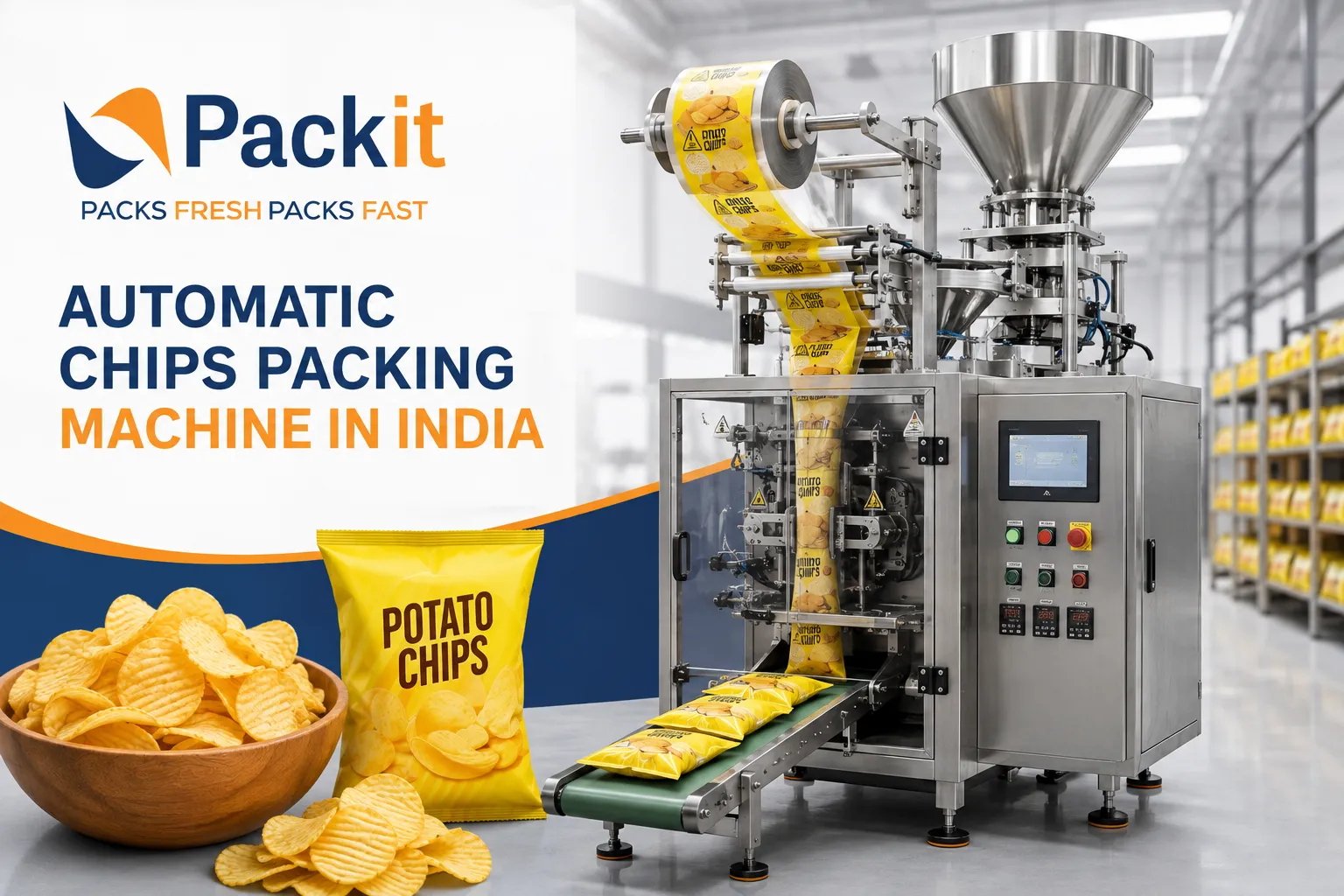
An automatic chips packing machine is a device that is used to make a pocket out of a roll of film and fill it with a certain amount of chips. It automatically closes the package and removes it after filling without requiring human interaction.
An automatic chips packaging machine differs from a semi-automatic one in the level of control involved. The former uses PLCs logic to open and close valves, and a servo motor to pull the film during the packaging process. In addition, it cuts the film and forms the bag by continuously moving the material in a loop, while the operator initiates all the actions in the latter type of machine.
How does automation affect the packing process?
In a manual or semi-automatic packing process, an operator does the weighing of the product, positioning of the pouch and manual or mechanical operation of the sealer. In an automated packing process, these operations are done automatically without the need for manual intervention.
The automated packing process works as follows:
- A weighing system, usually a multihead weigher, automatically weighs the required amount of chips;
- The film is automatically unwound and formed into a tube;
- The required amount of chips is dropped into the tube automatically without manual intervention;
- The servo-controlled jaws automatically seal and cut the bag;
- The sealed bags are discharged into a conveyor or collection point for boxing.
When I was in a snack manufacturing unit that had just automated their packing process, the owner told me that the most surprising result of automating their packing process was not that it increased production rate, but rather that the seal quality had become so consistent because human error was eliminated.
What Determines Automatic Chips Packing Machine Price in India
There are a number of factors that influence the placement of a complete automatic machine on the price spectrum. Knowing them allows you to correctly evaluate suppliers and not fall under the spell of the cheapest price.
The degree of automation. Obviously, a machine with automatic film splicing, auto lubrication and self diagnostics will cost more than one that requires manual film change and operator intervention during run.
Filling system compatibility. Automatic packing machines that use a multihead weigher for dosing will cost more than a simple volumetric or auger filler but for products like chips where density and size greatly impact fill weight, it's a necessary investment.
Speed and motion type. Continuous motion automatic machines have a higher productivity than their intermittent counterparts. This directly impacts the price of the machine as well as your project production requirements.
Sensors and monitoring capabilities. Eye mark sensors for print registration, product clogging detection and automatic dechoking features add to the cost but reduce machine downtime and losses due to faults.
Build quality. Food Grade stainless steel mixers, branded servo motors and PLC systems add to the cost but also impact the machine's longevity and reliability.
Service and support. Machines with established dealer networks that offer rapid service and technical support carry a higher price tag but are a wise investment considering downtime costs. From my experience, the price differential is always justified.
One factor that many business owners forget when considering the automatic chips packing machine price in India is the reduction in manpower costs and waste that an automated system offers over a traditional packing setup. While an automatic line may cost more to purchase, install and maintain; it's often significantly cheaper to operate due to lower labor costs and reduced product wastage. In many cases, the manpower required for an automated process is a fraction of that needed for a manual operation.
Why Businesses Are Switching to Automatic Packing Machines
This shift is not just a trend, it reflects real operational pressure. Our detailed post on why businesses are switching to automatic packing machines covers this in depth, but the short version comes down to three pressures every growing snack business eventually faces.
Labor availability and cost. Specialists in manual packing are not so easy to find, and for a semi-automatic line, their stable presence on shifts directly impacts productivity.
Retail and export requirements. The quality of packing material sealing and homogeneous product weight are critical parameters for large retail chains and export companies, which manual packing methods are not always able to provide.
Volume of production. When the order size reaches a certain level, it makes little sense to use manual packing methods as they are not capable of meeting deadlines without a significant increase in workforce.
In my practice, working with various companies in the industry, I have noticed that those who postponed the transition to automation the farthest often had to make this move under urgent necessity. A sudden increase in the volume of orders that manual packing methods were unable to meet led to the need for automation. However, if the company has the opportunity to make this step without pressing circumstances, it is much more efficient since the new equipment can be chosen more carefully.
Recommended Automatic Machines for Chips Packing
Not each automatic VFFS machine is suitable for packing chips because chips are not a powder or granule, however, they are quite bulky and fragile with an irregular form. There are two options that can address this need.
GT-5S
This high-speed machine is a continuous motion VFFS machine designed for manufacturers that need to address the daily volume of products with high precision. The GT-5S can address the need for a wide range of bag sizes and offers the possibility to use it in combination with a multihead weigher to ensure the required speed and accuracy of the packaging process. This option is recommended for companies that have identified a consistent demand level and want to achieve higher productivity.
Komet Sprint
Another choice for automatic packaging of chips is Komet Sprint, which ensures full automation with no need for the highest speed level. It is more suitable for mid-volume manufacturers that want to achieve higher productivity by transitioning from a semi-automatic system or a small automatic machine to a more capable system.
Both options offer the possibility of extending the automation chain to include nitrogen flushing to ensure extended shelf life of the packed product, automatic coding to print the necessary information on the bag, and dust collection equipment.
Comparing Automation Levels
| Factor | Semi-Automatic | Fully Automatic |
|---|---|---|
| Operator involvement | High, manual steps required | Low, monitoring only |
| Output consistency | Variable, depends on operator | Highly consistent |
| Speed potential | Lower | Significantly higher |
| Labor dependency | High | Reduced |
| Best suited for | Small scale, early stage businesses | Growing to large scale manufacturers |
Suitable Industries and Applications
While this article features chips, the automatic chips packing machine technology of GT-5S and Komet Sprint variety can be applied to various other snack categories as well.
- Potato chips and wafers – discussed in detail in our potato chips packing machine price in india guide
- Banana chips – discussed in detail in our banana chips packing machine price in india guide
- Namkeen, bhujia, sev
- Extruded and puffed snacks
- Roasted nuts and dry fruits
- Multigrain and health focused snack mixes
If you have multiple snack categories in your product catalog, go for an automatic packing machine that allows filling various products and bag widths to secure your ROI in the long run.
Packaging Materials for Automatic Chips Packing
Continuous operation of automatic lines places even greater importance on the consistency of the film than on manually operated machines.
- Metalized BOPP film offers excellent protection against moisture and oxygen ingress and is suitable for use with automatic film feeding systems.
- Laminated multilayer film offers extended shelf life or export grade protection against ingress of moisture and gases.
- Pre gusseted or reel fed film must be tested on your particular machine forming collar as uneven thicknesses can cause jams on high speed automatic lines.
I've noticed that companies that are upgrading from manual to automatic packing often continue to use the same film supplier without retesting compatibility with their new machine resulting in frequent stoppages during the first few weeks of operation.
Buying Guide: What to Ask Before You Buy
- Make sure that the production capacity matches. Buy a machine whose speed is not a lofty goal but rather a realistic order size.
- Test it on your product and film. The automation of the machine is precise, so there is no point in risking expensive mistakes after installation by not subjecting it to a trial run on your material.
- Find out what level of automation comes with the machine. Sometimes the terms used are ambiguous, and it is necessary to establish exactly what procedures are automated in the quoted configuration.
- Ask about sensors and safety mechanisms. The higher the speed of the machine, the more important it is to have systems that will immediately respond to the loss of certain parameters.
- Talk about training and commissioning. To commission a fully automatic machine, you will need to train personnel in its operation during commissioning.
- Ask about compliance with applicable standards. To process food, the parts of the machine directly contacting the product must meet hygienic standards, as established by FSSAI for the packaged food sector.
- Take into account not only the cost of the machine but also the savings in the form of reduced labor costs and reduced waste, as well as increased productivity due to optimized time between changeovers.
Common Mistakes That Buyers Make
- Over-automating: Investing in a high capacity automatic machine when demand does not justify it leads to a poor cash flow.
- Under-automating: On the other hand, many buyers fall into the trap that staying on a semi-automatic machine for too long will incur higher costs than switching to an automatic now.
- Incorrectly commissioning a machine: Rushing the installation process and lacking necessary training for its use leads to underperformance that is often blamed on the machine even when it performs exactly as designed.
- Neglecting film and product testing: Probably the single most common cause of dissatisfaction with installed automatic lines.
- Buying on price: At first glance 2 automatic machines may appear very similar but on a closer inspection, they vary significantly in terms of quality of servo motors, sensors, and agreements for after-sales support.
Maintenance Guide
As automatic machines perform a higher number of cycles daily, discipline in maintenance is of particular importance.
- Clean the parts of the machine which are subject to product contact on a daily basis, primarily the areas around the filling and sealing places where oil and crumbs tend to collect.
- Check the sealing jaws and film guides for wear on a weekly basis, as they are responsible for the forming of the seal on high speed.
- In addition, it is necessary to follow the lubrication schedule for servo driven equipment as recommended by the manufacturer.
- Periodical calibration of the automatic weigher is required to ensure the accuracy of the filling process.
- Finally, remember to keep a stock of spare parts, such as various sealing elements and sensors.
Safety on Automatic Packing Lines
Higher speeds and less human interaction change the safety dynamics of a packing line. Machinery should have proper guarding, easily accessible e-stops, and definable lockout/tagout procedures for maintenance. Adhering to general industrial safety standards (such as those listed by PMMI or generally accepted by BIS for industrial machinery) will help you to ensure that your upgraded system is safer, not less safe, than before.
Pros and Cons of Automatic Chips Packing Machines
Pros
- Higher and more stable output than manual or semi-automatic
- Less dependence on manual labor
- Improved fill accuracy resulting in less product giveaway
- Consistent seals to reduce customer complaints and product returns
- Potential to extend shelf life via automated nitrogen flushing
Cons
- Higher purchase cost than manual or semi-automatic machines
- Need to invest time in commissioning and training to get the most out of the equipment
- Need to maintain a high level of maintenance to sustain the high speed capability
ROI and Future Trends
Automatic chips packing machine offers return on investment through reduced labor cost, minimization of material waste due to higher accuracy, and increased productivity in terms of daily output per floor space. In my experience, the most common situations where manufacturers that automate the packaging process at the right time, thus being neither too early nor too late, see a significant ROI within a reasonable amount of time on the mentioned areas. The future trends in automation for Indian snack packaging will likely include advanced technologies such as automatic film splicing, real-time production tracking, and self-diagnosis systems becoming standard features rather than optional upgrades. The overall industry data witnessed by PMMI on a global scale indicates a growing tendency towards automatization, and Indian manufacturers will follow suit in response to both international market requirements and the rising expectations of the local retail network.
Reasons Why Businesses Goes With VS PacKit
VS PacKit has been a form fill seal engineering company for more than two decades now. And as such, they have invested in the research that allows them to configure automatic machines according to the behavior of a chosen product rather than a one size fits all approach. Their primary difference shimmers through the customization on the basis of the characteristics of a certain chip, the bag style and a required daily output.
In combination with the food grade stainless steel, reliable servo systems and local support, VS PacKit is an investment that makes sense for those who want to transition into full automation as the first time setup is often a lot more important than a small cost difference.
You can check out the automation options on the Snacks Packing Machine page, see what determines the price on the chips packing machine price page or look at some of the related guides like the potato chips packing machine price in india and banana chips packing machine price in india depending on the product you are interested in.
Final Thoughts
Automatic chips packing machine price in India incorporates more than just the specified figures on the quotation. It includes everything from the degree of automation and accuracy of filling to the overall machine’s quality and support. The businesses that understand the matter and can derive worth from the automatic option are those that opt for a manufacturer that appreciates the intricacies involved in a high-speed packing of these components.
To schedule a chat with us regarding your production requirements and the most suitable automatic configuration, use the contact page, or explore our engineering background and philosophy in the About and Home sections.